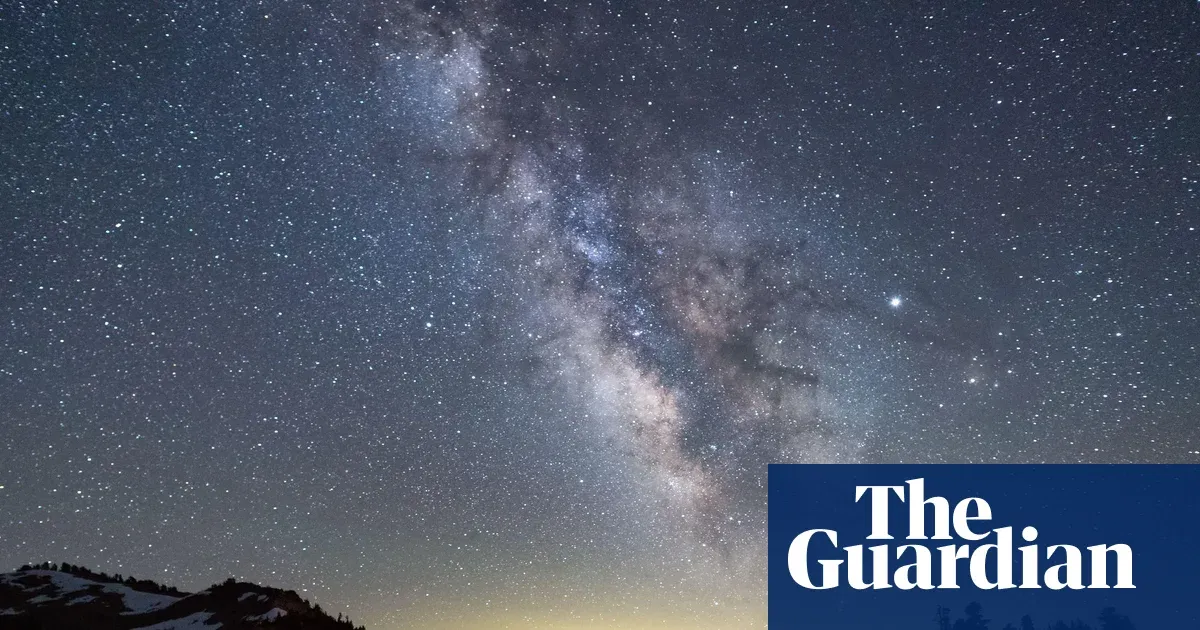
Astronomers have found evidence that the Milky Way galaxy was flipped on its side. This happened about 10 billion years ago after a direct hit from another galaxy. This event took place long before our solar system even formed.
The collision was massive. The Milky Way was struck head-on by a dwarf galaxy called the Gaia Sausage. The Milky Way then tore this smaller galaxy apart and absorbed its stars. Researchers believe this chaos likely flipped the entire disc of the Milky Way by more than 90 degrees. This put it into the position we see today.
A Galactic Flip
Researchers at Durham University used supercomputer simulations to study this event. They found that galaxies like the Milky Way, when hit head-on by something like the Gaia Sausage, would likely experience a "disc flip." This slowly but dramatically reoriented the galaxy. Kirill Batrakov, the lead researcher, noted this process would take at least a few hundred million years.
We're a new kind of news feed.
Regular news is designed to drain you. We're a non-profit built to restore you. Every story we publish is scored for impact, progress, and hope.
Start Your News DetoxThe discovery came while scientists were looking into why stars in the Milky Way's halo rotate so slowly. The halo is a sparse, ball-shaped cloud of stars around the galaxy. Most of these halo stars originally came from smaller galaxies that merged with the Milky Way over time.
Stars in the Milky Way's main disc orbit the galactic center at about 220 kilometers per second. However, stars in the stellar halo move much slower, at about 25 kilometers per second. This difference has been a long-standing mystery.
The Durham team's simulations showed that galaxies ended up with slow-moving halo stars if they were hit head-on by a galaxy the size of the Gaia Sausage. This collision would then cause a disc flip. These findings are being presented at the Royal Astronomical Society’s National Astronomy Meeting.
The Gaia Sausage Collision
The ancient collision was first identified in 2018. An international team used observations from the European Space Agency’s Gaia mission to map star movements. They found some stars on unusual, sausage-shaped orbits. Researchers traced these back to a dwarf galaxy breaking apart as it crashed into the Milky Way. These extreme orbits are strong evidence of the huge collision, leading to the dwarf galaxy's name: the Gaia Sausage.
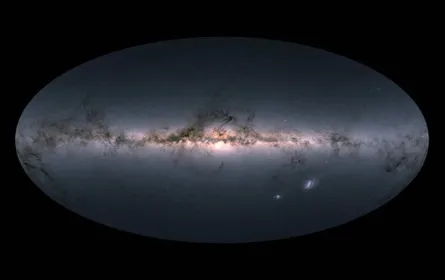
Astronomers now see this collision as the Milky Way's last major merger. It was a key event in the galaxy's history. It reshaped the galaxy, creating the central bulge and dominating the stellar halo.
Even though it was a dwarf galaxy, the Gaia Sausage contained stars, gas, and dark matter. Its total mass was more than 10 billion times that of the sun. The next major galactic upheaval might be billions of years away. That's when the Large Magellanic Cloud, another dwarf galaxy, is expected to merge with the Milky Way.
A smaller merger is already happening with the Sagittarius dwarf galaxy. However, this is expected to have a much less dramatic impact. Batrakov explained that the Sagittarius dwarf is not as massive as the Gaia Sausage was. Also, the Milky Way itself is much larger now than it was back then.