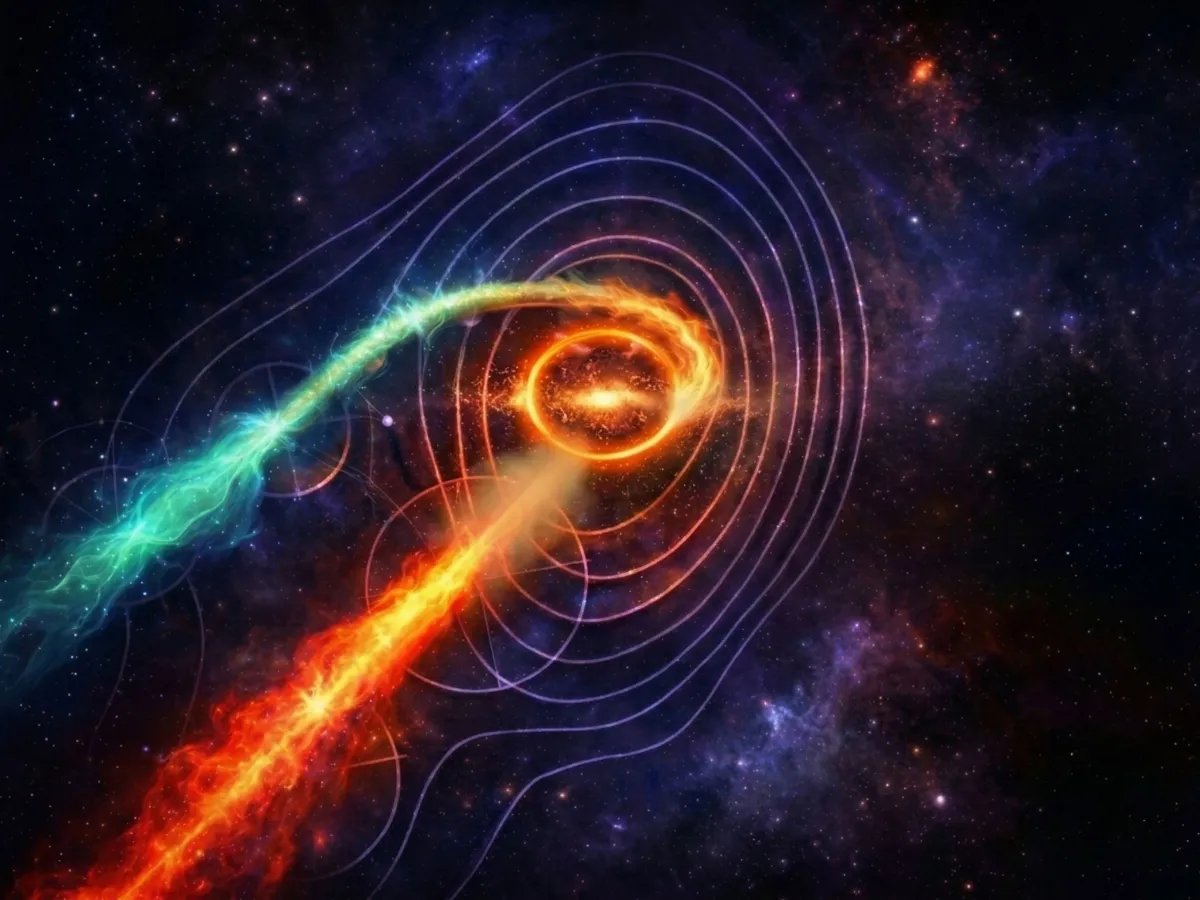
Astronomers have found a closely orbiting pair of supermassive black holes. This discovery happened in the galaxy Markarian 501. They tracked two powerful jets of particles to find them.
This binary system could merge in about 100 years. When they merge, they might create gravitational waves that scientists can detect.
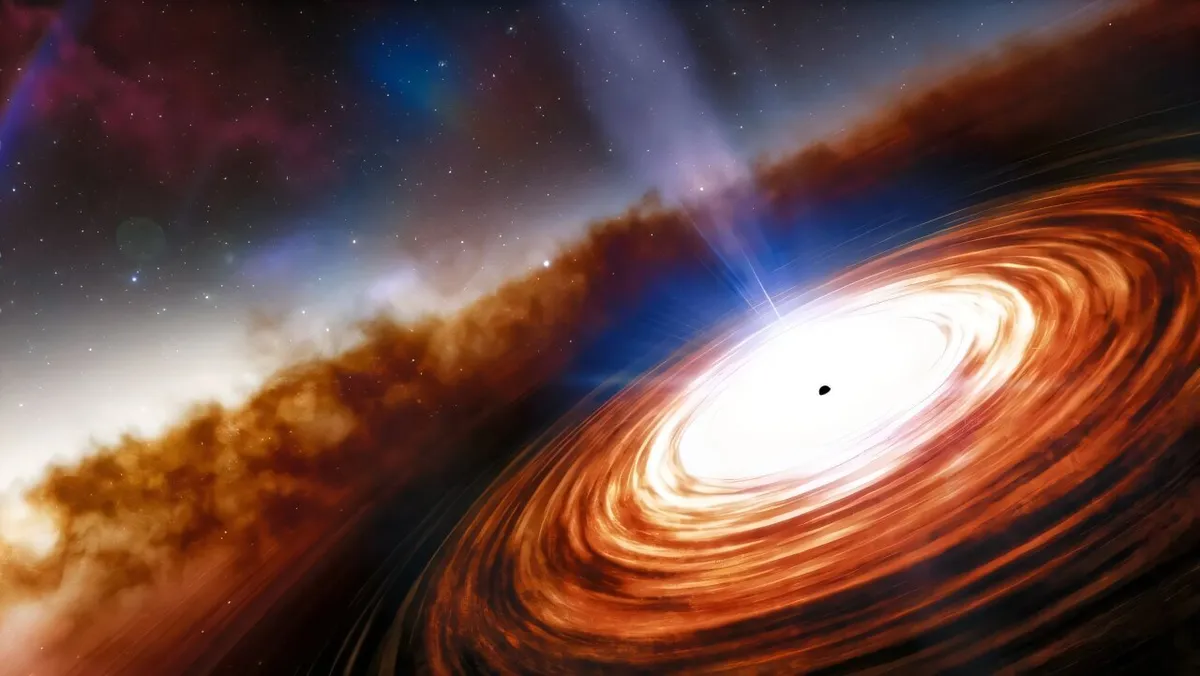
Most large galaxies have a supermassive black hole at their center. These black holes can be millions or billions of times heavier than the Sun. How they grow so large is still a mystery. Simply gathering gas isn't fast enough. This suggests that merging with other massive black holes is key to their growth.
We're a new kind of news feed.
Regular news is designed to drain you. We're a non-profit built to restore you. Every story we publish is scored for impact, progress, and hope.
Start Your News DetoxGalaxy collisions are common in the universe. So, the supermassive black holes within them are also expected to merge eventually. Before they combine, these black holes orbit each other, slowly moving closer.
Scientists have found it hard to accurately model the final stages of this process. Even though galaxy mergers happen often, no close pair of supermassive black holes had been clearly identified until now. A new study of Markarian 501 (Mrk 501) in the constellation Hercules offers strong evidence.
An international team, led by Silke Britzen from the Max Planck Institute for Radio Astronomy (MPIfR), found direct signs of a supermassive black hole pair. Their findings were published in the Monthly Notices of the Royal Astronomical Society.
Twin Jets Reveal a Hidden Black Hole Pair
The known supermassive black hole in Mrk 501 shoots out a powerful jet of particles. These particles travel almost at the speed of light. To study this area, researchers used high-resolution radio observations. They collected data over about 23 years. Instead of one jet, they found a second one.
These observations are the first direct image of such a system in a galaxy's center. They strongly suggest a second supermassive black hole. Silke Britzen said they searched for so long, and it was a complete surprise to not only see a second jet but also track its movement.
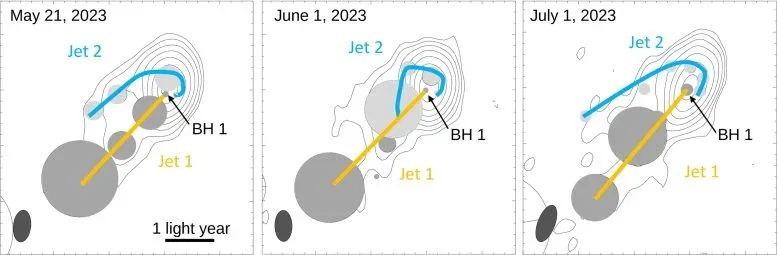
The first jet points toward Earth, making it very bright and easy to study. The second jet points in a different direction, making it harder to spot. Within weeks, researchers saw big changes in it. The second jet appears from behind the larger black hole and moves counterclockwise around it in a repeating pattern.
Silke Britzen explained that evaluating the data felt like being on a ship because the entire jet system is moving. A system of two black holes can explain this, as their orbital plane sways.
In June 2022, radiation from the system bent so much it looked like a ring, called an Einstein ring. This likely happened because the system was perfectly aligned with Earth. The black hole in front acted like a gravitational lens, bending light from the second jet behind it.
Evidence for a Rapidly Orbiting Black Hole Binary
By studying long-term changes and repeating brightness patterns, researchers found that the two black holes orbit each other every 121 days. They are separated by about 250 to 540 times the Earth-Sun distance. This is remarkably close for objects that are 100 million to 1 billion times the Sun's mass. Depending on their exact masses, they could merge in as little as 100 years.
Mrk 501 is too far away for even the best instruments, like the Event Horizon Telescope, to see the two black holes separately. So, astronomers won't be able to directly watch their orbit shrink.
However, researchers expect to detect signs of their decreasing separation through gravitational waves. The system should create very low-frequency gravitational waves. These could be observed using pulsar timing arrays (PTAs).
Supermassive black hole binaries (SMBHBs) are thought to be the source of the gravitational wave background detected in 2023. Mrk 501 is now a strong candidate to link PTA measurements to a specific supermassive black hole binary.
Co-author Héctor Olivares noted that if gravitational waves are detected, their frequency might steadily rise as the two giants spiral toward collision. This would offer a rare chance to watch a supermassive black hole merger happen.
Deep Dive & References
Detection of a second jet within the nuclear core of Mrk 501 - Monthly Notices of the Royal Astronomical Society, 2026