Last fall, Espen Saastad was exploring the Skagerrak strait between Norway and Denmark. He found a shipwreck nearly 2,000 feet below the surface. It was filled with delicate, intact porcelain dishes.
Saastad, a watchmaker with an underwater survey company, contacted the Norwegian Maritime Museum. Archaeologists were amazed by his discovery. They named the unknown ship the "Porcelain Wreck" and have been studying it since.
Hanna Geiran, director general of the Norwegian Directorate for Cultural Heritage, called the find "almost beyond belief."
We're a new kind of news feed.
Regular news is designed to drain you. We're a non-profit built to restore you. Every story we publish is scored for impact, progress, and hope.
Start Your News DetoxUncovering the Treasures
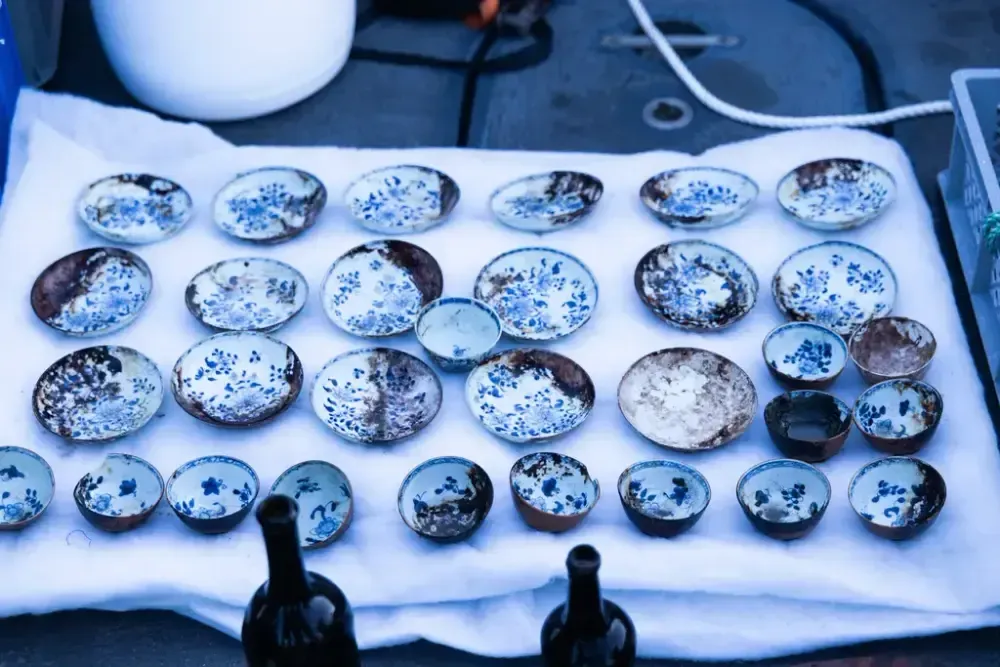
Researchers used a remotely operated underwater vehicle with a camera. They documented the 72-foot-long ship and its cargo. Some pieces are Batavia ware, a Chinese porcelain with blue and white designs and a brown glaze.
Other items are Blanc de Chine, a porcelain from Dehua, China. One cup has a monogram that researchers have not yet identified.
Sven Ahrens, research director at the Norwegian Maritime Museum, noted the excellent condition of the cargo. He told ScienceNorway that they usually find broken items or things covered in marine growth. Here, whole plates were stacked on the seabed.
Besides ceramics, they found barrels of grain and luxury European goods. These included chandeliers and stemmed glasses. A box held mysterious substances, possibly coffee, tea, cocoa, or medicine. Ahrens called it a "dream wreck" because of the variety and preservation of its contents. Even organic materials survived well at that depth.

Bringing Artifacts to the Surface
In May, researchers used a drone with a robotic arm to retrieve about 40 artifacts. These items are now at the Norwegian Maritime Museum in Oslo. The museum plans a permanent exhibition. Some artifacts are currently on display for the public.
The ship's upright position suggests it sank quickly and went straight to the seafloor. Most of the cargo is still in its original loading place.
Experts believe the ship sank around 1750, during the 18th century. This was a time of big changes in Northern Europe, as modern consumer culture began. Trade in raw materials and luxury goods grew into a connected maritime system. The rise of the middle classes also boosted commerce and shipping.
Chinese porcelains were often stored at the bottom of ships because they resist water. Rice straw in some crates suggests the porcelain came from China or Indonesia. However, the ship likely picked up the cargo from an auction in Northern Europe. Possible locations include Gothenburg, Sweden; Copenhagen; or Amsterdam.
A brick from the ship's kitchen offers a clue. It was made by Lübecker Ratsziegelei, a German brick company active until 1772. This links the ship to Lübeck, Germany, but doesn't mean it was built or based there.
Based on its size and features, the ship might be a "galliot," a type of merchant vessel with two masts common in the 18th century.
Many questions remain. Researchers wonder what caused the ship to sink and what happened to its crew of five or six people. They hope to retrieve thousands more items, as many crates are still unopened.
Deep Dive & References
The Porcelain Wreck - Norwegian Maritime Museum Sensational shipwreck discovery off Norway: Intact Chinese porcelain and chandeliers at a depth of 600 metres - ScienceNorway East and West: Chinese Export Porcelain - Metropolitan Museum of Art