Imagine a tiny, invisible shuttle service that zips a proton around just long enough to supercharge an energy transfer, then drops it back exactly where it started. Scientists just discovered a new quantum effect that does precisely that, and it's already making waves for things like solar cells and lasers.
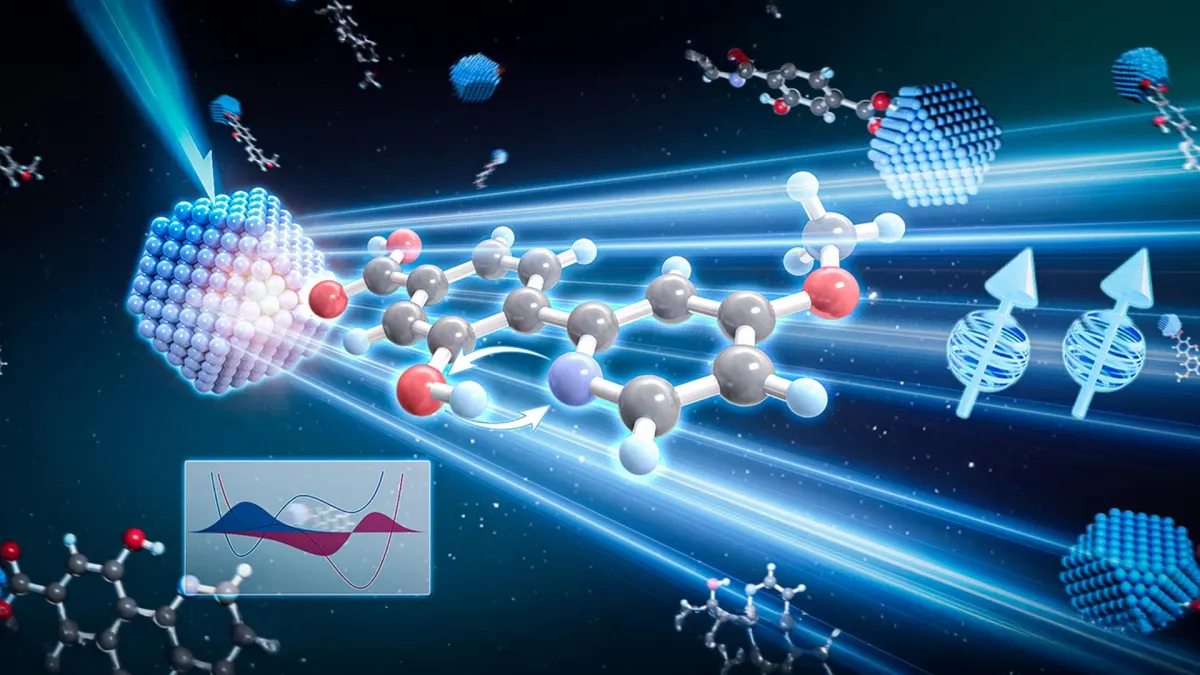
This isn't just a neat parlor trick; it's a new way energy moves between quantum dots (those tiny, light-emitting particles) and molecules. The process, officially dubbed proton shuttle-assisted triplet energy transfer (PS-TET), essentially uses a proton's brief joyride to help electrons move, dramatically boosting the speed and efficiency of energy transfer.
The Quantum Shuffle
Nature, it turns out, is a big fan of protons and electrons working in tandem. Think photosynthesis or how you're breathing right now—it all relies on similar, proton-coupled electron transfers. Building on that idea, Professor Kaifeng Wu and his crew at the Dalian Institute of Chemical Physics decided to see what happens when protons get involved with triplet energy transfer, a crucial way energy moves in many systems.
We're a new kind of news feed.
Regular news is designed to drain you. We're a non-profit built to restore you. Every story we publish is scored for impact, progress, and hope.
Start Your News DetoxThey studied ZnSe-based quantum dots, which, when hit with light, get excited. Here’s where the shuttle comes in:
- A "hole" (basically, a missing electron) moves from the quantum dot to a molecule.
- Simultaneously, a proton from that molecule takes a quick detour to another part of the molecule.
- Then, an electron moves from the quantum dot to the molecule, and—you guessed it—the proton zips back to its original spot.
This linked, almost balletic sequence moves spin-triplet energy from the quantum dot to the molecule. The proton ends its journey exactly where it began, but its brief absence and return make all the difference, sending energy transfer rates soaring compared to systems without this clever shuttle.
Tunnel Vision, Room Temperature Edition
Perhaps the weirdest part? The speed of this PS-TET process barely changed with temperature. This is a huge clue that the proton isn't just wiggling around because of heat. Instead, it seems to be quantum tunneling. For the uninitiated, that's where a particle basically teleports through a barrier it shouldn't have enough energy to cross. And it's happening at room temperature, which, if you think about it, is both impressive and slightly terrifying.
Calculations backed this up, showing how the proton's tiny vibrations actually guide the whole system toward this super-efficient energy transfer. It's a stark reminder that quantum effects aren't just for super-cold labs; they're pulling strings in everyday materials.
Professor Wu notes that this discovery has massive implications. Imagine "tuning" triplet formation in materials: creating a proton shuttle to boost it for industrial chemical reactions or environmental cleanup, or removing it to suppress unwanted triplets in things like organic solar cells and lasers. Because apparently, that's where we are now: designing tiny proton shuttles to make our tech better.