What if the Big Bang wasn't the beginning, but more like a cosmic reset button? What if some gnarly, ancient black holes just shrugged off the whole universe-creating event and kept on trucking? Welcome to a new theory that suggests some black holes are so old, they predate the Big Bang itself.
Yes, you read that right. We're talking about "cosmic fossils" that might have survived from a universe before ours. These relics could not only rewrite the opening chapter of existence but also finally explain that famously elusive party crasher: dark matter.
Challenging the Ultimate Origin Story
For nearly a century, scientists have traced everything back to the Big Bang, that fiery, dense moment 13.8 billion years ago when space and time decided to show up. It's a wildly successful model, explaining everything from the leftover glow of the Cosmic Microwave Background to how galaxies are scattered across the cosmos.
We're a new kind of news feed.
Regular news is designed to drain you. We're a non-profit built to restore you. Every story we publish is scored for impact, progress, and hope.
Start Your News DetoxBut it's also got a few glaring plot holes. What actually caused the Big Bang? Why did the universe start in such a particular way? And what about dark matter, that invisible stuff that outweighs regular matter five to one and keeps playing hide-and-seek?
Professor Enrique Gaztañaga and his team propose an alternative: a "cosmic bounce." Imagine the universe not starting with a bang, but with a contraction, then a bounce back into expansion. In this scenario, some things could have simply… survived the transition.
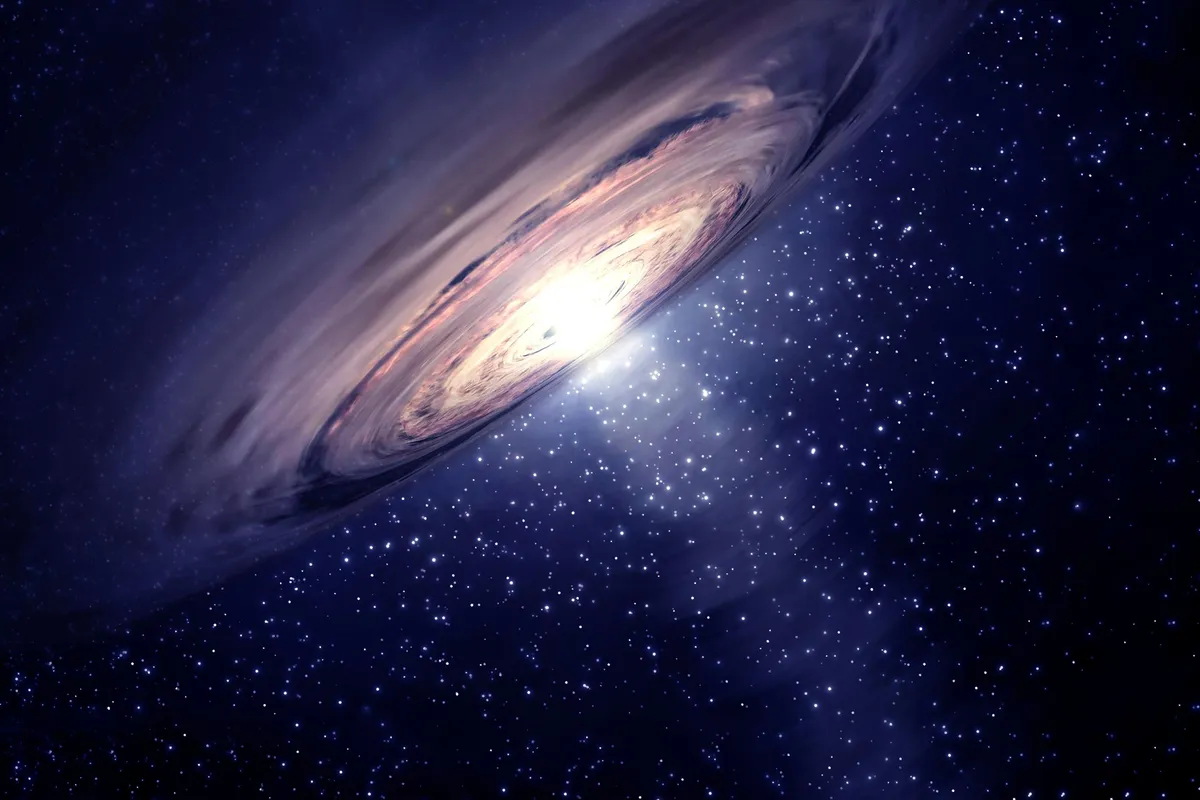
Think of it. Black holes, those cosmic vacuum cleaners, might have been around before the bounce, sailing right through the epic cosmic reset. They could still be out there, quietly influencing how galaxies form billions of years later. Or, perhaps, they formed just after the bounce, when quantum effects created dense pockets of matter that quickly collapsed into black holes. Either way, they're not exactly fresh out of the cosmic oven.
The Universe as a Rubber Ball
Einstein's general relativity gives us the Big Bang's "singularity" — a point of infinite density where all known physics just throws its hands up. Most physicists see this as a giant "our theories broke here" sign. A bouncing cosmology neatly sidesteps this, suggesting the universe was once a massive cloud that contracted, reached a very high but limited density, and then bounced back into expansion.
Gaztañaga points out that singularities are often where our understanding hits a wall. A bounce, on the other hand, lets the universe transition from shrinking to expanding without needing some entirely new, frankly baffling, physics.
Solving Cosmic Whodunits
The team suggests quantum physics could be the secret sauce for this bounce. At extreme densities, quantum effects generate pressure, stopping matter from being infinitely squished. It's the same principle that stabilizes white dwarfs and neutron stars, just scaled up to the entire universe. As the universe shrinks, this quantum pressure says, "Nope, that's enough," and triggers a new expansion.
This isn't just a neat trick; it might also solve two massive cosmic mysteries: the rapid, uniform expansion phase known as inflation, and the accelerating expansion we see today, usually blamed on dark energy. Two birds, one quantum bounce.
And here's the kicker: the theory predicts that structures larger than about 90 meters (295 feet) could survive this cosmic bounce. Gravitational waves, density changes, and, yes, those ancient black holes could all pass through the transition and emerge into our expanding universe.
These surviving black holes could even be dark matter. If enough of them formed during the bounce, they could account for a significant chunk, or even all, of that invisible stuff. Suddenly, dark matter isn't some exotic particle; it's just really, really old black holes.
This model also lines up with recent James Webb Space Telescope observations, which found surprisingly massive objects — dubbed "little red dots" — in the very young universe. Many astronomers suspect these are rapidly growing black holes that appeared far too early to fit neatly into the standard Big Bang timeline. Gaztañaga says if massive black holes already existed right after the bounce, the early universe didn't have to start from scratch to build its first galaxies. Which, if you think about it, is both impressive and slightly terrifying.
Much work is still needed, of course. But if the universe did experience a bounce, the dark structures shaping galaxies today could be the ultimate cosmic heirlooms — remnants from a time before our universe even began. Let that sink in.