Researchers at the Federal Institute for Materials Research and Testing (BAM) are proposing a new way to design high-performance materials. Their goal is to make materials for batteries, hydrogen tech, wind turbines, and electronics more sustainable and resource-efficient. This approach aims to reduce reliance on critical raw materials and improve recyclability.
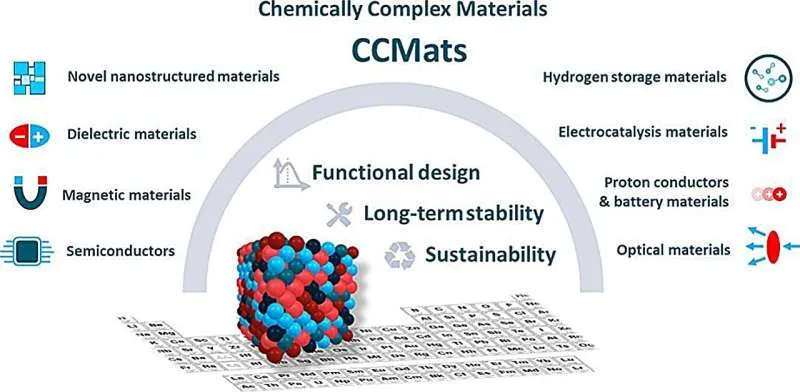
Many advanced materials use rare or politically sensitive raw materials. These materials often break down quickly and are hard to recycle. This leads to high costs and new dependencies. BAM researchers suggest a shift: instead of just making materials perform at their best, we should also focus on their long-term stability, reusability, and raw material availability from the start.
Making Materials Sustainable
Tilmann Hickel, a materials scientist at BAM and lead author, explained that while we've learned to make materials high-performing, we now need to make them robust and sustainable. He noted that a material is truly sustainable only if it works well over time, even in real-world conditions.
We're a new kind of news feed.
Regular news is designed to drain you. We're a non-profit built to restore you. Every story we publish is scored for impact, progress, and hope.
Start Your News DetoxThe new strategy has three main parts:
- Replacing critical elements: Swap rare elements with combinations of more common ones. This improves sustainability without losing performance.
- Controlling defects: Use "defect engineering" to intentionally change irregularities in a material, like grain boundaries. This can improve stability or function.
- Using chemical diversity: Instead of using just a few chemical building blocks, combine many different elements. This makes materials tougher and able to meet several needs at once.
Real-World Applications
This approach is especially important for the energy transition. For example, lightweight parts made of strong steels can be used in wind turbines. This saves resources and helps build more efficient offshore towers. These parts face high stress and must last a long time. There's also a push to recycle complex materials like these steels more effectively.
Andrea Stucchi de Camargo, a co-author, sees this as a design challenge, not a conflict. She said the energy transition's success depends on materials working reliably for years in practice, being repairable, and adapting to changing raw material supplies.
Early Successes
The BAM paper isn't just theory; it's based on many real research examples. Researchers have already replaced some critical elements in various materials. They've maintained function over long periods and solved common trade-offs, like balancing efficiency and durability.
For instance, complex battery materials can now partly replace cobalt in rechargeable batteries. Cobalt is expensive and politically critical. In fuel cells, new proton-conducting materials work well at high temperatures where older materials failed. This is thanks to their chemical diversity.
Also, multi-component metal alloys are proving as efficient as platinum in catalysts. Catalysts are vital for many chemical processes.
Deep Dive & References
Chemically complex materials enable sustainable high-performance materials - Current Opinion in Solid State and Materials Science, 2026