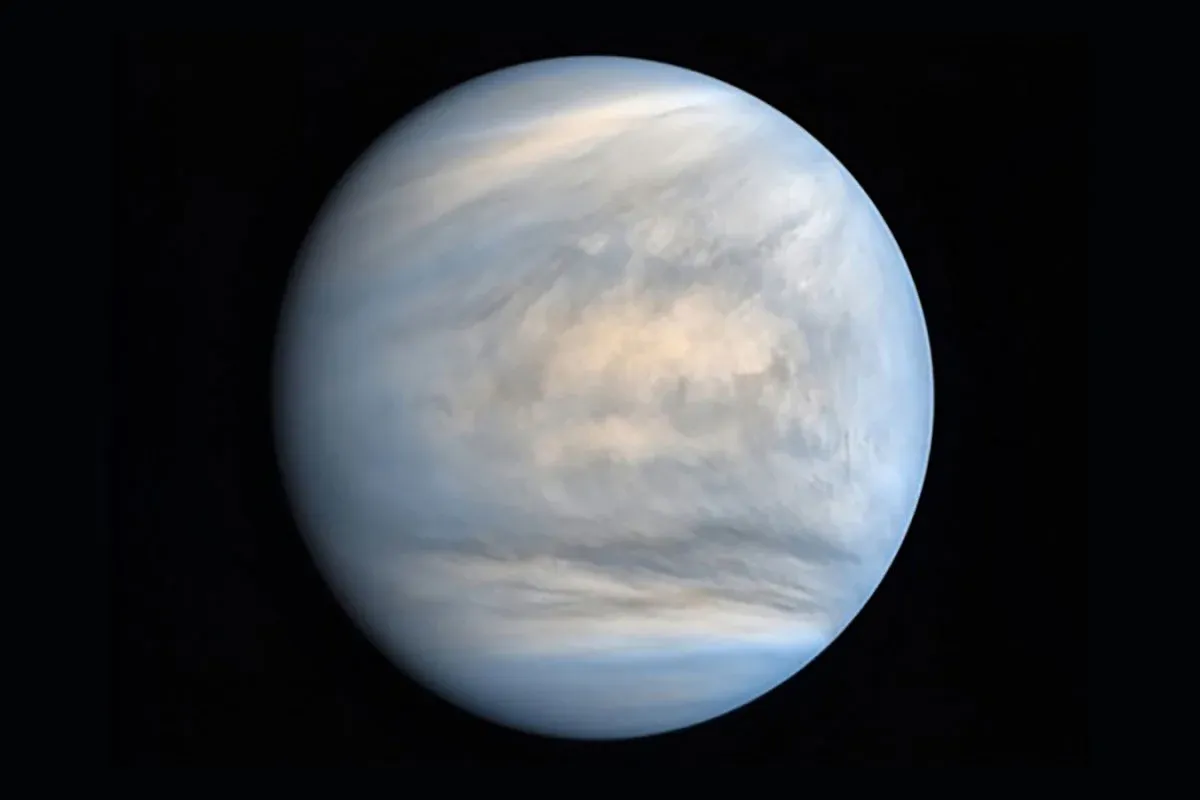
Imagine Earth, not just as a cradle of life, but as a giant slingshot, flinging microscopic hitchhikers across the solar system. Turns out, our planet might be sending its biological bits to Venus, of all places. That's the gist of new research suggesting that life, or at least its essential ingredients, could be making the interplanetary leap.
This isn't some sci-fi fever dream; it's called panspermia, and it's the idea that life can travel between planets, perhaps tucked inside an asteroid or a piece of planetary shrapnel. Scientists have long pondered if Earth and Mars swapped biological greetings. But now, with all the buzz about potential life in Venus's famously hostile clouds, the question has shifted: Could material also be moving between Venus, Earth, and Mars?
The Life Equation for a Hell Planet
A recent study dove headfirst into this delightfully weird possibility. Researchers from The Johns Hopkins University Applied Physics Laboratory and Sandia National Laboratories presented their findings, armed with a tool called the "Venus Life Equation" (VLE). It's essentially a cosmic checklist for life's chances, breaking down the question into factors like:
We're a new kind of news feed.
Regular news is designed to drain you. We're a non-profit built to restore you. Every story we publish is scored for impact, progress, and hope.
Start Your News Detox- O = Origination (did life start there?)
- R = Robustness (can it handle Venus's mood swings?)
- C = Continuity (did habitable conditions last long enough?)
And, of course, the big one: L = Likelihood of Extant Life (from zero to certainty).
Before even thinking about Venus, the team had to figure out if anything organic could survive the ultimate road trip.
Surviving the Interstellar Commute
Space is, shall we say, unforgiving. We're talking impact shock, extreme heat, radiation, and the kind of vacuum that makes your home cleaner look like a gentle breeze. Yet, computer models and actual meteorites found on Earth tell a different story: organic material can, in fact, survive being blasted off a planet and cruising through the cosmos.
Once this hardy material reached Venus, the next challenge was to spread out and, you know, live in or above its clouds. The team zeroed in on how meteorites, or "bolides," would behave as they plunged through Venus's thick atmosphere. They used a "pancake model" — because apparently, that's what happens when a space rock explodes and scatters horizontally. It forms a dispersed, pancake-like cloud of debris.
Using this deliciously named model, the researchers estimated that hundreds of billions of these dispersed "cells" (meaning bits of material, potentially containing life) might have been transferred from Earth to Venus's clouds. And get this: hundreds of billions of them could still be viable.
Their best estimate? About 100 such cells could be dispersed in Venus's clouds every Earth year. Over the last billion years, that's roughly 20 billion cells making the journey from Earth. Let that satisfyingly large number sink in.
The scientists readily admit their model isn't perfect, and there are plenty of unknowns. But the takeaway is clear: panspermia between Earth and Venus isn't just possible, it's plausible. So, if a future mission does find life hanging out in Venus's clouds, we might just be looking at our own cosmic descendants. Which, if you think about it, is both impressive and slightly terrifying.