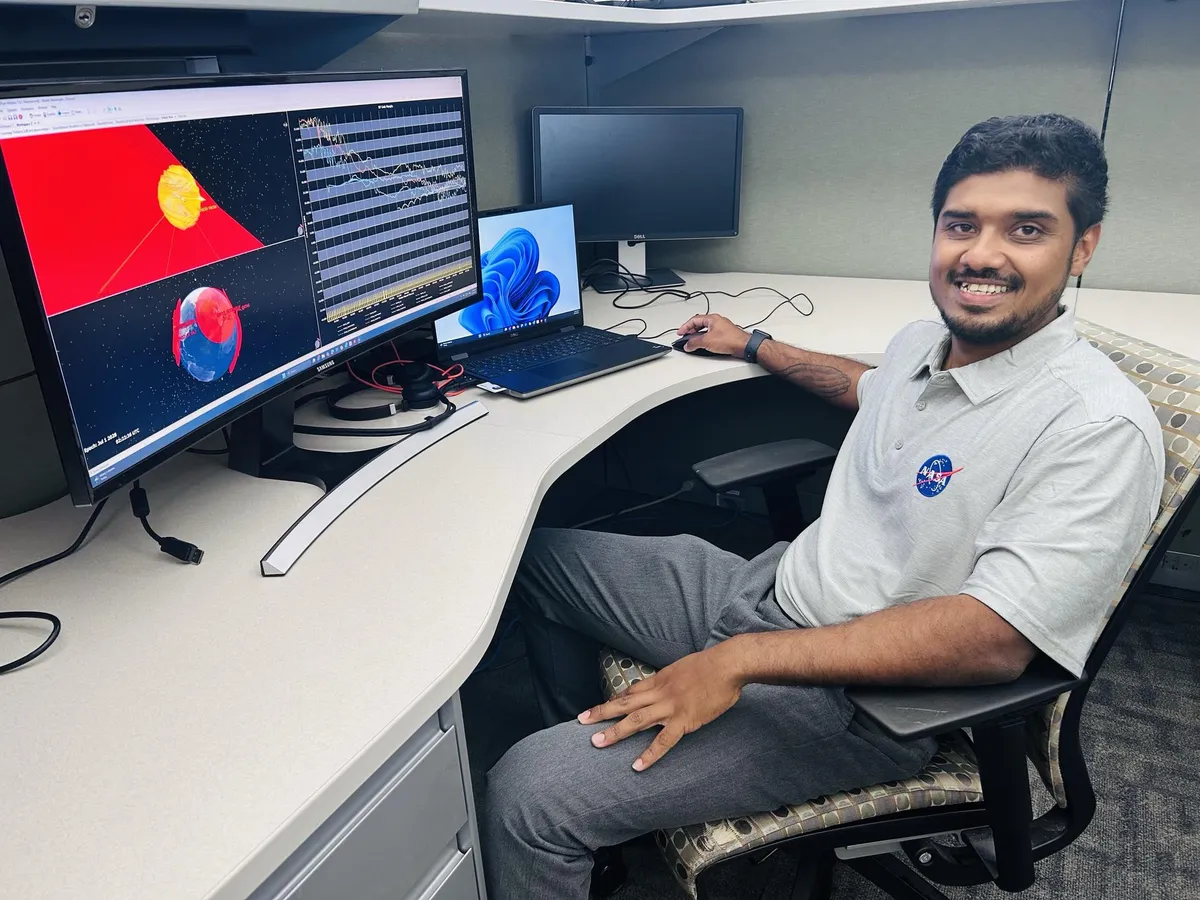
Rohit Goeptar, an electromagnetic/radio frequency analyst with NASA’s Launch Services Program, has a remarkable journey to NASA. He is one of the new civil servants sworn in as part of NASA Administrator Jared Isaacman’s plan to strengthen technical skills within the agency.
From Suriname to the Space Coast
Goeptar was born into a poor family in Suriname, South America. His parents worked three jobs just to provide food and shelter. When he was about six, his family moved to California. Two years later, he moved back to South America with his father. His mother stayed in the U.S. and remarried. At 13, Goeptar became a U.S. citizen and returned to California with his brothers to live with their mother.
At 19, Goeptar joined the U.S. Marine Corps, serving six years as a technical operator. During a deployment to the Philippines, he helped set up communication systems for people affected by a typhoon. This allowed them to contact their loved ones.
We're a new kind of news feed.
Regular news is designed to drain you. We're a non-profit built to restore you. Every story we publish is scored for impact, progress, and hope.
Start Your News Detox"I was lost, the Marine Corps gave me an opportunity," Goeptar recalled.
His life had many challenges. He lost two fathers to suicide. A short first marriage ended with him being unhoused in Kissimmee, Florida, for six months. But Goeptar eventually found his path.
His wife played a key role in his success. After they met, she told him, "Your brain works in mysterious ways." She then filled out college applications for him. This led him to apply to NASA’s Kennedy Space Center.
While raising three children and studying full-time for degrees in computer and electrical engineering, Goeptar received a life-changing call.
"In spring 2025, I was driving to pick my son up from school when a gentleman from Kennedy calls, telling me he’s seen my resume and do I have time for a quick interview," Goeptar recounted. He pulled over and did an impromptu job interview.
Two weeks later, he had an in-person interview. Two weeks after that, he had a contractor badge at Kennedy Space Center.
Goeptar started as an intern under the Expendable Launch Vehicle Integrated Support (ELVIS) contract. He then worked part-time while finishing his degree at the University of Central Florida (UCF). After graduating, he became full-time at the beginning of 2026. Recently, he was one of the ELVIS contractors chosen to become a civil servant.
Making an Impact at NASA
Now, as an employee of NASA’s Launch Services Program, Goeptar focuses on electromagnetic interference, compatibility, and radio frequency. He ensures that electronic systems do not interfere with each other throughout a mission. He also makes sure independent systems work well together. Additionally, he performs radio frequency link analysis for rockets and science payloads, whether they belong to NASA or commercial partners. His work ensures constant communication with the ground.
In his short time at Kennedy, Goeptar has contributed to missions like Sentinel-6B, JPSS-4 (Joint Polar Satellite System), and IMAP (Interstellar Mapping and Acceleration Probe).
His wife's observation about his unique brain proved true. Within a year at Kennedy, he noticed an analytical issue his team had missed. When a rocket launches, it performs pitch, yaw, and roll movements. The team's analysis didn't account for this, making it less accurate. Goeptar presented his solution to his team lead. This improvement now helps NASA and partner data sync much better.
"There is no greater feeling, being able to serve. It’s more than serving the public, it’s serving our country. It’s serving the future of our country," Goeptar said, with tears in his eyes. "Being able to give back to that same government that gave me an opportunity to be where I’m at today. There’s no greater feeling than that."
Goeptar’s 11-year-old son, a NASA enthusiast, takes credit for his father's job at the space center. His son believes he "spoke it into existence."
"One day he wants to become an astronaut," Goeptar said with joy. "And I told him I will guide him until the day that I die. Maybe my last mission could be the one my son flies on. I’m not going to stop until that day happens."
Goeptar's positive momentum continues. He was recently accepted into electrical engineering master’s programs at both Johns Hopkins University and UCF.
Deep Dive & References
NASA Missions - NASA