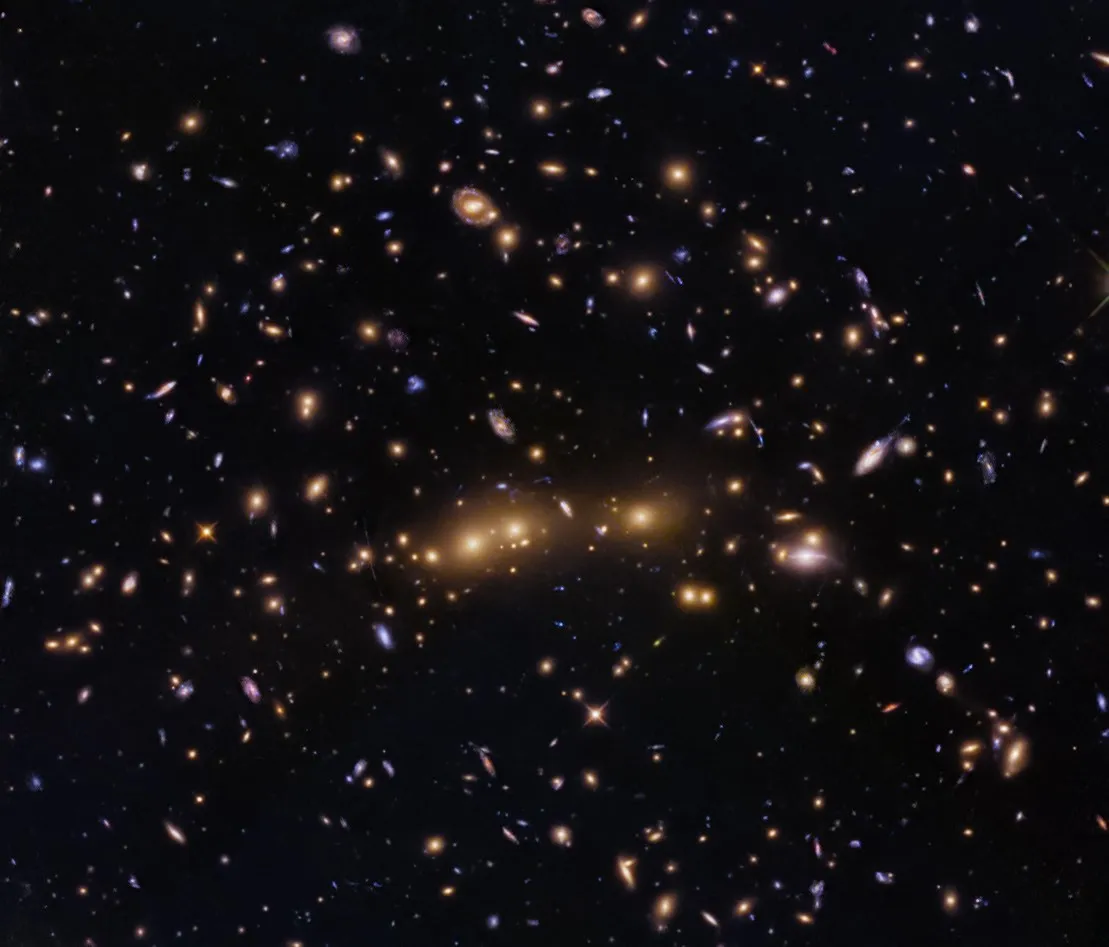
Turns out, the universe has its own version of a fender bender, only it involves entire galaxy clusters and happens over millions of years. NASA's Hubble Space Telescope recently snagged an image of one such cosmic collision: a bright, X-ray-emitting cluster originally known as CL0016+1609 (now also MACS J0018.5+1626, because apparently, even galaxies get name changes). What looked like one massive entity is actually two, caught mid-merge.
Astronomers have been poking at this particular pile-up with X-ray and radio observations for a while. The latest Hubble data from its Advanced Camera for Surveys is helping them map out the dark matter distribution within the colossal crash. Because nothing says "good time" like trying to figure out where all the invisible stuff is going in a galactic smash-up.
The Gravity of the Situation
Hubble, being a telescope and not a wizard, can't actually see dark matter. But it can spot the effects of its gravity. Think of it like watching a ghost move furniture – you don't see the ghost, but you see the couch flying across the room. In this case, dark matter's immense gravitational pull warps the light from normal matter, an effect delightfully dubbed "gravitational lensing."
We're a new kind of news feed.
Regular news is designed to drain you. We're a non-profit built to restore you. Every story we publish is scored for impact, progress, and hope.
Start Your News DetoxThis isn't just a cosmic rubbernecking exercise. Understanding these mergers helps scientists piece together the universe's large-scale structure, which, if you think about it, is a pretty big puzzle.
The image also includes intel from Hubble's Wide Field Camera 3, part of a program called RELICS (Reionization Lensing Cluster Survey). This survey was basically a galactic treasure hunt, taking the first infrared images of 46 massive galaxy clusters and sniffing out distant galaxies whose light was bent by these behemoths. RELICS managed to spot about 300 potential distant galaxies that had been gravitationally lensed. That's a lot of cosmic funhouse mirrors.

Keep an eye out in the image: just to the left of those big elliptical galaxies in the center, there's a faint, vertical arc, a ghostly whisper from a distant galaxy. And above and slightly right of the central hub, a brighter, shorter arc. Because even in a galactic collision, some things just want to stand out.