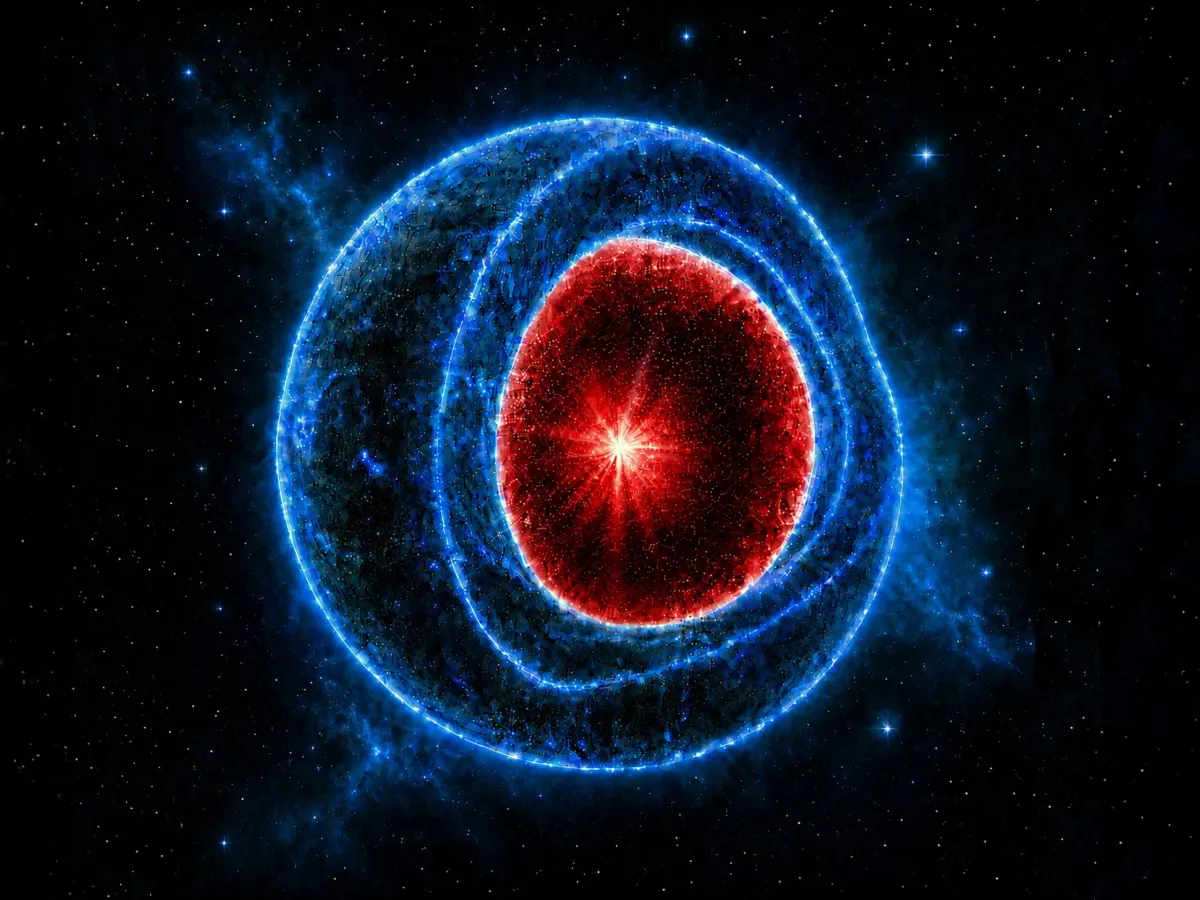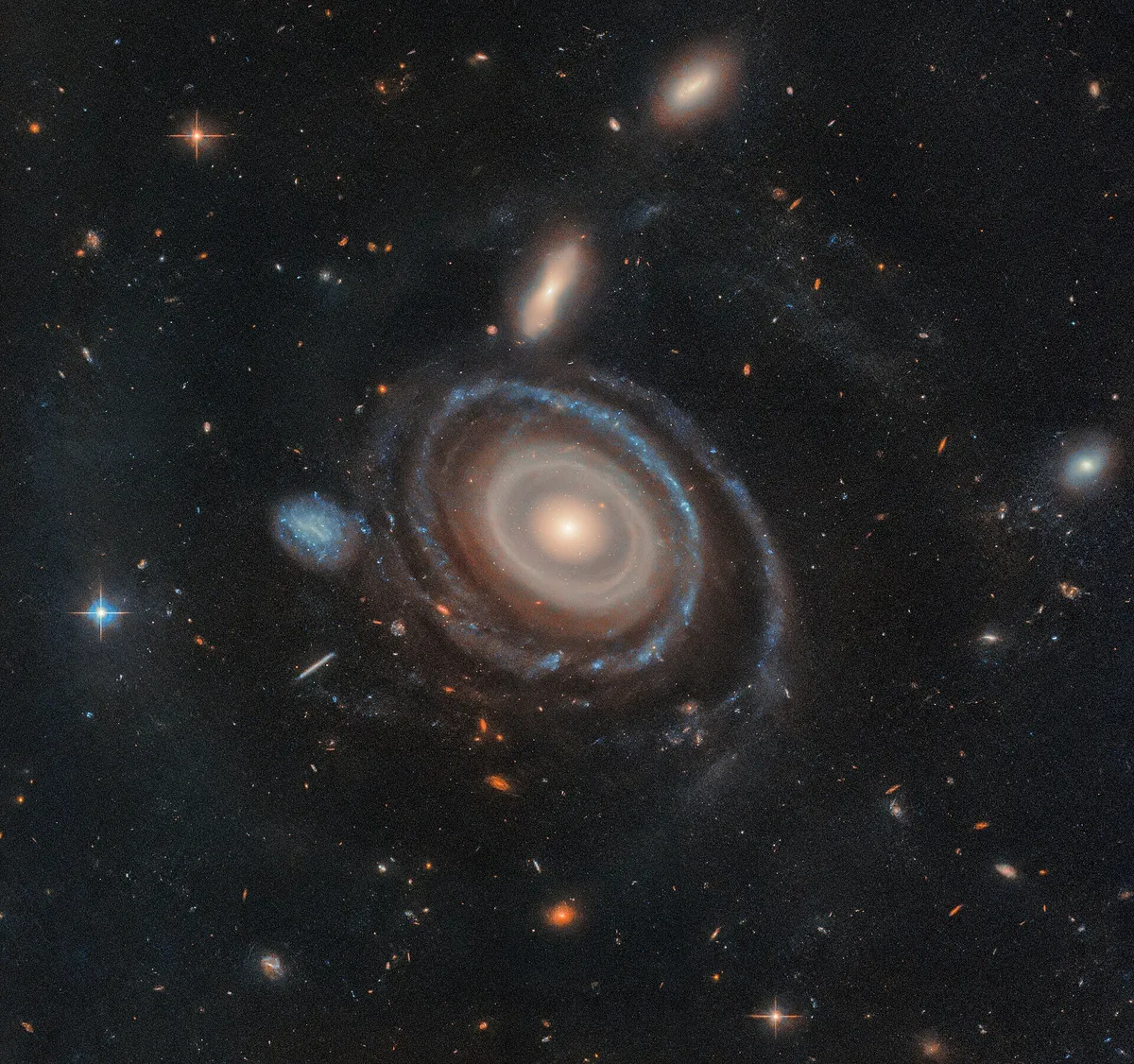
Imagine a galactic target practice, but instead of a bullseye, it's a galaxy with nine perfectly concentric rings. That's LEDA 1313424, charmingly dubbed the "Bullseye galaxy." For years, the cosmic consensus was that these kinds of ringed galaxies formed when a smaller galaxy played a very aggressive game of galactic bumper cars, smashing right into the center of a larger one.
Then came the Bullseye, discovered in 2025 by astronomers at Yale. Nine rings. Not one, not two, but nine. The collision theory quickly became a bit of a head-scratcher. Specifically, physicists Pierre Sikivie and Yuxin Zhao from the University of Florida crunched the numbers and found a problem: for the outermost ring to form via a collision, it would have had to travel at an eye-watering 758 miles per second. Which, if you think about it, is both impressive and slightly terrifying for galactic material.
The Case for Quantum Dark Matter
Sikivie and Zhao, publishing their analysis in The Astrophysical Journal, proposed something far more elegant, and frankly, a lot weirder: dark matter. Specifically, the quantum behavior of hypothetical dark matter particles called axions.
We're a new kind of news feed.
Regular news is designed to drain you. We're a non-profit built to restore you. Every story we publish is scored for impact, progress, and hope.
Start Your News DetoxNow, dark matter, as we all know, is the universe's most elusive celebrity. It makes up 85% of everything but has yet to make a direct appearance. We only know it's there because of its gravitational pull on things we can see. Sikivie's earlier work suggested that if dark matter is made of these weakly interacting axions, it should form "caustic rings" around galaxies. These aren't rings of visible matter, but rather specific patterns in the dark matter halo itself.
The kicker? When they mapped the observed ring sizes of the Bullseye galaxy, they found a striking match to the pattern predicted by these dark matter caustic rings. Essentially, the nine visible rings of the Bullseye galaxy could be an imprint, a cosmic echo, of these invisible dark matter structures.
But wait, there's more. The duo suggests that these axions aren't just forming patterns; they're acting like a Bose-Einstein condensate. This is a quantum state where particles, when cooled to near absolute zero, fall into the lowest possible energy state and behave as one big, quantum entity. If dark matter axions can do this, their collective quantum properties could manifest on a galactic scale, interacting with normal matter to create exactly what we see in LEDA 1313424.
So, those nine rings? Not necessarily a galactic car crash. Instead, they might be proof that dark matter isn't just lurking in the shadows, but actually putting on a quantum light show. Which, for something we can't even directly detect, is quite the flex.
While axions remain frustratingly hard to pin down, this theory offers a tantalizing new explanation for one of the universe's most bizarre recent discoveries. Because apparently, the cosmos decided it needed a bullseye, and dark matter was just the thing to draw it.