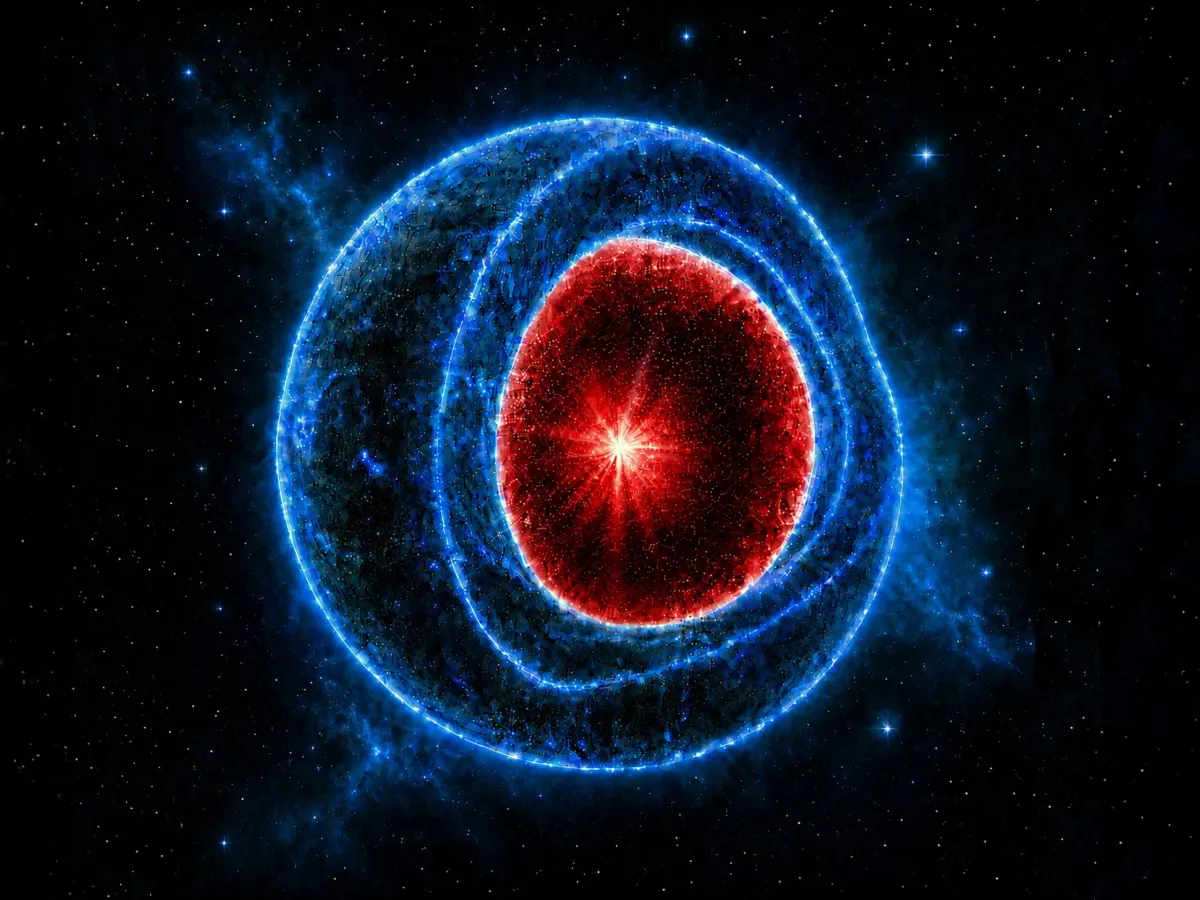
You know how when a massive star kicks the bucket, it typically goes supernova and then collapses into a black hole? Well, some scientists are now saying, "Maybe not always." What if, instead of a cosmic vacuum cleaner, it births a whole new, tiny, expanding universe right there in its core?
Meet the gravastar. It's the universe's latest contender for "most intriguing way to avoid a black hole's existential dread." Because, let's be honest, those singularities and event horizons are a real head-scratcher for physicists.
The Problem with Black Holes
Stars are basically giant, fiery balancing acts. Nuclear fusion pushes out, gravity pulls in. When a really big star runs out of fuel, gravity wins, and the whole thing collapses. The standard script says: black hole. That's a point of infinite density (a singularity) surrounded by a boundary (an event horizon) where even light can't escape.
We're a new kind of news feed.
Regular news is designed to drain you. We're a non-profit built to restore you. Every story we publish is scored for impact, progress, and hope.
Start Your News DetoxBut here's the rub: How does all that mass squish into a single point? And how does spacetime curve infinitely? At these extremes, our current understanding of physics just kind of throws its hands up. It's like trying to explain a smartphone to a caveman — the concepts are just too far out.
Enter the gravastar. It's a compact, super-dense object, much like a black hole, but without the pesky singularity or the no-escape event horizon. Think of it as a black hole's slightly less terrifying, more theoretically sound cousin.
So, what's inside this cosmic oddity? The outside is regular matter, but the core? Dark energy. Yes, the same mysterious force that's pushing our entire universe apart. In a gravastar, this dark energy creates an outward pressure, stopping the star from collapsing all the way down to a singularity.
For years, this was a cool idea but a bit of a theoretical dead end. How would such a thing even form?
Big Bang, Small Package
Theoretical physicists Daniel Jampolski and Professor Luciano Rezzolla recently cracked the code. Using Einstein's General Relativity equations, they figured out how a collapsing star could actually become a gravastar. And it's wild.
Their research suggests that as a massive star collapses, a miniature universe could spontaneously form inside it. This isn't just a metaphor; it's a process eerily similar to the Big Bang that kicked off our own universe. Dark energy, the cosmic expansion engine, would power the growth of this new mini-verse.
This expanding baby universe then pushes back against the star's inward collapse, halting it before a black hole can fully form. Eventually, a delicate balance is struck between the expanding mini-universe and the collapsing stellar material, resulting in a stable gravastar. It's the ultimate cosmic "stop hitting yourself" moment.
This is the first time anyone has explained how gravastars could realistically form from collapsing matter — a puzzle that's kept scientists busy for about 25 years. Let that satisfying number sink in.
Jampolski, who made this discovery during his master's thesis (because apparently that's where we make universe-altering discoveries now), noted that the "Big Bang" of this new universe happens when the star is just millimeters away from becoming a black hole. It's a cosmic cliffhanger.
Professor Rezzolla is quick to point out that this isn't about ditching black holes entirely. They're still the most likely outcome. But, as he wisely put it, history is littered with "unusual ideas" that eventually became accepted wisdom. And if that doesn't make you want to tell someone, what will?