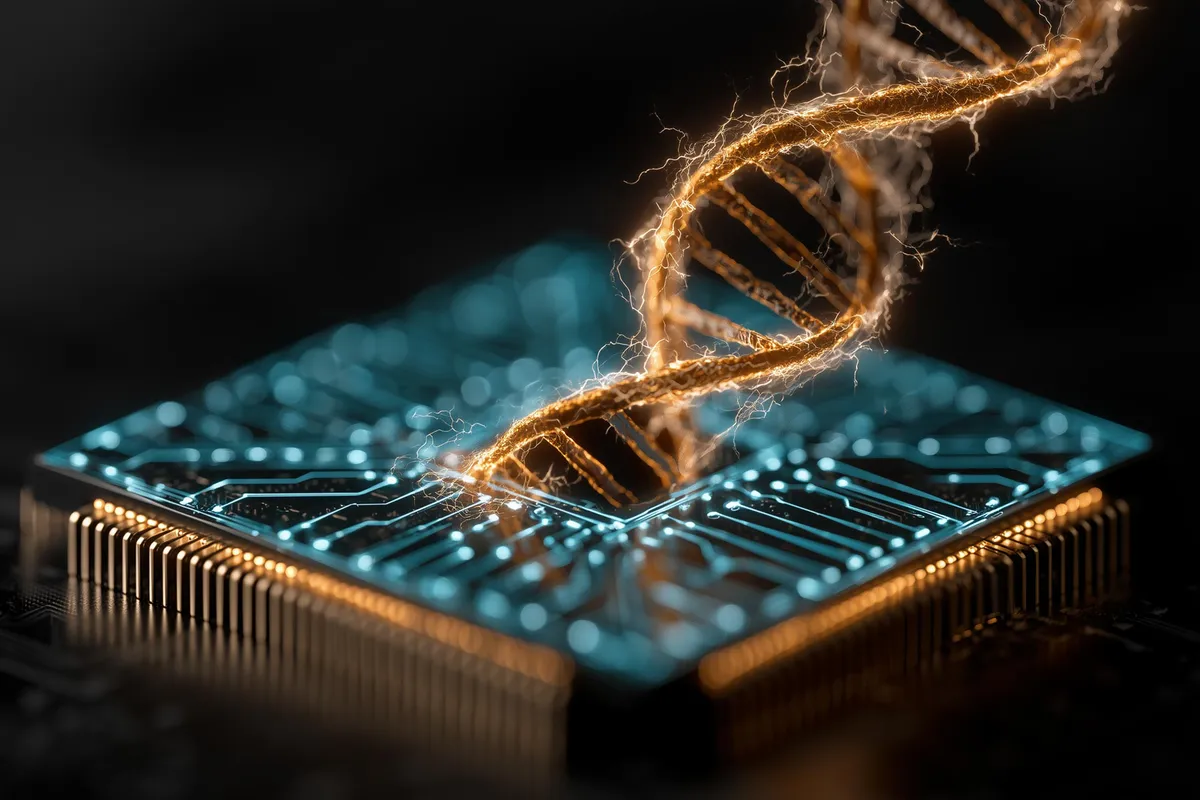
For over 50 years, silicon chips have been the unsung heroes of our digital lives, powering everything from your phone to supercomputers. Now, they're stepping into a new role: building DNA. And not just any DNA — they're doing it with water and electricity, leaving those nasty chemicals behind.
A team at Harvard has created a silicon chip capable of churning out 64 different DNA sequences simultaneously. Think of it as a microscopic assembly line, but instead of widgets, it's meticulously crafting the very code of life. This isn't just a neat trick; it's a significant leap towards cleaner, more portable DNA manufacturing.
The Green Revolution of DNA Synthesis
Historically, creating synthetic DNA has been a messy business. The dominant method, phosphoramidite chemistry, is efficient but requires dangerous organic solvents and a dedicated facility. Not exactly something you'd want in your backyard.
We're a new kind of news feed.
Regular news is designed to drain you. We're a non-profit built to restore you. Every story we publish is scored for impact, progress, and hope.
Start Your News DetoxEnter the Harvard chip. Published in Nature Electronics, this little marvel uses an enzymatic process that happens entirely in water. It mimics how your own cells build DNA, making it far gentler and, crucially, safer. Instead of vats of chemicals, it uses precise electric currents to kickstart reactions at specific points on its surface.
This isn't just about being eco-friendly; it's about scale and accessibility. Smaller, safer DNA-writing devices could revolutionize everything from diagnostics to gene editing and cancer research. Until now, enzymatic methods couldn't keep up with traditional chemistry in terms of parallel output, usually maxing out at a dozen sequences. The Harvard team just shattered that record, hitting 64 distinct sequences, each up to 39 nucleotides long.
So, how does this tiny factory work its magic? DNA strands are built one nucleotide at a time. After each addition, a temporary blocker stops further growth. To add the next piece, this blocker needs to be removed, a process called deprotection. This happens in an acidic, low-pH environment.
The genius of the Harvard chip lies in its control. Each of the 64 synthesis sites has two ring electrodes. When a site needs a nucleotide, the inner ring zaps it with current, creating protons and lowering the pH. Simultaneously, the outer ring pulls current in the opposite direction, gobbling up any rogue protons trying to spread the acidity. This keeps the low-pH zone perfectly contained, ensuring only the intended DNA strand grows.
Over many cycles, this precise electrical choreography builds 64 unique DNA sequences. It's like having 64 tiny, independent construction crews working on their own projects, all on a chip the size of a postage stamp.
From Neurons to Data Storage
Funnily enough, this chip's electrical wizardry wasn't originally for DNA. It was first developed in Professor Donhee Ham’s lab to record activity from thousands of neurons. They later realized the same precise current control could be repurposed from probing cells to manipulating molecules.
Beyond just building DNA for research, this technology opens the door to wild new possibilities. The team even used their 64 DNA sequences to encode a 169-byte text, demonstrating a tiny example of DNA-based data storage. Imagine storing entire libraries in a vial of liquid — that's the long-term goal.
Such ambitious projects would require astronomical amounts of DNA, making environmentally friendly, water-based synthesis not just a good idea, but a necessity. As co-first author Woo-Bin Jung put it, current DNA data storage needs are "much larger than today." Enzymatic synthesis in water could be the key to making that happen on a massive, planet-conscious scale.
Of course, science is rarely without its curveballs. When the team tried to cram even more DNA strands onto the chip, things went awry. The electronics were working perfectly, keeping the pH zones tight, but the deprotection chemistry itself was the culprit. Intermediate molecules, created by the acidic conditions, were drifting into neighboring sites, causing unwanted reactions. It turns out the chip was ahead of the chemistry.
As postdoctoral researcher Han Sae Jung explained, the limitation wasn't the silicon, but the chemistry. The next step? Developing an acid-driven deprotection method that can keep up with the chip's impressive precision. Because apparently, even DNA factories on a chip have their workflow bottlenecks.