About 660 kilometers (410 miles) below Earth's surface lies a crucial boundary. This 660-km seismic discontinuity separates the mantle transition zone from the lower mantle. It helps control how heat and materials move inside Earth.
This movement drives mantle convection, plate tectonics, and volcanic activity. It also affects the planet's long-term changes. Scientists once thought this boundary formed when the mineral ringwoodite broke down into bridgmanite and ferropericlase. However, this idea didn't fully explain the complex structures seen by seismic tools, especially under subduction zones and mantle plumes.
To solve this, a research team looked at how majorite garnet affects this change. Garnet is the second most common mineral in the mantle transition zone. Associate Professor Takayuki Ishii from Okayama University led the team. They worked with Professor Hiroshi Kojitani and Professor Masaki Akaogi from Gakushuin University in Japan.
We're a new kind of news feed.
Regular news is designed to drain you. We're a non-profit built to restore you. Every story we publish is scored for impact, progress, and hope.
Start Your News DetoxThey did high-pressure, high-temperature experiments. They used a special device called a Kawai-type multi-anvil apparatus. They compared mantle compositions with and without garnet under the same conditions.
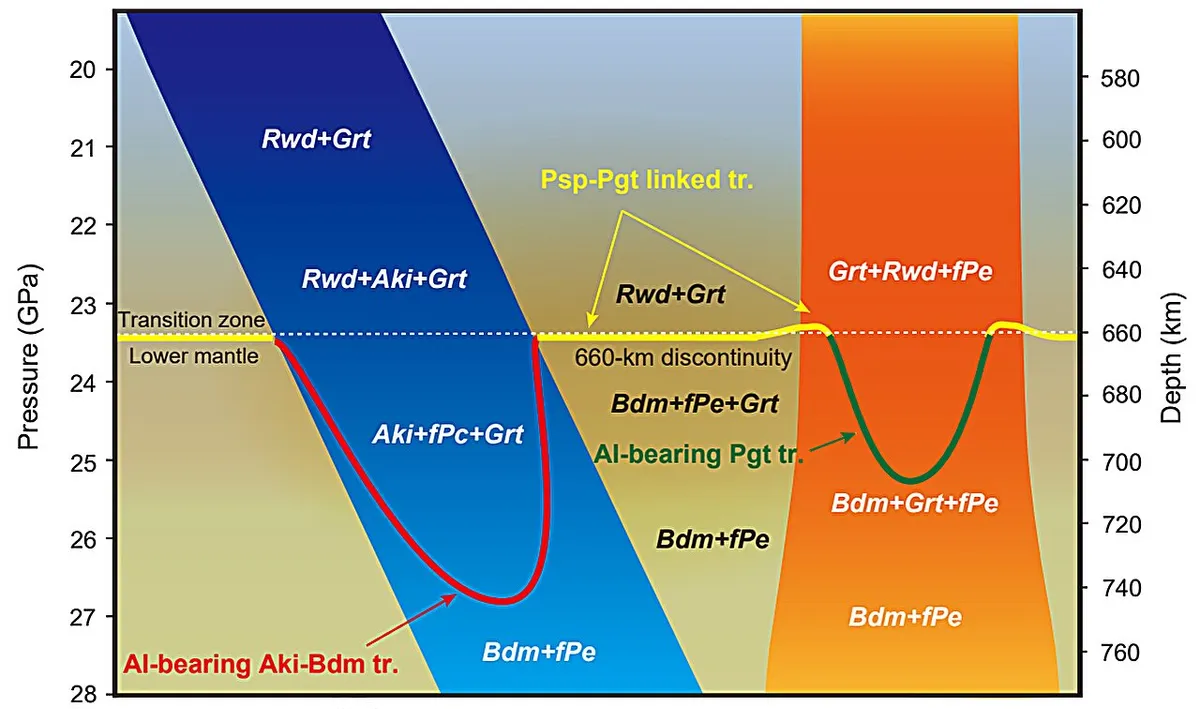
Their experiments showed that the post-spinel transition doesn't happen alone in the mantle. Instead, it's linked to the post-garnet transition. These findings were published in Nature Communications in May 2026.
Garnet Reshapes the Boundary
The experiments revealed that garnet, which contains aluminum, changes how the post-spinel transition reacts to pressure and temperature. Bridgmanite forms not just from one mineral changing, but from a linked reaction. This involves both ringwoodite breaking down and garnet changing.
This linked process explains why the 660-km discontinuity forms at its observed depth. It also accounts for its unevenness under cold subduction zones and hot mantle plumes. The results suggest that garnet is not just there; it actively controls the mineral reactions that create this major seismic boundary.
Dr. Takayuki Ishii noted that their study shows the 660-km boundary is created by a coupled post-spinel transition involving garnet. He said this is different from just ringwoodite breaking down. This new mechanism explains many seismic observations that older models couldn't.
A More Uniform Mantle Picture
The researchers also found that these linked mineral changes support the idea of a mantle with a consistent, pyrolite-like composition. This means the mantle is not a mix of different rock types. This new understanding helps scientists better interpret seismic images of Earth's deep interior. It also improves models of how material and heat move through the mantle.
Understanding how the 660-km discontinuity forms has wider impacts on Earth science. By clarifying the mineral reactions at this boundary, the study provides a stronger basis for understanding mantle convection. It also helps explain how tectonic plates dive into the lower mantle and how hot mantle plumes rise.
These processes control how heat and material move inside Earth. They ultimately affect the tectonic and volcanic activity we see on the surface. The findings might also lead to new ideas about the mantle's composition and Earth's long-term evolution.
Ishii explained that his work started with a question from his student days: why the breakdown of ringwoodite changes when garnet is present. He said solving this question has now shown a more realistic picture of Earth's deep interior and how the mantle behaves.
Overall, the study identifies garnet as the key mineral that forms Earth's 660-km seismic boundary. It offers a full explanation for its complex seismic structure. It also supports the idea that the mantle has a consistent, pyrolite-like composition.
Deep Dive & References
Role of garnet shaping the 660-km seismic discontinuity - Nature Communications, 2026