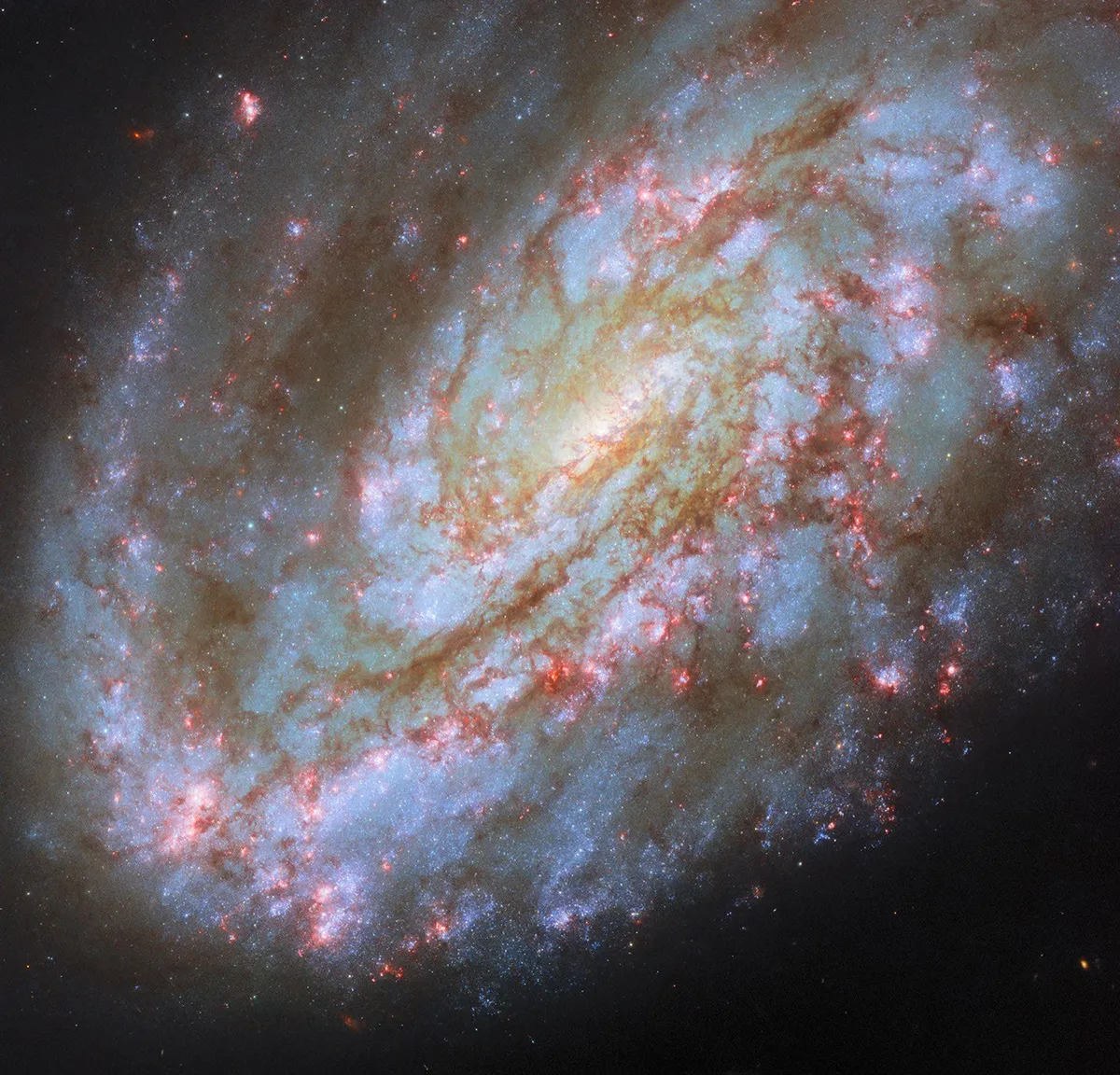
The universe, it turns out, is full of bullies. And sometimes, they leave a galaxy looking like it went through a cosmic car wash with one side tied behind its back. Case in point: the spiral galaxy NGC 4654, recently snapped by the Hubble Space Telescope, a cool 72 million light-years away in the constellation Virgo.
Now, NGC 4654 is what astronomers call an "intermediate spiral galaxy." Think of it as a middle-of-the-road spiral, not quite a perfect pinwheel and not quite a barred spiral with a pronounced central strut. It's got a faint bar, but that's not the most interesting part.

The Universe's Version of a Speed Bump
What makes this galaxy truly eye-catching is its distinct lopsidedness. One side is all neat and rounded, minding its own business. The other? It's sporting a long, streaky tail of gas, like a bad hair day that stretches for light-years. This cosmic mullet is the result of something called "ram pressure stripping."
We're a new kind of news feed.
Regular news is designed to drain you. We're a non-profit built to restore you. Every story we publish is scored for impact, progress, and hope.
Start Your News DetoxImagine a galaxy zipping through a cluster of other galaxies, moving at incredible speeds through the hot, thin gas between them. It's like a high-speed car hitting a wall of air – the gas pushes on the galaxy's leading edge and drags its own gas into a long, trailing tail behind it. Which, if you think about it, is both impressive and slightly terrifying for a collection of billions of stars.
But wait, there's more to this wonky wonder. The stars themselves are unevenly distributed. The spiral arm facing forward is bursting with stars and gas, while the one on the opposite side looks a bit... empty. Fewer stars, less sparkle. This means ram pressure isn't the only culprit.
Astronomers suspect NGC 4654 also had an uncomfortably close encounter with another galaxy, NGC 4639, around 500 million years ago. This fly-by likely tugged away gas from one side, effectively stunting star formation there and contributing to its asymmetrical glow.
Despite all this cosmic drama, NGC 4654 is still a busy little star factory, churning out about two Suns' worth of new stars every single year. It's keeping pace with other galaxies its size, which is quite the feat after getting both stripped and sideswiped.
The Hubble image beautifully highlights these active star-forming regions with bright pink bubbles and glowing red gas clouds. It’s a vivid reminder that even when a galaxy looks like it's been through the celestial wringer, life (and stars) finds a way.