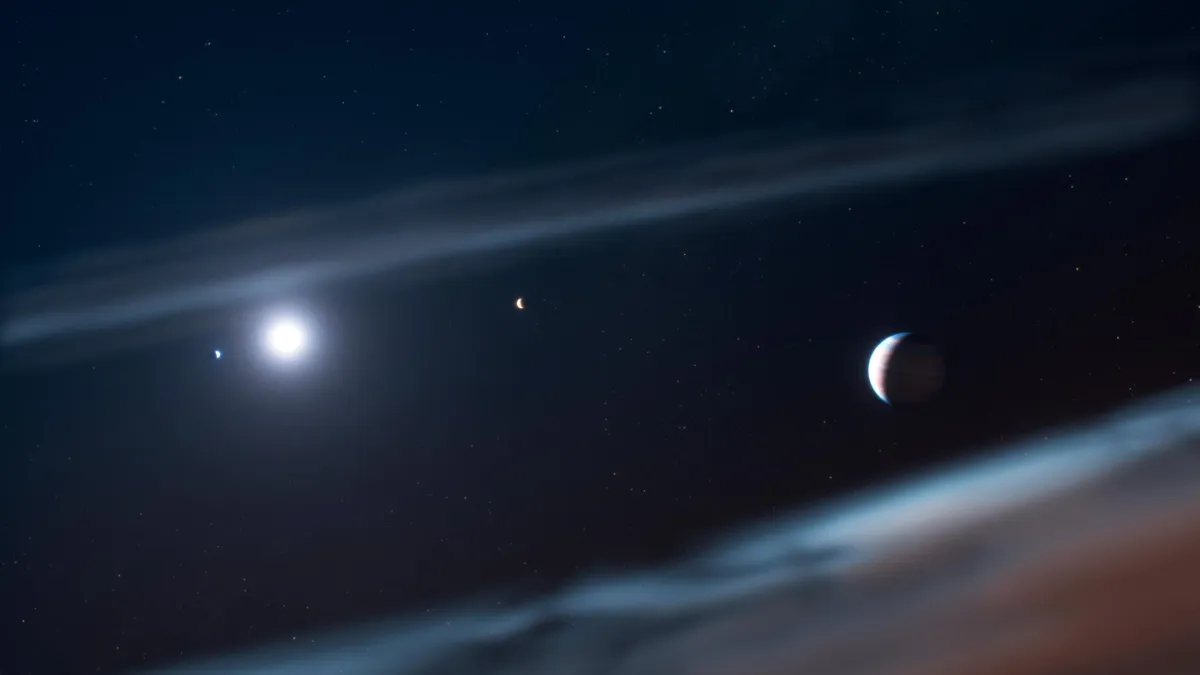
The James Webb Space Telescope has found a new giant planet in the Beta Pictoris star system. This system is one of the most studied in the Milky Way. The new planet, called Beta Pictoris d, was hidden by a bright dust disk.
Webb found the planet by looking at the chemicals in its atmosphere. This is a new way to find planets that are hard to see directly.
A New Giant Planet Joins the Family
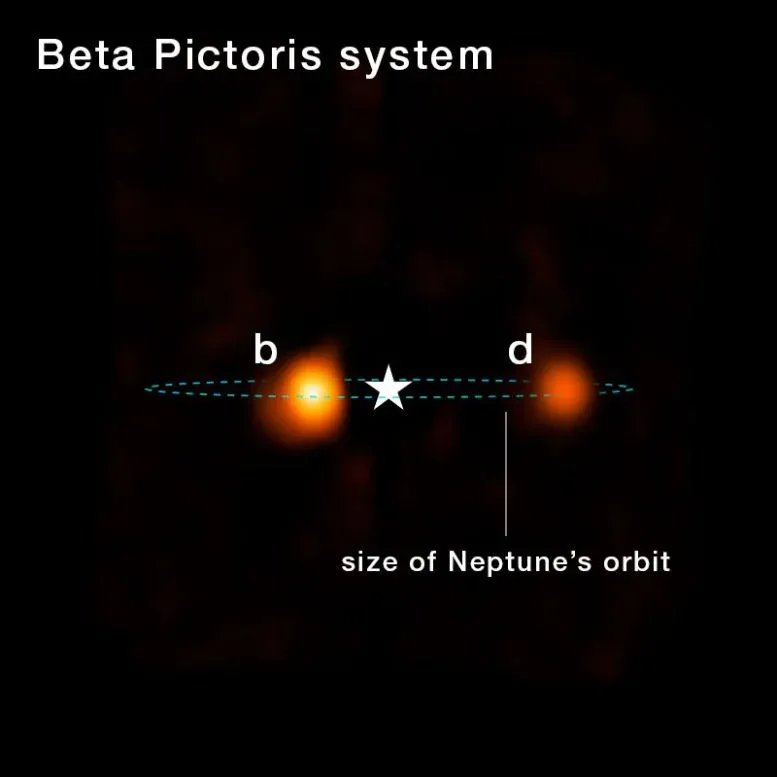
Scientists already knew about two other planets in the Beta Pictoris system: Beta Pictoris b and Beta Pictoris c. Beta Pictoris b was one of the first exoplanets ever seen directly. With Beta Pictoris d, this system is now only the second known to have at least three planets that have been directly imaged.
We're a new kind of news feed.
Regular news is designed to drain you. We're a non-profit built to restore you. Every story we publish is scored for impact, progress, and hope.
Start Your News DetoxAidan Gibbs, a lead author of the study from the University of California, San Diego, said this discovery adds to an already interesting planetary system. He noted that Beta Pictoris helps scientists understand how planetary systems form and change. The findings were published in The Astrophysical Journal Letters.
Beta Pictoris is 63 light-years from Earth and is about 23 million years old. Its young age and closeness allow astronomers to study how new planets interact with the dust and debris left over from the system's formation.
How Webb Found the Hidden Planet
Beta Pictoris d is at least twice as massive as Jupiter. This makes it the smallest of the three known giant planets in the system. It orbits about 30 times farther from its star than Earth does from the Sun. This is similar to Neptune's orbit in our solar system. Beta Pictoris d has the widest orbit of the three planets, but it stays within the inner edge of the debris disk.
Researchers were actually studying Beta Pictoris b's atmosphere using Webb’s NIRSpec (Near-Infrared Spectrograph). That's when they saw signs of Beta Pictoris d. The NIRSpec tool takes an image and also collects a spectrum, which is like a chemical barcode, from every point in the image.
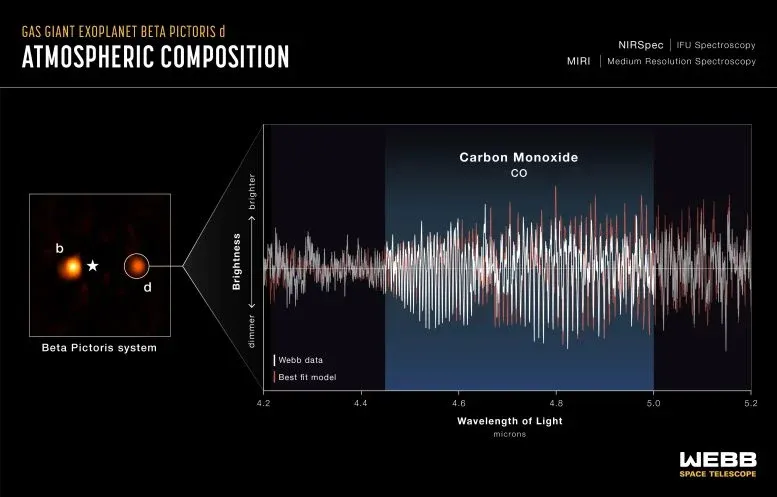
Instead of a smooth spectrum from dust, they saw repeated peaks and dips. This pattern came from carbon monoxide, which is common in giant planet atmospheres. By measuring its movement, they confirmed it was an object orbiting Beta Pictoris.
Jean-Baptiste Ruffio, a research scientist at UC San Diego, explained that they weren't looking for a new planet. He said they were trying to understand a known one when this signal appeared unexpectedly.
Later observations using Webb’s MIRI (Mid-Infrared Instrument) found methane and water vapor. These chemicals further confirmed it was a planet and gave more details about its atmosphere.
Because the planet was found using its chemical signature, astronomers could immediately start studying its atmosphere. Ruffio noted that a spectrum holds a lot of information, revealing a planet's temperature, chemistry, and motion.
A New Way to Find Planets
Beta Pictoris d was hard to find because it was hidden by one of the brightest debris disks ever seen. The dust scattered the star's light, making it difficult to tell a planet from other features in the disk. Webb’s method of looking for specific molecular signals in the atmosphere helped overcome this problem.
This planet might also explain some strange features of the disk, like its sharp inner edge. Astronomers had thought an unseen planet might be shaping the disk.
This discovery is important because it shows a new way to find exoplanets. This method works even when dust or other structures make traditional imaging difficult. Beta Pictoris d is the first directly imaged planet found mainly through this type of spectroscopy.
Researchers will keep studying Webb’s data to learn more about the planet's orbit, temperature, and atmospheric makeup. This will help create a more complete picture of this well-known young planetary system.
Deep Dive & References
Discovery of an Exterior Third Planet Orbiting β Pictoris - The Astrophysical Journal Letters, 2026