Ever wonder what a molecule does after it gulps down a bit of light? Turns out, it doesn't just sit there. It shimmies, it shakes, and it pulls off some incredibly fast shape-shifting. Now, for the first time, scientists have managed to get a real-time, atom-by-atom breakdown of this microscopic dance.
Think of it as a molecular surveillance camera, but instead of watching a whole room, it's zoomed in on individual partygoers, catching every subtle twitch and sway. This new method, developed at the European XFEL facility, tracks how molecules convert light energy into pure, unadulterated vibration.
Atoms Spill the Beans Differently
Here’s the kicker: not all atoms within the same molecule tell the same story. One atom might be gossiping about where the electrical charge is zipping off to, while another is busy showing off its new vibrational moves. Apparently, light can also make an atom extra nosy about its neighbors' movements. Which, if you think about it, is both impressive and slightly terrifying.
We're a new kind of news feed.
Regular news is designed to drain you. We're a non-profit built to restore you. Every story we publish is scored for impact, progress, and hope.
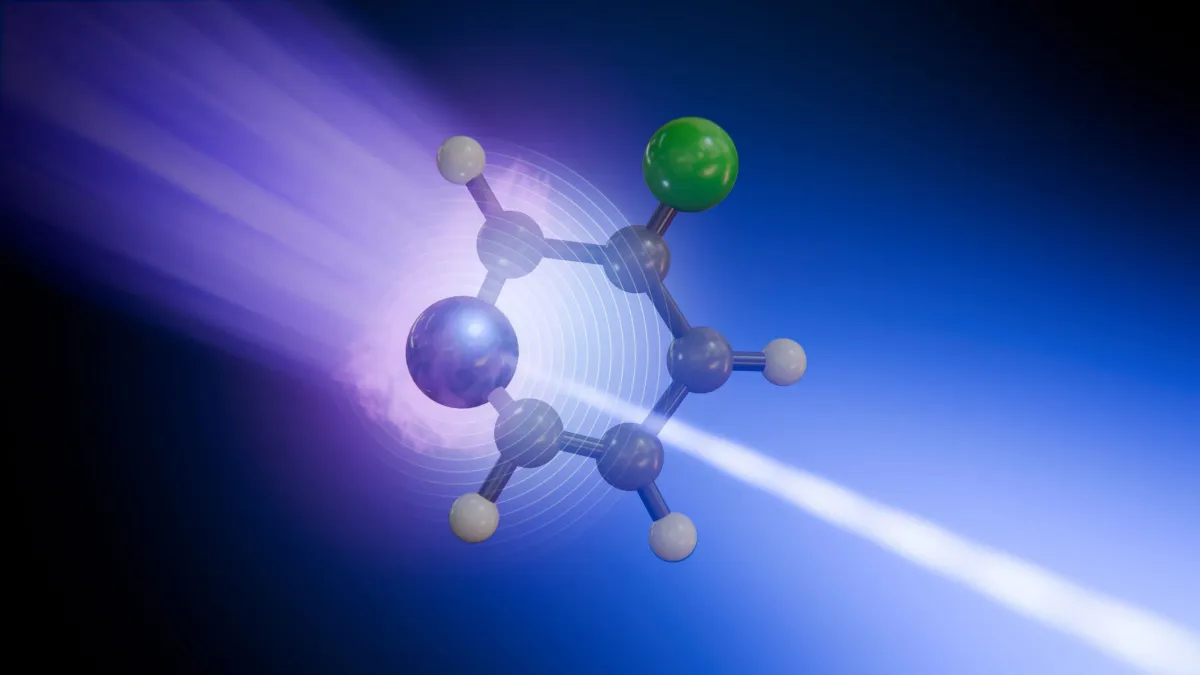
Start Your News DetoxThe molecule under the microscope was 3-fluoropyridine, a small, ring-shaped number chosen because its nitrogen and fluorine atoms were expected to be quite chatty. First, a zap of ultraviolet light put the molecule into an "excited state" — basically, it got a jolt of energy and started to bend out of its usual flat shape.
Then came the "conical intersection," a fleeting moment where two energy states meet, and electrons and nuclei move in a synchronized ballet. After this quick pivot, the molecule settled back down, but that absorbed energy didn't just vanish. Nope, it turned into atomic jiggling and wiggling. Because, physics.
The nitrogen and fluorine atoms, as predicted, had different tales. Fluorine was all about how the extra energy spread through molecular motion, while nitrogen, being closer to the initial action, showed a mix of electron redistribution and structural gymnastics. As co-author Antonio Picón put it, "Not all atoms tell the same story." Some show charge, others show vibration. It’s like a molecular Rashomon.
To catch all this, the team employed time-resolved X-ray photoelectron spectroscopy (tr-XPS). They hit the excited molecules with a soft X-ray pulse, which knocked electrons off either the nitrogen or fluorine. By doing this repeatedly at various delays, they stitched together a series of snapshots over mere picoseconds – that's trillionths of a second. Let that satisfyingly tiny number sink in.
This new technique is more than just a molecular peep show. It could revolutionize our understanding of everything from how DNA shields itself from sun damage to how solar energy is captured in materials. Because apparently, that's where we are now: watching individual atoms dance to the light fantastic.
Daniel Rivas, a co-author, noted this is exactly what the European XFEL was designed for: watching chemical changes at specific atomic sites on their natural timescale. Combining multi-site sensitivity with femtosecond resolution, he believes, opens a new window into the microscopic mechanisms of photochemistry. And who wouldn't want a new window into that?