For years, scientists thought they had a handle on how cells power themselves. Then a team at the University of Cologne went poking around in the mitochondria — those cellular power plants — and discovered a whole new layer of complexity. Turns out, the way proteins fold isn't just about making neat little protein packages; it's also directly linked to making heme, that crucial molecule that helps your blood carry oxygen and your cells keep the lights on.
Think of it like this: your cell's energy production is a finely tuned orchestra. And these researchers just found a conductor (an enzyme called ALR) who's not only making sure the violin section (other enzymes) is playing in tune, but also secretly helping the percussion section (heme production) hit its beats. Which, if you think about it, is both impressive and slightly terrifying if the conductor misses a cue.
The Unsung Hero: ALR
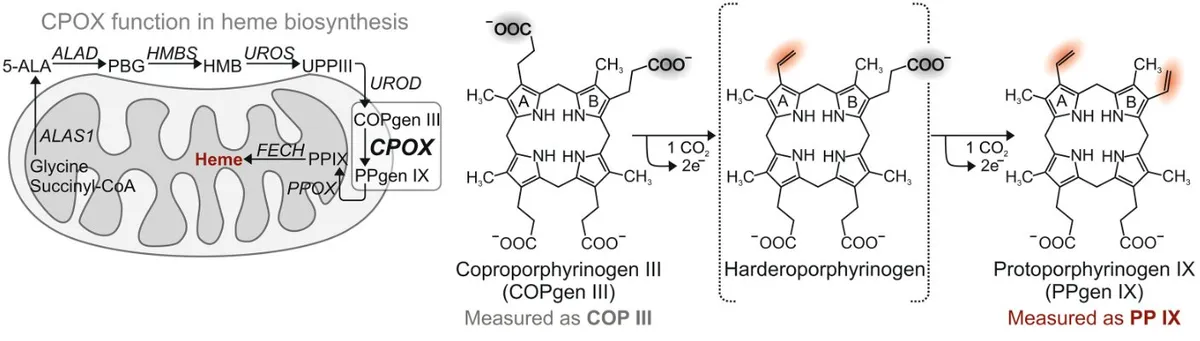
Led by Julia Racho and Dylan Stobbe, under Professor Dr. Jan Riemer, the team focused on ALR. This enzyme was already known for keeping another enzyme, MIA40, active. But now, it's got a new line on its resume: stabilizing CPOX, an enzyme absolutely critical for heme production.
We're a new kind of news feed.
Regular news is designed to drain you. We're a non-profit built to restore you. Every story we publish is scored for impact, progress, and hope.
Start Your News DetoxWithout ALR's steadying hand, CPOX goes wobbly, and the whole heme-making process gets thrown off. Even worse, if CPOX ends up outside the mitochondria, it starts churning out harmful byproducts that basically throw cellular wrenches into the works, causing damage and stress. So, ALR isn't just a helpful colleague; it's a vital gatekeeper.
Julia Racho, the lead author, put it plainly: the process of proteins folding correctly in mitochondria is far more important than we realized. It's not just about getting proteins into the right shape; it's about supporting a fundamental metabolic process that keeps everything running.
This discovery sheds light on why glitches in the ALR gene can cause rare inherited mitochondrial diseases, which often result in a cell's energy supply sputtering out. It’s a reminder that sometimes, the smallest connections hold the biggest secrets to how our bodies — and our energy levels — truly function. Expect future studies to explore if other enzymes are similarly stabilized, because apparently, the cell's internal wiring diagram just got a lot more interesting.