Controlling molecules with laser light is much harder than controlling individual atoms. Molecules have complex movements that make them tough to cool and trap.
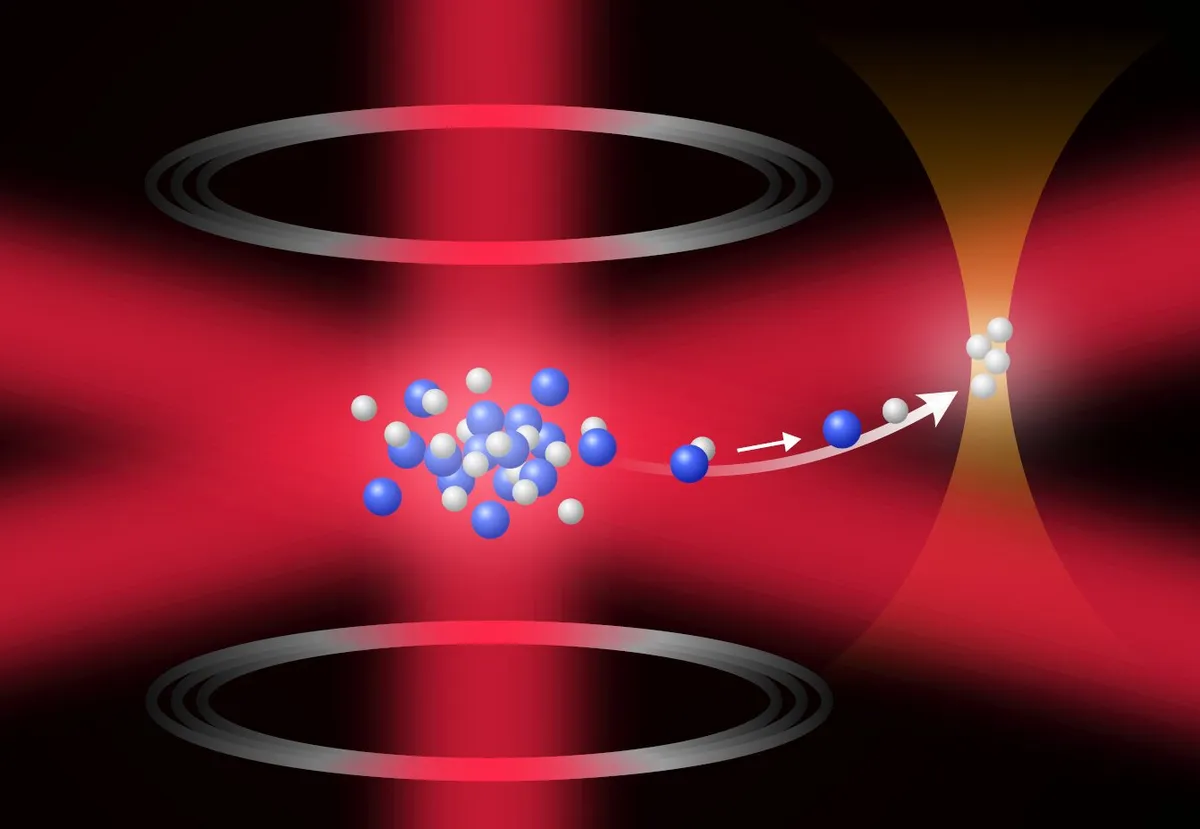
Researchers at Columbia University and Indiana University Bloomington have successfully cooled and trapped calcium monohydride (CaH). This molecule is made of one calcium atom and one hydrogen atom. They used a special setup called a three-dimensional (3D) magneto-optical trap (MOT). This device uses lasers and magnetic fields to cool and hold particles.
Jinyu Dai, the lead author, explained that their main goal was to create ultracold hydrogen atoms. These atoms could then be used in optical dipole traps for very precise measurements. Hydrogen is the simplest atom, making it perfect for testing fundamental physics. This work sets the stage for making ultracold hydrogen by breaking apart ultracold metal hydride molecules.
We're a new kind of news feed.
Regular news is designed to drain you. We're a non-profit built to restore you. Every story we publish is scored for impact, progress, and hope.
Start Your News Detox
Cooling and Capturing Calcium Monohydride
The team first created a beam of CaH molecules. They then cooled and slowed these molecules using a direct laser method. This technique has been used by physicists for about 10 years to study ultracold molecules.
Dai noted that they developed a new cryogenic buffer-gas beam source for CaH. They also changed the laser cooling method to prevent CaH from breaking apart too easily. Laser cooling is key in modern physics because it allows precise control over molecules. It helps slow down a fast CaH beam and trap the molecules at very cold temperatures.
Using these methods, the researchers trapped about 230 CaH molecules in a MOT. These molecules reached temperatures below 1 millikelvin (mK).

Advancing Ultracold Molecule Research
This study shows that MOT devices can effectively cool and trap metal hydride molecules. These experimental techniques could also be used for other complex molecules in the future.
Dai stated that their work proves metal hydrides can be laser-cooled and trapped, even with their challenges. This makes metal hydrides a new platform for studying ultracold quantum chemistry. One exciting possibility is using photodissociation to create ultracold atomic hydrogen. This could be an ideal system for high-precision tests of the Standard Model and measurements of fundamental constants.
This breakthrough could open new doors for fundamental physics research. It could lead to new ways to trap ultracold molecules and hydrogen atoms. It may also help develop new controllable molecular systems and precision measurement tools.
The team is working on further cooling and trapping the molecules to achieve higher densities. The next step will involve using dissociation spectroscopy to study ultracold chemistry and produce ultracold hydrogen.
Deep Dive & References
Magneto-Optical Trapping of a Metal Hydride Molecule - Physical Review Letters, 2026