Imagine a stubborn roommate situation, but instead of dirty dishes, it's a persistent infection and the roommates are a fungus and a bacterium. Scientists just figured out their secret — and it involves a surprisingly sophisticated system for managing a metal that's usually toxic: copper.
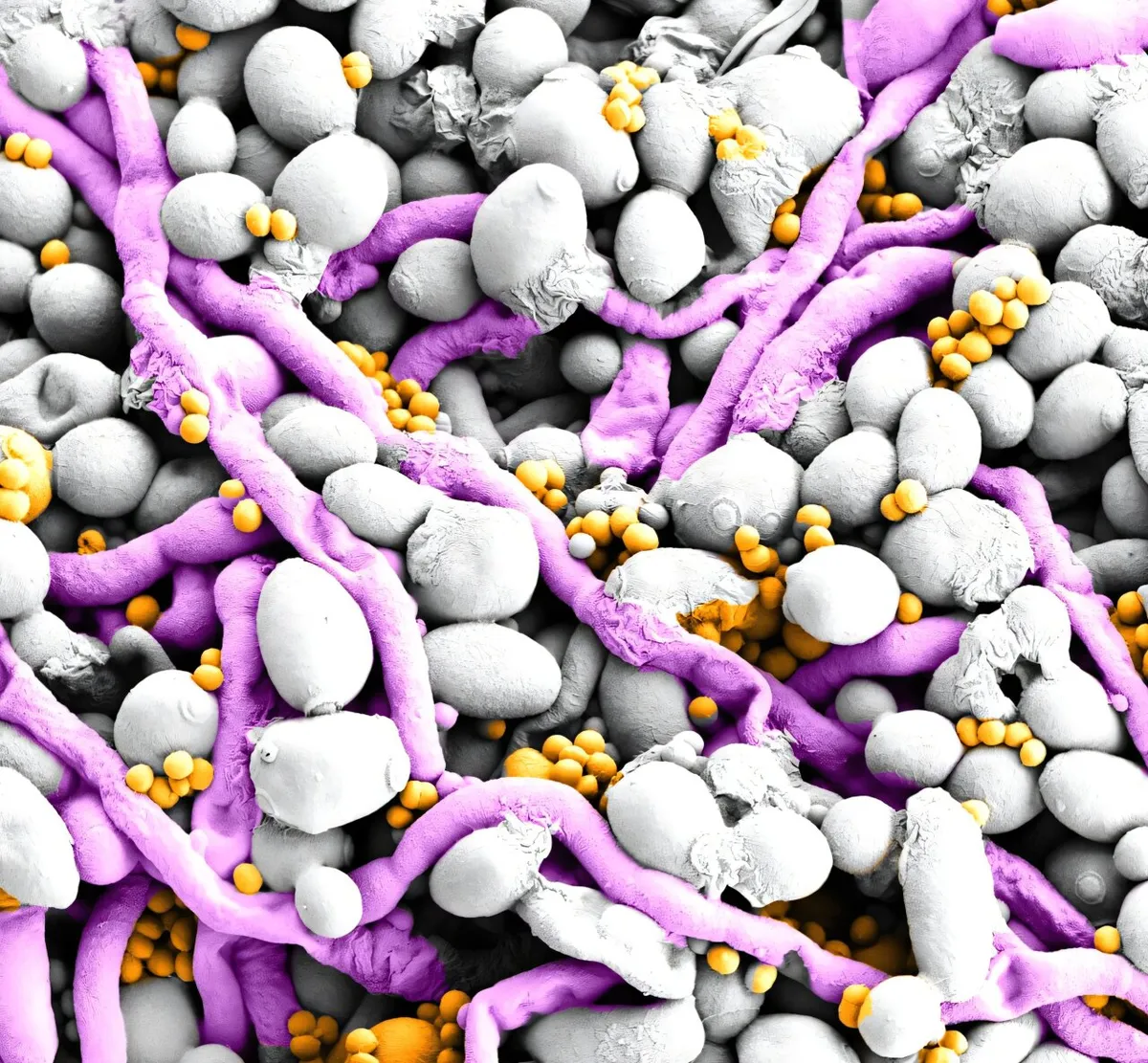
Two notorious human pathogens, the fungus Candida albicans (think yeast infections) and the bacterium Staphylococcus aureus (hello, staph infections), are often found cohabiting in nasty places like wounds, bloodstreams, and medical devices. Alone, they're problematic. Together? They build fortresses called biofilms.
Biofilms are essentially microbial cities glued to surfaces, making them incredibly difficult to dislodge or treat. And when it's a mixed biofilm, with both fungi and bacteria, they become practically impenetrable, each organism protecting the other in a microscopic, biological standoff.
We're a new kind of news feed.
Regular news is designed to drain you. We're a non-profit built to restore you. Every story we publish is scored for impact, progress, and hope.
Start Your News DetoxThe Copper Connection
Dr. Seána Duggan and her crew at the University of Exeter's MRC Center for Medical Mycology stumbled upon the literal lynchpin: copper. They're calling it a microbial "copper economy," which sounds like a very tiny, very specific stock market crash waiting to happen.
Turns out, while high levels of copper are usually poison to microbes, in these specific mixed biofilms, it acts like a shared currency, keeping the whole partnership stable. Mess with the copper balance, and the whole thing collapses. Which, if you're trying to clear an infection, is exactly what you want.
The team observed these two microrganisms in the lab, mimicking human body conditions. What they saw was fascinating: C. albicans ramped up proteins to absorb copper, while S. aureus boosted proteins to export copper and protect itself from copper stress. It’s like one’s the collector and the other’s the security guard, making sure everyone gets just enough, but not too much, of the shiny stuff.
Pulling the Plug on the Partnership
When scientists tweaked the copper levels, either adding too much or taking too much away, the cooperation broke down. The mixed biofilm weakened significantly. That's the mic drop moment: this community relies on a perfectly balanced copper environment.
Even better, the mixed biofilm was far more sensitive to copper disruption than either organism on its own. It's not just hurting individual microbes; it's dismantling their entire shared infrastructure. The early tests even suggest that strategically using copper could be the key to breaking down these stubborn communities.
Dr. Duggan points out that mixed infections are a huge clinical headache, and we know surprisingly little about their molecular inner workings. This research suggests that something as seemingly minor as a trace nutrient like copper could be the secret ingredient determining whether pathogens compete, cooperate, or just become impossible to treat. Find out what makes them fail, and you've got a shot at breaking them apart. Which is a much more satisfying outcome than just throwing more antibiotics at the problem and hoping for the best.