Imagine having a material that, with a little coaxing, could decide if it wanted to be an electrical highway or a total roadblock. And while it's at it, also decide if it wants to be magnetic or not. Well, scientists just figured out how to do exactly that, using a process called "exsolution" to fundamentally alter how oxide thin films behave.
Turns out, this isn't just a neat trick for the lab. This discovery could pave the way for a whole new generation of electronics and spintronics (which is like electronics, but with an extra magnetic twist).
The team, led by Professor Hyeon Han and Professor Donghwa Lee from POSTECH, in collaboration with Professor Sang Ho Oh's group at KENTECH, published their rather electrifying findings in the journal Advanced Materials.
We're a new kind of news feed.
Regular news is designed to drain you. We're a non-profit built to restore you. Every story we publish is scored for impact, progress, and hope.
Start Your News DetoxNow, "exsolution" sounds fancy, but here's the gist: you have metal ions chilling inside an oxide crystal. Under specific conditions, these ions decide they've had enough of the interior and migrate to the surface, forming tiny, stable metal nanoparticles. Think of it as a material version of an introvert suddenly becoming a social butterfly, but in a very controlled, scientific way.
This process has been a hero in energy tech, particularly for fuel cells. But how it fundamentally messed with a material's electrical and magnetic properties? That was still largely a mystery.
The Great Flip-Flop
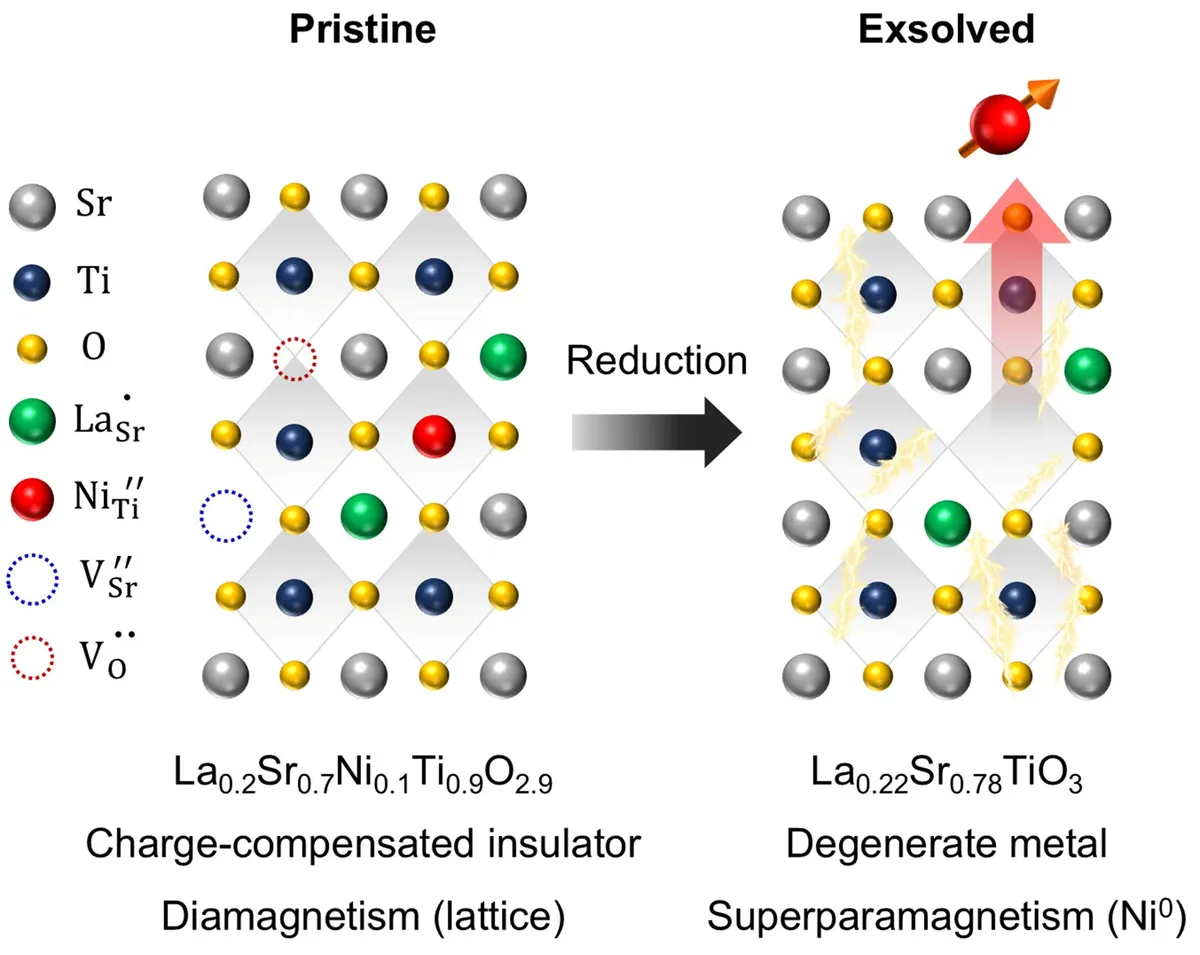
The researchers zoomed in on a material called La0.2Sr0.7Ni0.1Ti0.9O₃-δ. Catchy, right? They found this material was a bit of a hot mess inside, riddled with defects like missing atoms and swapped elements. At first, these defects were in a delicate balance, making the material an insulator — meaning, no electricity flowed through it. A total electrical wallflower.
Then came the exsolution. As nickel nanoparticles started popping up inside and on the surface, they dramatically reshaped the defect landscape of the oxide. Suddenly, the material's electronic structure changed, transforming it into a highly conductive metal. We're talking its electrical resistance dropping by more than a thousand times. From electrical wallflower to rockstar conductor, just like that.
But the party didn't stop there.
Magnetic Personality Shift
The original film was barely magnetic — you'd have more luck magnetizing a piece of toast. But after exsolution, with those nickel nanoparticles doing their thing, the film became superparamagnetic at room temperature. This means it gained a magnetic personality, all thanks to the new nanoparticles interacting with each other.
So, what we have here is a single process that allows scientists to control both the electrical behavior of the oxide and the magnetic response of the metal nanoparticles simultaneously. It's like having a single switch that controls two completely different, yet equally crucial, functions.
Professor Han summed it up, explaining that combining defect engineering with nanoparticle formation could unlock entirely new design principles for the next generation of electronic and spintronic devices. Because apparently, just being an insulator or a conductor is no longer good enough.