Imagine turning regular sunlight into something more potent — like a mild-mannered Bruce Banner suddenly deciding to go green. That's essentially what scientists at Kyushu University have done, creating a new material that converts ordinary visible light into high-energy ultraviolet (UV) light. And yes, it works with natural, outdoor sunshine.
This isn't just a lab trick. It's a breakthrough that could supercharge everything from purifying your air to powering next-gen 3D printers, all using the sun's energy. The material achieved a 1.9% conversion efficiency, which might sound like a small number until you realize most solid-state materials can't even dream of doing this with natural light.
The Light-Flipping Magic Trick
So, how does sunlight get its glow-up? It’s called photo upconversion. Think of it like two low-energy light particles (photons) meeting up, pooling their energy, and then poof — becoming one higher-energy photon. Getting this to happen with the sun's diffuse light has been the scientific equivalent of herding cats.
We're a new kind of news feed.
Regular news is designed to drain you. We're a non-profit built to restore you. Every story we publish is scored for impact, progress, and hope.
Start Your News DetoxUV light, while only about 6% of the sunlight hitting Earth, is crucial. It’s what helps harden dental fillings, print intricate 3D objects, and zap airborne nasties. So, making more of it from the abundant visible spectrum is a pretty big deal.
Associate Professor Yoichi Sasaki explains their method literally "adds together" the energy from two visible light photons to create a single UV photon. This happens via something called triplet-triplet annihilation (TTA). And no, it's not as violent as it sounds.
Here’s the CliffsNotes version:
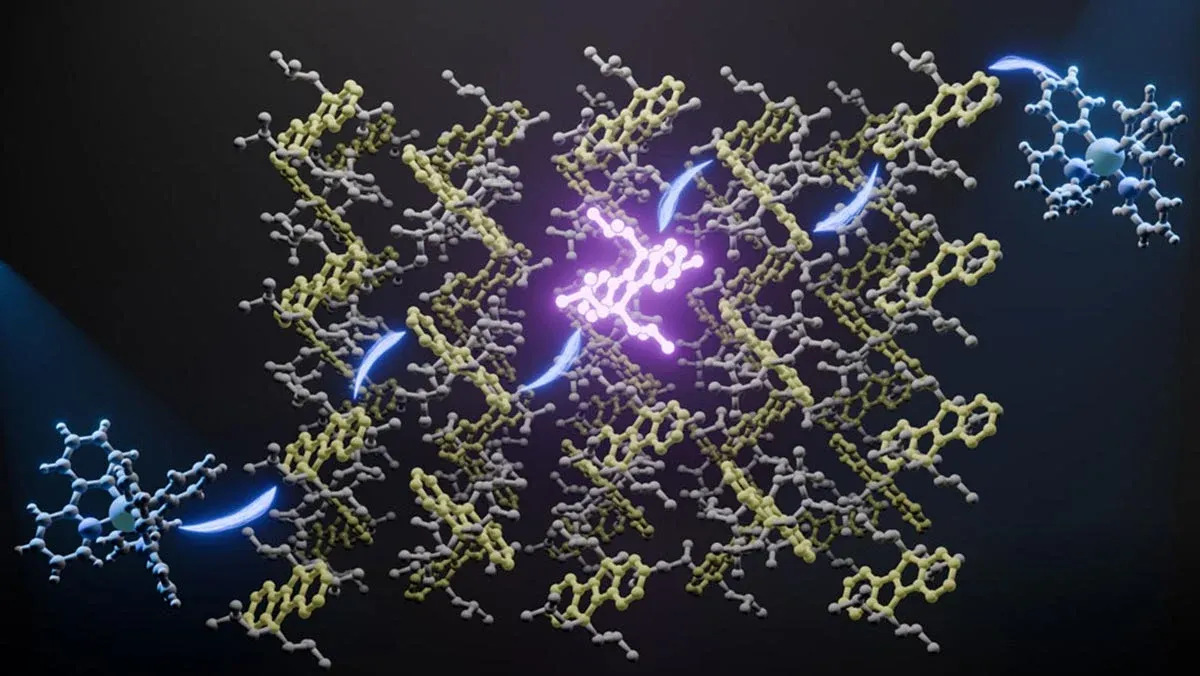
- A "donor" molecule soaks up visible light, getting its electrons all jazzed up into a "triplet state."
- This energy then jumps to a nearby "acceptor" molecule.
- When two of these energized "triplet states" bump into each other, they combine their power and — zap! — release it as one powerful UV photon.
This process has worked in liquids for a while, but liquids come with their own drama: toxic solvents, evaporation, general impracticality. Researchers have been chasing a solid-state solution for years, because who wants their solar panel to evaporate?
The Goldilocks Solution for Molecules
The challenge with solids? Molecules are packed in tight, and their electron clouds can get too cozy, causing energy to leak away before it can upconvert. You need molecules close enough to swap energy, but not so close they cancel each other out. It's a surprisingly delicate molecular dance.
The Kyushu team found their perfect partner in an organic semiconductor called dihydroindenoindenedene (DHI). The clever bit? They attached alkyl chains (think tiny, flexible arms) to its carbon atoms. These chains created just the right amount of space between molecules, like perfectly placed velvet ropes at an exclusive club. This spacing allowed energy to transfer efficiently without the molecular brawls that cause energy loss.
The result is a material that glows brightly, holds its excited state for a long time, and transfers energy with over 60% efficiency. When paired with a donor molecule, it hit that 1.9% photo upconversion efficiency. Sasaki notes that this means for every 100 visible photons absorbed, about two UV photons pop out. Which, for natural sunlight, is actually quite impressive.
This material isn't just effective; it's also relatively simple to make and uses cheap ingredients. The team has already filed a patent, eyeing applications from solar-powered chemical reactions to low-intensity 3D printing and, yes, even cleaning the air in your living room.
This decade-and-a-half-long quest began in 2012 with Professor Emeritus Nobuo Kimizuka, who envisioned molecular systems that could self-assemble into useful functions. While his team made headway with liquids and gels, the solid-state dream remained elusive. Fast forward to May 2024, and a new generation of graduate students joined Sasaki to finally bring this vision to life. Kimizuka calls it the "culmination of over 14 years of our research." And sometimes, that's exactly how breakthroughs happen: a long, persistent dream, and then suddenly, the light flips on.