Imagine trying to speed up a tiny boat by shining a spotlight on it, only for the boat to slow down. That's essentially what a team of scientists just observed, proving that light can create a bizarre kind of friction at the quantum level.
For years, physicists have theorized about a phenomenon called "quantum friction" – a drag force that doesn't come from surfaces rubbing together, but from the weird, invisible quantum "noise" that permeates everything. It’s been notoriously difficult to prove outside of theory. Until now.
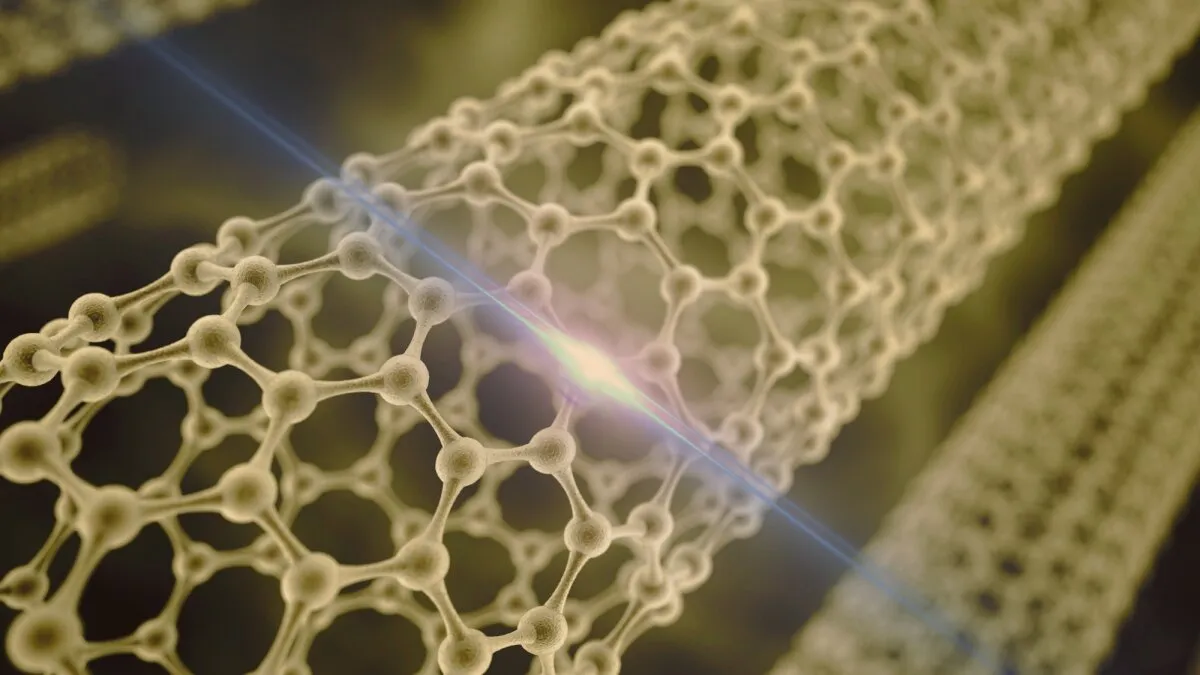
Researchers at Ruhr University were shining light on tiny carbon nanotubes moving in water, expecting… well, not this. They noticed the tubes started moving slower. And the more light they shone, the slower the tubes went. Because apparently that’s where we are now: light, the ultimate energizer, can also be a cosmic brake pedal.
We're a new kind of news feed.
Regular news is designed to drain you. We're a non-profit built to restore you. Every story we publish is scored for impact, progress, and hope.
Start Your News DetoxThe Unexpected Slowdown
Sebastian Kruss, one of the co-authors, admitted it was a surprise. "Normally, adding energy makes things move faster, not slower," he dryly noted. Which, if you think about it, is a pretty reasonable expectation for… most things.
But these aren't just any tubes. Carbon nanotubes, when they absorb light, briefly enter an "excited state," creating what are called excitons. Think of them as tiny, energized packets of light moving along the tube. These excitons carry a changing electrical charge, which then interacts with the electrically charged water molecules nearby.
This subtle, quantum tango between the excitons and water molecules creates an additional drag, effectively increasing the friction at the nanotube's surface. So, the light isn't just energizing; it's also subtly grabbing the water around it, pulling it back.
To confirm their wild theory, the team ran simulations and then introduced flaws into the nanotubes. These flaws acted like tiny traps, stopping the excitons from moving. And just like that, the light-induced friction vanished. No moving excitons, no friction. It's like turning a switch on and off.
Why This Matters Beyond the Lab Bench
This isn't just a party trick for tiny tubes. The way water behaves around carbon has been a long-standing mystery. Water flows weirdly through carbon nanotubes and over graphene, and quantum effects have always been a suspect. This study provides some serious experimental muscle to that idea.
It means we might be able to control fluid dynamics at a microscopic scale using nothing but light. Imagine a future where you could literally shine a light on a micro-robot to slow it down, or speed it up, by subtly altering its quantum interaction with its environment. The implications for tiny devices and novel materials are, well, pretty bright.
For now, the team is still figuring out how different colors of light might change the effect and if other materials show similar bizarre behavior. But one thing is clear: light isn't just for seeing anymore. It's also for putting on the brakes in the quantum fast lane.