Investors and governments are putting billions into nuclear fusion research. The goal is to create a nearly endless source of clean energy.
Fusion is the process that powers stars, like our sun. Scientists have recently shown it's possible to create this reaction on Earth.
However, there are big challenges to containing a miniature burning star on our planet. A key step is to simulate these reactions first.
We're a new kind of news feed.
Regular news is designed to drain you. We're a non-profit built to restore you. Every story we publish is scored for impact, progress, and hope.
Start Your News DetoxVirginia Tech mathematician Ionut Farcas and other researchers use advanced computer models. These models help them fix problems with fusion reactors before they are built.
Farcas said that control systems in a real fusion power plant must be perfect. There is no room for mistakes.
Handling Extreme Heat
A major challenge is finding materials that can withstand the incredibly high temperatures needed for fusion.
The sun's core is made of super-hot, electrically charged gas called plasma. It reaches about 27 million degrees Fahrenheit (15 million degrees Celsius). The sun's huge gravity also creates immense pressure.
Earth's fusion reactors cannot use gravity like the sun. So, they must operate at even higher temperatures, over 180 million degrees Fahrenheit (100 million degrees Celsius).
Farcas explained that no known material on Earth can hold plasma at these temperatures.
Instead, researchers use magnetic fields to suspend the charged plasma. This is similar to how Magneto from X-Men is contained.
Keeping Plasma Stable
Even at extreme temperatures, turbulence in the plasma can cause it to lose heat. This prevents the plasma from staying hot enough for nuclear fusion.
Farcas noted that we need materials and control methods that can handle high temperatures and heavy use.
Speeding Up Complex Models
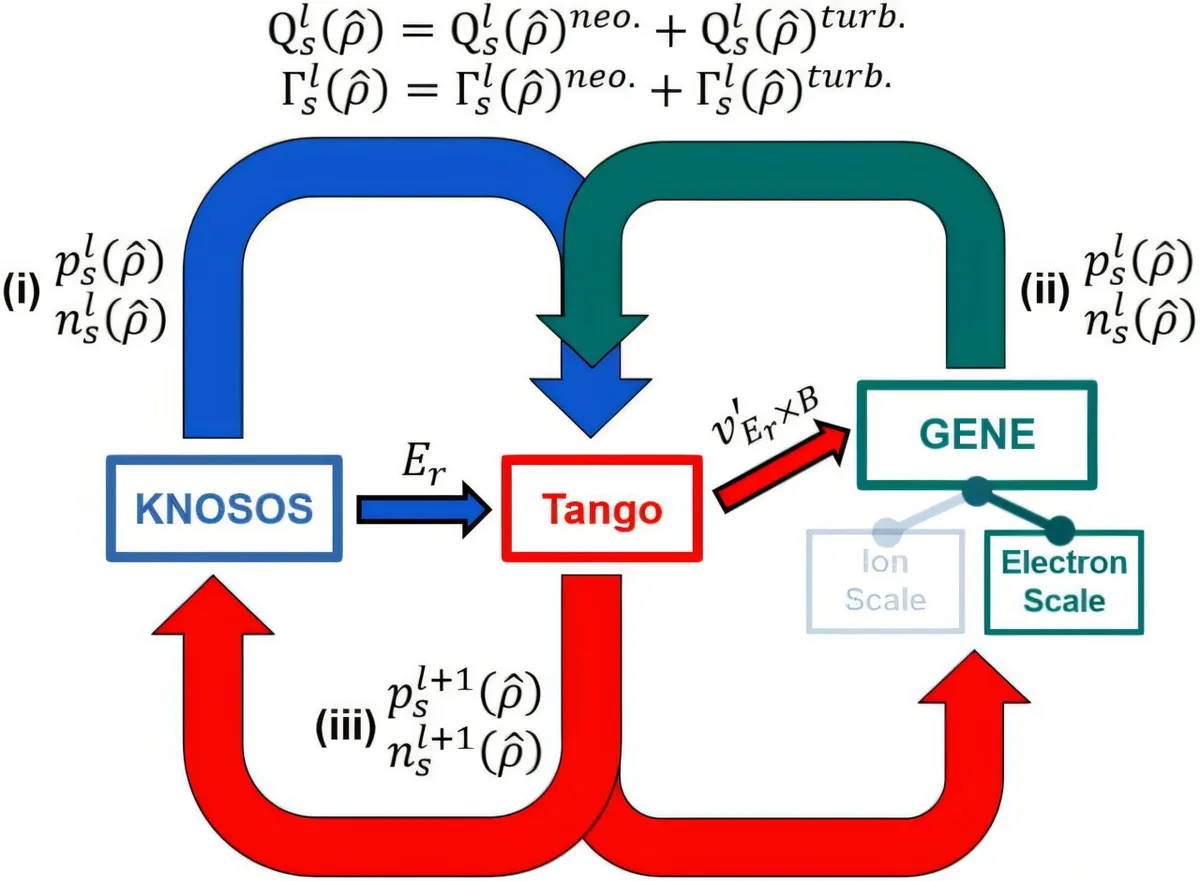
Computer models are vital for understanding plasma physics. They help scientists design, build, control, and run nuclear fusion devices.
But physics in these extreme conditions can change very quickly. Modeling just one plasma control problem can take a supercomputer days or weeks. This is too slow for real-time control.
Farcas developed a "reduced model" to speed up these calculations.
This technique focuses on the main parts of a problem. It sacrifices some detail to turn days of computing into seconds or less. This allows for real-time predictions, design, control, and decisions.
He showed how reduced modeling can help with real-time plasma control in Physics of Plasmas. He also published studies in Journal of Computational Physics and The Bridge magazine.
Reduced models can be used in many fields. Farcas and others explored using them for next-generation rocket engines in Nature Chemical Engineering.
Farcas said that a realistic rocket simulation usually takes about three days for just a millisecond of physical time. Their reduced model gave the answer in one second.
Nuclear fusion is an interdisciplinary field. It involves physics, engineering, and math. Farcas believes the solution will come from efforts across all these fields.
Deep Dive & References
- Machine learning for electron-scale turbulence modeling in W7-X - Physics of Plasmas, 2026
- Fast prediction of plasma instabilities with sparse-grid-accelerated optimized dynamic mode decomposition - Journal of Computational Physics, 2026
- Simulating complex physics at lightning speed - Nature Chemical Engineering, 2026