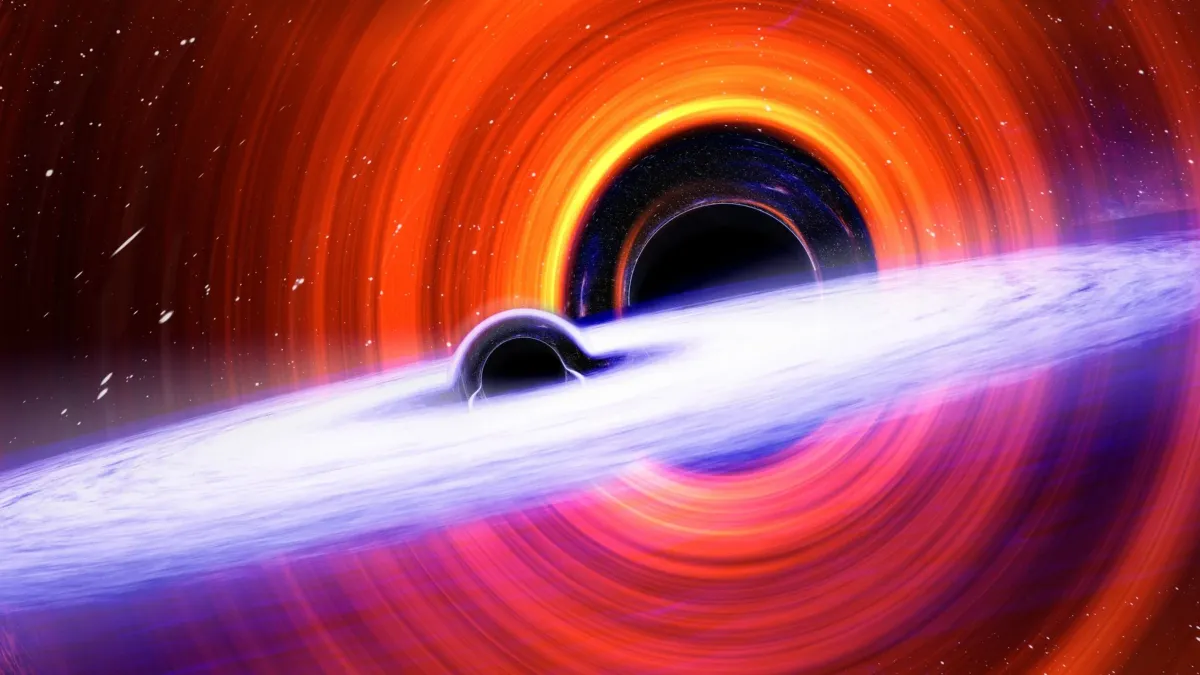
Scientists think they might have found the first real proof of primordial black holes. These are theoretical objects that formed right after the Big Bang. This discovery could also help solve the mystery of dark matter.
Uncovering Primordial Black Holes
Researchers at the University of Miami are getting closer to confirming these elusive objects. If proven, it would confirm their existence and their link to dark matter. Dark matter makes up about 85% of the universe's matter. It provides the gravity that holds galaxies together.
Nico Cappelluti, a physics professor, and Ph.D. student Alberto Magaraggia led the research. They believe their study will help confirm that primordial black holes exist.
We're a new kind of news feed.
Regular news is designed to drain you. We're a non-profit built to restore you. Every story we publish is scored for impact, progress, and hope.
Start Your News DetoxTheir work started after the Laser Interferometer Gravitational-Wave Observatory (LIGO) detected an unusual signal. Gravitational waves are ripples in spacetime from powerful events like black hole collisions.
LIGO's Strange Signal
Most black holes form when massive stars die in a supernova. These black holes usually have masses a few times that of our Sun, or even billions of times larger.
However, last November, LIGO detected a merger where at least one object weighed less than one solar mass. This suggests it could be a primordial black hole. Scientists are still debating if this signal is a real discovery or just noise.
Cappelluti and Magaraggia argue that a primordial black hole best explains this observation. These would have formed in the very dense early universe, before stars existed. Their findings support this idea.
Magaraggia said they estimated how many primordial black holes might exist and how many LIGO should detect. Their results show that subsolar black holes, like the one LIGO may have seen, should be rare. This matches how few such events have been observed so far.
Primordial Black Holes and Dark Matter
The study, published in The Astrophysical Journal, suggests the LIGO signal is most likely a primordial black hole. This is because there's no other common explanation for it. Cappelluti noted that their research indicates these black holes could make up a large part, or even all, of dark matter.
More analysis is needed to confirm the signal and its link to dark matter. Confirmation depends on LIGO and its partners detecting similar events in the future. Cappelluti explained that one strong signal is good, but several more are needed for solid proof.

From Theory to Observation
The idea of primordial black holes began with Soviet scientists Yakov Zeldovich and Igor Novikov. Stephen Hawking expanded on this in the 1970s, suggesting they could be numerous and explain dark matter.
LIGO provided the first direct evidence that could support these theories. In 2015, it detected gravitational waves for the first time. This confirmed a key part of Albert Einstein’s theory of general relativity.
LIGO has two facilities in Washington and Louisiana. It works with the Virgo detector in Italy and the KAGRA observatory in Japan. This network, called the LVK collaboration, searches for black holes.
Future Observatories
LIGO will get upgrades to improve its sensitivity and detect more unusual signals. However, it wasn't designed to see gravitational waves directly from the Big Bang. Its detectors are best for high-frequency waves from recent cosmic events.
Future instruments will explore much earlier cosmic history. The European Space Agency’s Laser Interferometer Space Antenna (LISA), launching in 2035, will detect gravitational waves from the earliest times after the Big Bang.
Another project, Cosmic Explorer, is being designed in the U.S. It's expected to be 10 times more sensitive than LIGO. This will allow it to detect black hole and neutron star mergers from when the first stars formed.
Deep Dive & References
Implications for Primordial Black Hole Dark Matter from a Single Subsolar Mass Gravitational-wave Detection in LVK O1–O4 - The Astrophysical Journal, 2026