Solar flares are powerful bursts of energy from the sun. They cause intense particle acceleration and heat up plasma quickly. Scientists have long wondered exactly how and where these particles speed up, and how energized electrons move through the sun's magnetic fields.
Radio observations are great for studying electrons and hot plasma in the sun's lower atmosphere. However, older instruments struggled to get clear, detailed radio images across a wide range of frequencies. It was hard to see both faint, spread-out emissions and bright, fast-changing bursts at the same time.
MeerKAT's New View of Solar Flares
A new study in The Astrophysical Journal Letters used MeerKAT, a powerful radio telescope in South Africa. MeerKAT is a testbed for the even larger Square Kilometer Array (SKA). For the first time, it provided detailed, high-quality imaging of a solar flare.
We're a new kind of news feed.
Regular news is designed to drain you. We're a non-profit built to restore you. Every story we publish is scored for impact, progress, and hope.
Start Your News DetoxThe study looked at a specific type of flare, called a GOES M1.3-class flare, in the 0.8–1.7 GHz range. MeerKAT's excellent sensitivity helped scientists get a much clearer picture.
The observations achieved a dynamic range over 1,000 across many frequencies. This allowed scientists to image both strong, focused bursts and faint, spread-out emissions from the same area. This solves a long-standing problem in solar flare research.
Three Electron Acceleration Sites
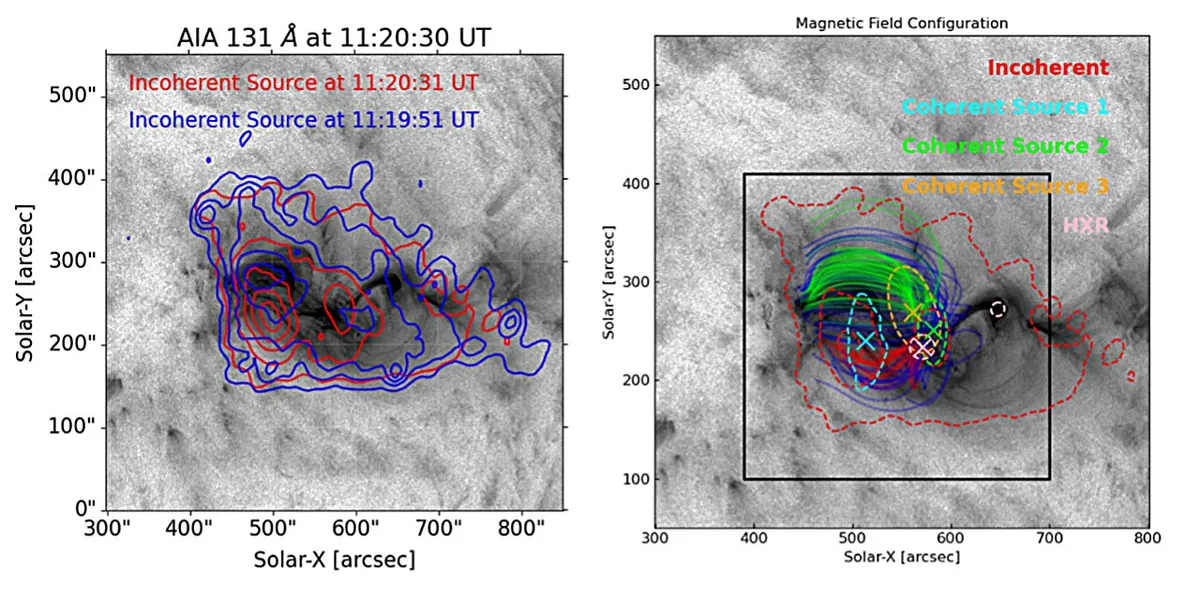
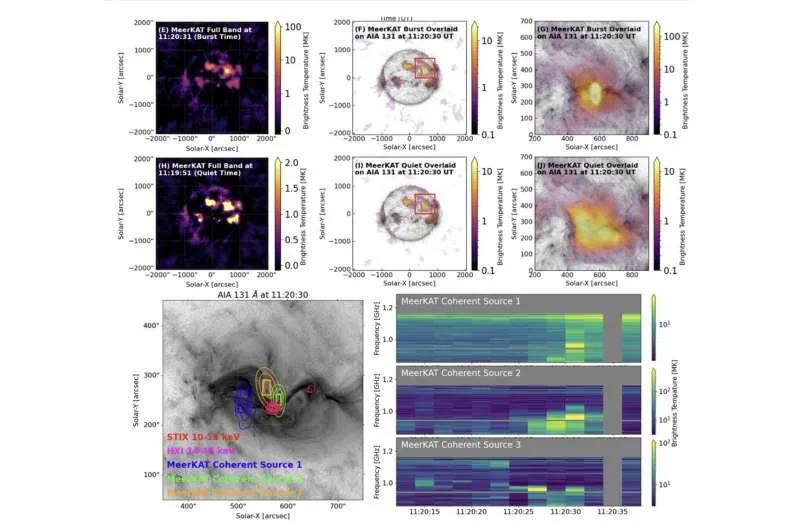
The MeerKAT observations showed three distinct radio sources in different parts of the flare. Each source was linked to different groups of accelerated electrons. This suggests that electrons are energized in multiple magnetic structures, not just one main spot. This fits with the idea that the magnetic reconnection process in flares might be fragmented or happen in bursts.
By using spectroscopic imaging, researchers could create detailed "vector dynamic spectra" for each source. This let them analyze each source's behavior over time and across different frequencies. The sources showed very different spectral patterns, meaning the electrons in each area were behaving differently.
Combining these radio observations with magnetic field models helped link the sources to specific magnetic structures in the sun's corona. This allowed scientists to understand how accelerated electrons move within these magnetic fields.
Uncovering Hidden Plasma
Beyond the bright bursts, MeerKAT also found faint, spread-out radio emissions. These emissions extended beyond what could be seen in ultraviolet light. This suggests there is hot, low-density plasma that standard ultraviolet instruments cannot detect.
This finding is important for understanding how energy is distributed in flares. It means that the thermal energy stored in this thin plasma might be underestimated in studies that only use ultraviolet data. This could change our understanding of how much energy flares actually release.
The study also combined radio observations with hard X-ray imaging, which tracks high-energy electrons. Magnetic field models provided a 3D view of the corona. This multi-instrument approach confirmed that the different radio sources came from distinct acceleration or trapping regions, not just imaging tricks.
MeerKAT offers a major step forward in studying separate emission sources and their energetic electrons. When combined with ultraviolet and hard X-ray observations, it greatly improves our ability to diagnose solar flares.
Deep Dive & References
First Detailed MeerKAT Imaging Spectroscopy of a Solar Flare - The Astrophysical Journal Letters, 2026