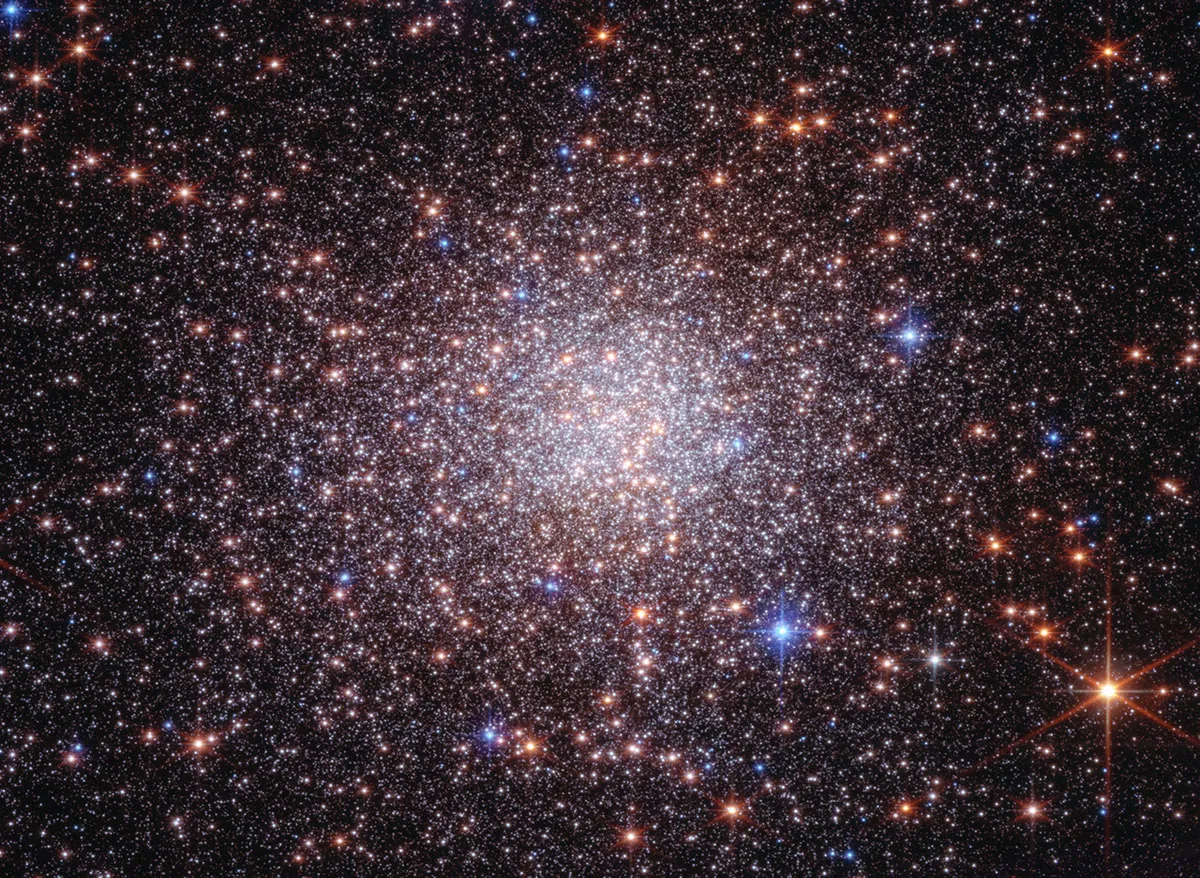
You know how sometimes you find an old photo of your parents, and suddenly their entire backstory makes a lot more sense? NASA's James Webb and Hubble Space Telescopes just did something similar for the Milky Way, but with a star cluster instead of a photo album.
Turns out, Terzan 5 — a celestial object lurking in our galaxy's central bulge — isn't your garden-variety globular star cluster. Those are typically one-and-done, ancient groups of stars. Terzan 5? It's a whole multi-generational saga, a cosmic time capsule with four distinct star populations.
A Galactic Family Tree
When astronomer Azop Terzan first spotted it in 1968, it looked like any other cluster. Then, in 2009, scientists noticed two star groups. By 2016, Hubble observations pinned their ages: one formed around 12 billion years ago, right when the Milky Way was getting its act together. The other, a sprightly 5-billion-year-old, predates Earth's formation. Clearly, Terzan 5 was no ordinary rock collection.
We're a new kind of news feed.
Regular news is designed to drain you. We're a non-profit built to restore you. Every story we publish is scored for impact, progress, and hope.
Start Your News DetoxNow, Terzan 5 is notoriously shy, hiding in a dusty, crowded part of the galaxy. But Webb's infrared vision cut through the cosmic haze, allowing scientists to catalog fainter stars than ever before. Combined with Hubble's incredible 12-year tracking data (measuring tiny stellar movements to distinguish Terzan 5's stars from the rest of the galactic crowd), the picture got a lot clearer.
And by clearer, we mean two more star populations popped up: one from 3.8 billion years ago, and another from a mere 2.5 billion years ago. The older two were also precisely re-dated to 12.5 billion and 4.7 billion years. Suddenly, a simple interaction with a gas cloud didn't cut it. Four generations? That's a full-blown dynasty.

Co-author R. Michael Rich called it a "fossil record" of how heavy elements, forged in supernova explosions, progressively enriched the cluster. See, most smaller systems would have just blown all that precious star-making material away. But Terzan 5 was massive enough to hold onto its ingredients, allowing new stars to keep forming over billions of years. It was basically a cosmic hoarder, and it paid off.
The Milky Way's Missing Piece
What this all means is that Terzan 5 isn't a cluster at all. It's more like a surviving remnant of a much larger system that formed 12.5 billion years ago. Imagine a giant, early galactic building block that just... never fully merged with the Milky Way's central bulge. It just hung out, doing its own thing, forming stars for eons.
Francesco R. Ferraro, a professor at the University of Bologna, dubbed it a "bulge fossil fragment." He explained that this "peculiar clump of stars formed separately from the bulge and was not destroyed as the bulge itself formed." It's basically a living, breathing artifact from the Milky Way's unruly youth. So far, only one other object, Liller 1, shares this unique multi-generational pedigree.
This discovery is a pretty big deal for understanding how galactic bulges — those dense, central regions of galaxies — actually come together. Early galaxies were chaotic, with huge gas disks breaking into star-forming clumps. Many of these clumps merged to form the bulges we see today. Webb has already spotted these "clumpy" galaxies in the early universe, and now Terzan 5 offers direct evidence of how those ancient building blocks might have behaved. It's like finding a perfectly preserved piece of the original blueprint.
Now, Ferraro's team is looking at 40 to 50 other globular clusters in the bulge. Because if there are more Terzan 5s out there, our understanding of galactic evolution is about to get a serious upgrade. And who doesn't love a good origin story?