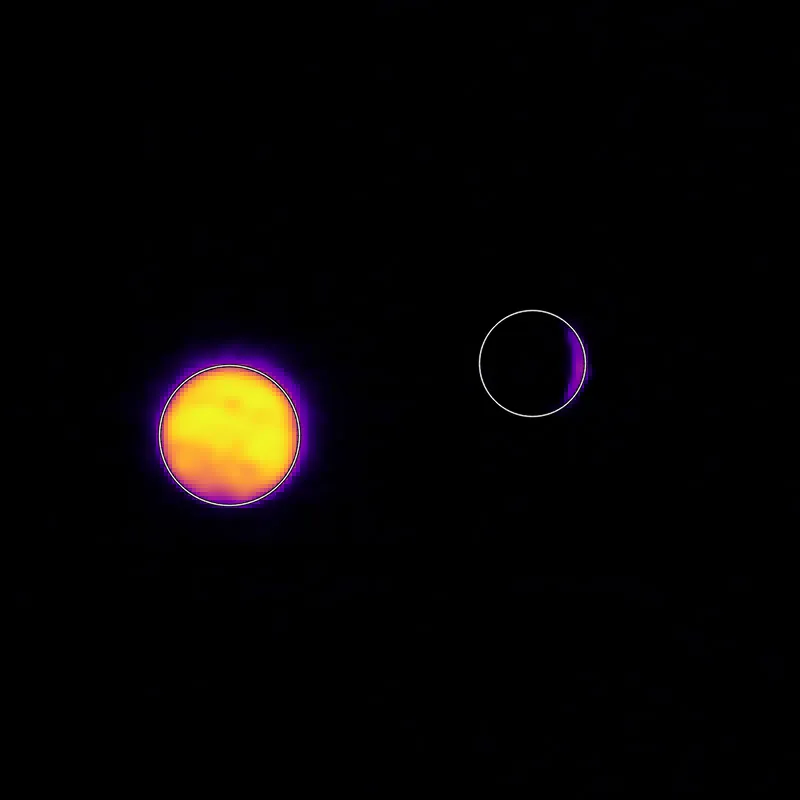
Turns out, even space probes get a little homesick. One of NASA's new ESCAPADE spacecraft recently turned its cameras back toward home, capturing a rather stunning family portrait of Earth and the Moon. And in true space fashion, it wasn't just any photo — it was a two-for-one deal, shot in both visible light and thermal infrared.
At the time of the snap, this plucky little probe was a cool 363,250 miles from Earth and 115,600 miles from the Moon. Which, if you're wondering why the Moon looks so prominent, is because it was practically in the spacecraft's lap.

Now, here's where it gets interesting. The visible light image shows both Earth and our lunar companion as delicate crescents, only about 8% lit by the Sun. But the thermal infrared image? That's where Earth's shadowed side comes alive, glowing with its own internal warmth. It's a subtle reminder that even in darkness, our planet is a cozy, living thing, with temperatures on its unlit side ranging from a chilly -10 to -44 degrees Fahrenheit. The Moon, meanwhile, without its oceans and atmosphere, just sits there at a brisk -280 degrees Fahrenheit. No wonder it looks so grumpy.
We're a new kind of news feed.
Regular news is designed to drain you. We're a non-profit built to restore you. Every story we publish is scored for impact, progress, and hope.
Start Your News DetoxA Quick Calibration Before Mars
The ESCAPADE mission, which stands for Escape and Plasma Acceleration and Dynamics Explorers (because NASA loves an acronym), used its Visible and Infrared Observation System cameras for this cosmic photoshoot. These aren't your average phone cameras; Northern Arizona University cooked them up for some serious science.
Rob Lillis, the mission's principal investigator at UC Berkeley, was understandably stoked. He explained that these cameras are destined to hunt for Martian aurora and dig into the thermal secrets of Mars's surface and atmosphere. Snapping Earth and the Moon was essentially a test run, a way to make sure the cameras were properly calibrated using two very familiar celestial bodies.
Built by Rocket Lab, the two ESCAPADE spacecraft are currently chilling out at Lagrange point 2, a million miles from Earth. Their ultimate destination? Mars. But they're taking the scenic route. In November 2026, they'll swing by Earth, using our planet's gravity for a slingshot maneuver that'll send them hurtling toward the Red Planet.
Once they arrive in September 2027, their main gig is to study the solar wind — that million-mile-per-hour stream of charged particles from the Sun — and figure out how it's slowly but surely stripping Mars of its atmosphere. Because apparently, even planets can't escape the sun's relentless aggression. So, while these probes are busy solving Martian mysteries, at least we know they took a moment to send a postcard home.