Ever wonder if ecosystems have a secret line in the sand, or rather, a line in the rain? Turns out, they do, especially when it comes to holding onto nitrogen. A new study, led by Professor Liu Lingli from the Chinese Academy of Sciences, pinpointed a magical number: 700 millimeters of annual rainfall. That's the point where things get weird.
Before you glaze over at the word "nitrogen," know this: it's basically the coffee of the plant world. Essential. And how much of it sticks around versus washes away is a pretty big deal for ecosystems.
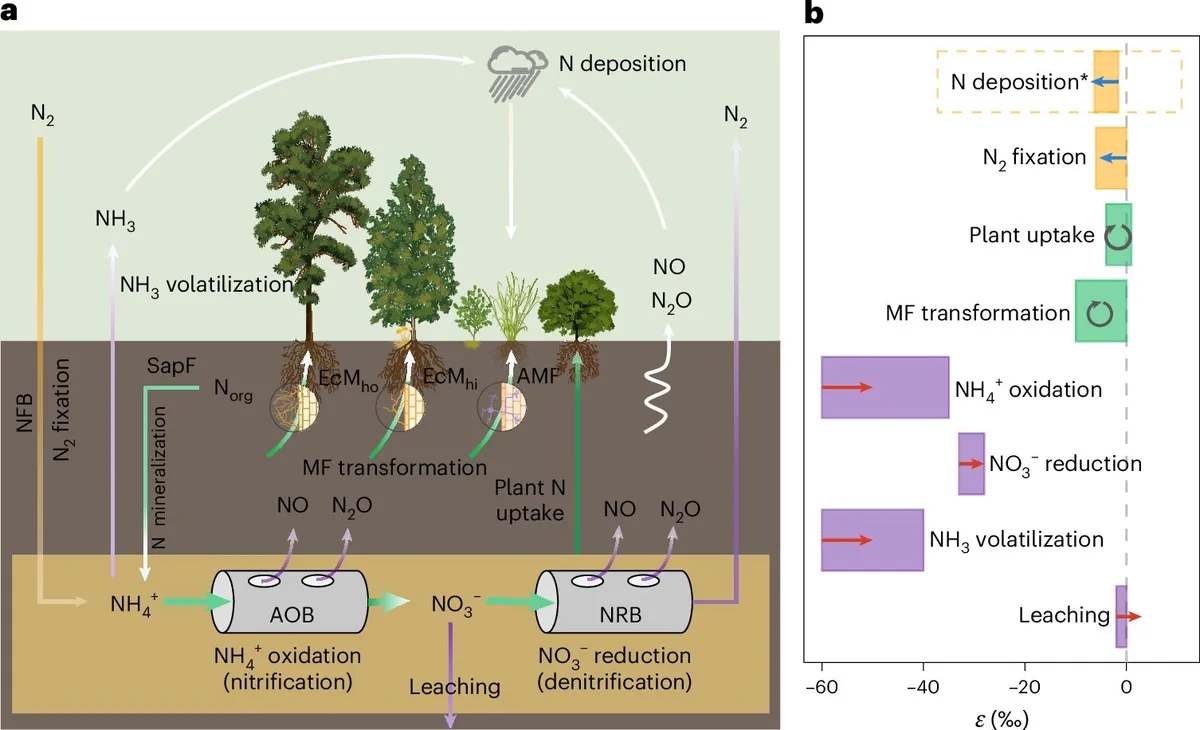
The research team used a clever trick: tracking nitrogen isotopes (δ15N) in soil. Think of it like a tiny, natural breadcrumb trail showing where the nitrogen's been. They gathered data from 31 sites across the good ol' U.S. of A.
We're a new kind of news feed.
Regular news is designed to drain you. We're a non-profit built to restore you. Every story we publish is scored for impact, progress, and hope.
Start Your News DetoxAnd what did they find? A crisp 700 mm rainfall boundary. Which, if you think about it, perfectly matches the established dry-humid divide in North America. A divide, by the way, that's currently doing a little climate-change-induced wiggle.
The Great Nitrogen Divide
Here’s where it gets interesting:
In dry areas (less than 700 mm of rain), more rain is actually good news for nitrogen. The soil hangs onto it better. It's like the plants are saying, "Finally, a drink! And we'll take that nitrogen, too, thanks."
But flip to humid areas (more than 700 mm of rain), and the story changes. More rain means more nitrogen loss. It's literally washing away, or microscopic critters are turning it into gas. It's like the soil is saying, "Alright, already! Too much of a good thing!"
So, what's behind this nitrogen drama? In dry spots, more rain means more plant diversity. These plants become tiny nitrogen hoarders, outcompeting soil microbes for the good stuff. In humid regions, though, the sheer volume of water just flushes the nitrogen out, or microbes get a bit too enthusiastic. Here, it's more about soil characteristics – how much carbon, nitrate, and clay it has.
This isn't just a fun fact for your next dinner party. Understanding this rainfall tipping point helps us predict how ecosystems will handle nitrogen as our climate gets increasingly… unpredictable. Because as extreme weather becomes the new normal, those climate boundaries are going to keep shifting. And apparently, so will the planet's coffee supply.
It’s a specific, satisfying number to wrap your head around, isn't it? 700 mm. Let that sink in.