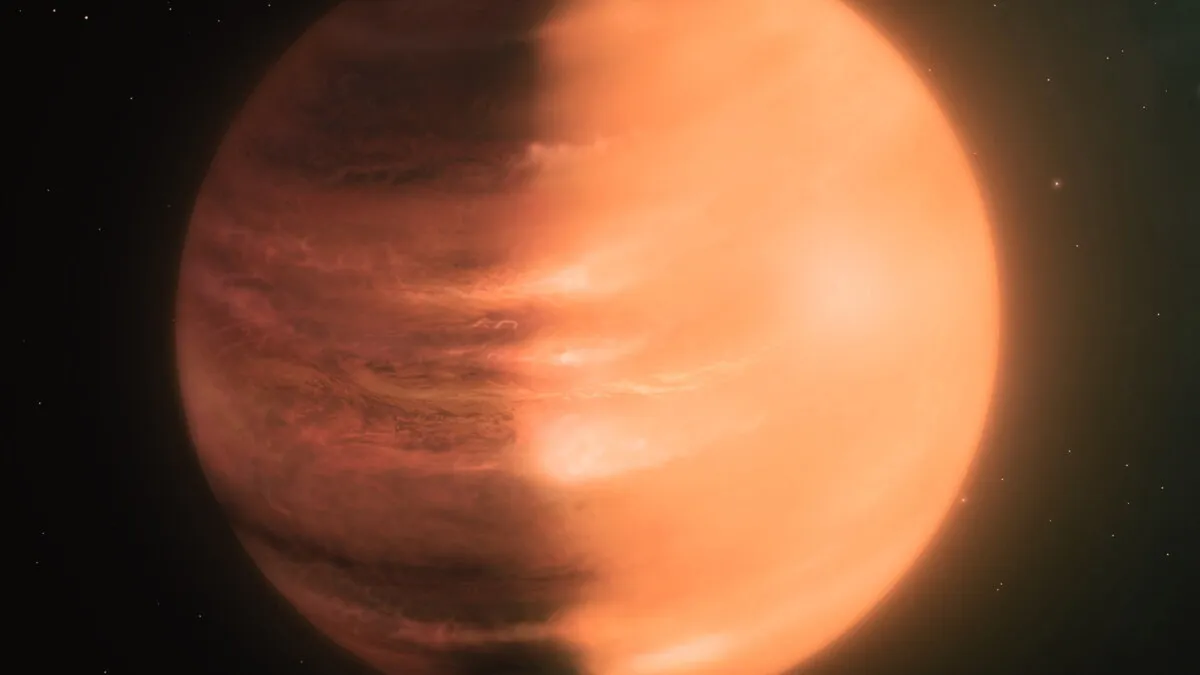
Imagine a planet the size of Jupiter. Now imagine that planet is so incredibly fluffy, it's less dense than a cloud of spun sugar. Scientists just found not one, but two of them. Apparently, the universe decided to get into the confectionery business.
These celestial oddities, dubbed TOI-791 b and TOI-791 c, are what astronomers call "super-puffs." And they're setting new records for cosmic airiness. An international team, led by researchers from the University of Oxford, discovered these incredibly low-density giants orbiting an F7-type dwarf star some 1,110 light-years away in the southern constellation of Volans. Because, of course, the most interesting things are always a casual thousand light-years out.
The Fluffiest Planets in the Universe
To put their density into perspective: cotton candy clocks in at about 0.05 grams per cubic centimeter. TOI-791 b is 0.038 g/cm³, and its sibling TOI-791 c is 0.047 g/cm³. Jupiter, for comparison, is a weighty 1.33 g/cm³. Earth? A whopping 5.5 g/cm³. These new planets are basically cosmic marshmallows, if marshmallows were the size of gas giants and made of… well, mostly nothing.
We're a new kind of news feed.
Regular news is designed to drain you. We're a non-profit built to restore you. Every story we publish is scored for impact, progress, and hope.
Start Your News DetoxThis discovery isn't just a fun fact for your next dinner party. It’s a crucial piece in the puzzle of how such bizarre planets even form. Scientists suspect these super-puffs might have developed far from their star’s scorching heat, allowing vast amounts of gas to cool and accumulate around a solid core, creating these ridiculously expanded atmospheres.
What makes this system even more intriguing is its rarity. Only four other systems are known to host more than one super-puff planet. Finding two in one go gives researchers a unique laboratory to study how these airy giants evolve.
And if that wasn't enough, these planets also share a rather uncommon gravitational dance: a 5:3 mean-motion resonance. This means that for every five times the inner planet circles its star, the outer one makes three trips. This cosmic ballet causes them to tug on each other, creating measurable shifts in their orbits — a detail that helps scientists calculate their masses and densities.
Volunteers for the Planet Hunters TESS project first spotted TOI-791 b in 2019 and TOI-791 c in 2023. Subsequent observations from telescopes worldwide confirmed their existence and helped measure their incredible puffiness. Now, researchers are eyeing the James Webb Space Telescope to peek into their atmospheres, hoping to find traces of carbon, nitrogen, and oxygen that could shed more light on their origins.
As Dr. George Dransfield, the study's lead author, wryly noted, "Despite nearly 6,300 planets found so far, nature keeps surprising us." Indeed. And sometimes, those surprises are literally lighter than candy floss.