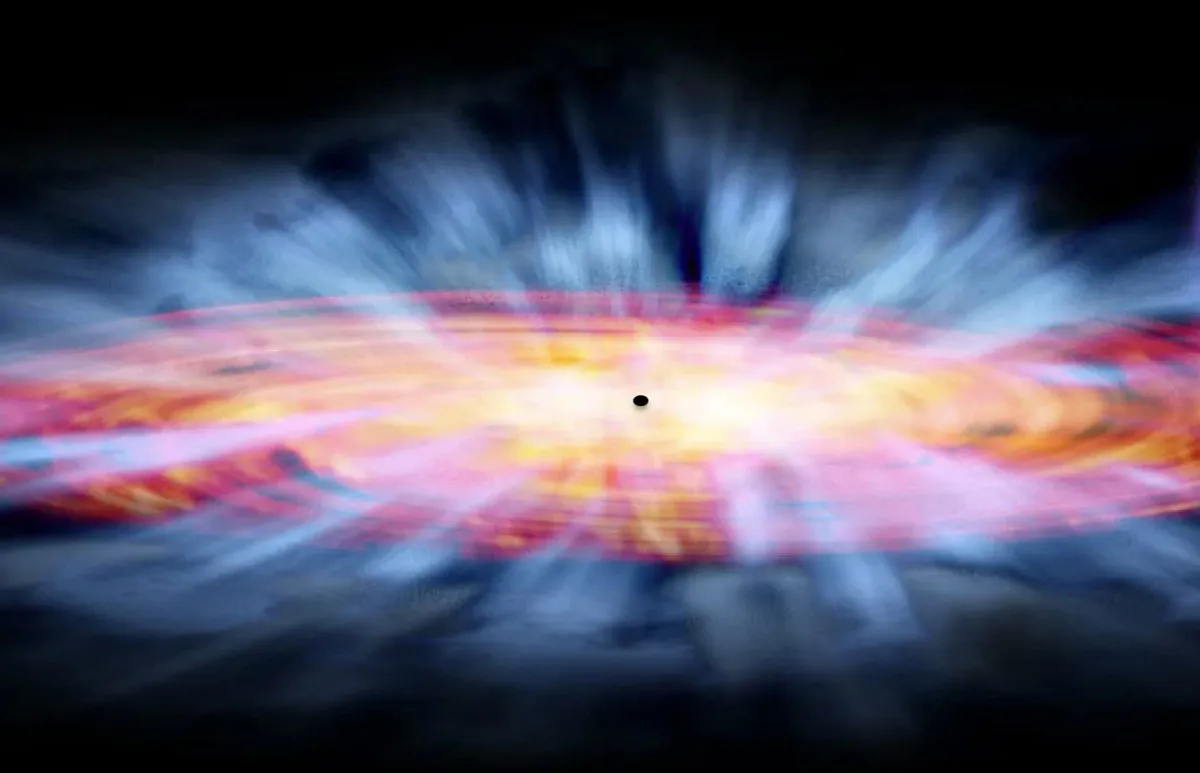
Imagine a cosmic hairdryer, but instead of warm air, it's shooting gas at nearly one-third the speed of light. And instead of drying your hair, it's influencing the growth of entire galaxies. That's the scene around J2318, a distant quasar where astronomers just clocked the fastest ultraviolet wind ever seen near a supermassive black hole. It's so fast, the scientists are scratching their heads wondering how it even stays visible.
This particular black hole, clocking in at 1.7 billion times the mass of our Sun, is pretty standard as far as these cosmic behemoths go. What's decidedly not standard is the sheer velocity of the gas it's expelling. We're talking 30% the speed of light, which, to put it mildly, is a bit zippier than your average breeze.
The Mystery of the Un-Vaporized Wind
Quasars, for the uninitiated, are essentially cosmic lighthouses. They form when massive amounts of gas spiral into a supermassive black hole, creating a dazzling disk of material that can outshine entire galaxies. As this matter gets pulled in, some of it gets ejected in these incredibly powerful winds.
We're a new kind of news feed.
Regular news is designed to drain you. We're a non-profit built to restore you. Every story we publish is scored for impact, progress, and hope.
Start Your News DetoxLead author Lucas Seaton described J2318's wind as a "category 79 hurricane." Which, if you consider that each category is only about 20% faster than the last, gives you a sense of just how absurdly powerful this outflow is. It's in the constellation Pegasus, doing its thing, and setting new records for ultraviolet observations.
But here's the real head-scratcher: The very same intense radiation that accelerates this gas to mind-boggling speeds should, in theory, strip all the electrons from its atoms. That would make the gas invisible to our telescopes. Yet, in J2318, researchers can still clearly see carbon and silicon ions moving at these extreme velocities.
"How to push the gas to the speeds we see while keeping the carbon and silicon ions we see intact... it's quite a puzzle," Seaton noted. It's like trying to launch a rocket at warp speed without incinerating its paint job.
Decades of Data, One Undergrad's Discovery
This record-breaking discovery wasn't made with a shiny new instrument, but rather by sifting through decades of data from the Sloan Digital Sky Survey (SDSS). The first hint came from graduate student Marianna Veltri, who flagged J2318 as potentially unusual during her undergrad days. With a little help from some clever software and the Frederick C. Gillett Gemini Telescope in Hawai'i, the team confirmed its extraordinary speed.
This is a rather satisfying detail: a discovery that once would have required a seasoned PhD astronomer is now accessible to undergraduates, thanks to the sheer volume of data available. Let that sink in.
Why does any of this matter? These powerful quasar winds aren't just cosmic fireworks. They're believed to play a crucial role in regulating how galaxies grow, heating up gas, stifling star formation, and essentially acting as a feedback loop between a galaxy's central black hole and its wider structure. Though a black hole is a tiny fraction of its galaxy, it might just be the puppet master.
Finding even faster ultraviolet outflows than J2318 won't be easy, but the search continues. Because when you're talking about something this extreme, every new discovery helps scientists push the boundaries of what these cosmic giants are capable of – and how they shape the universe we inhabit.