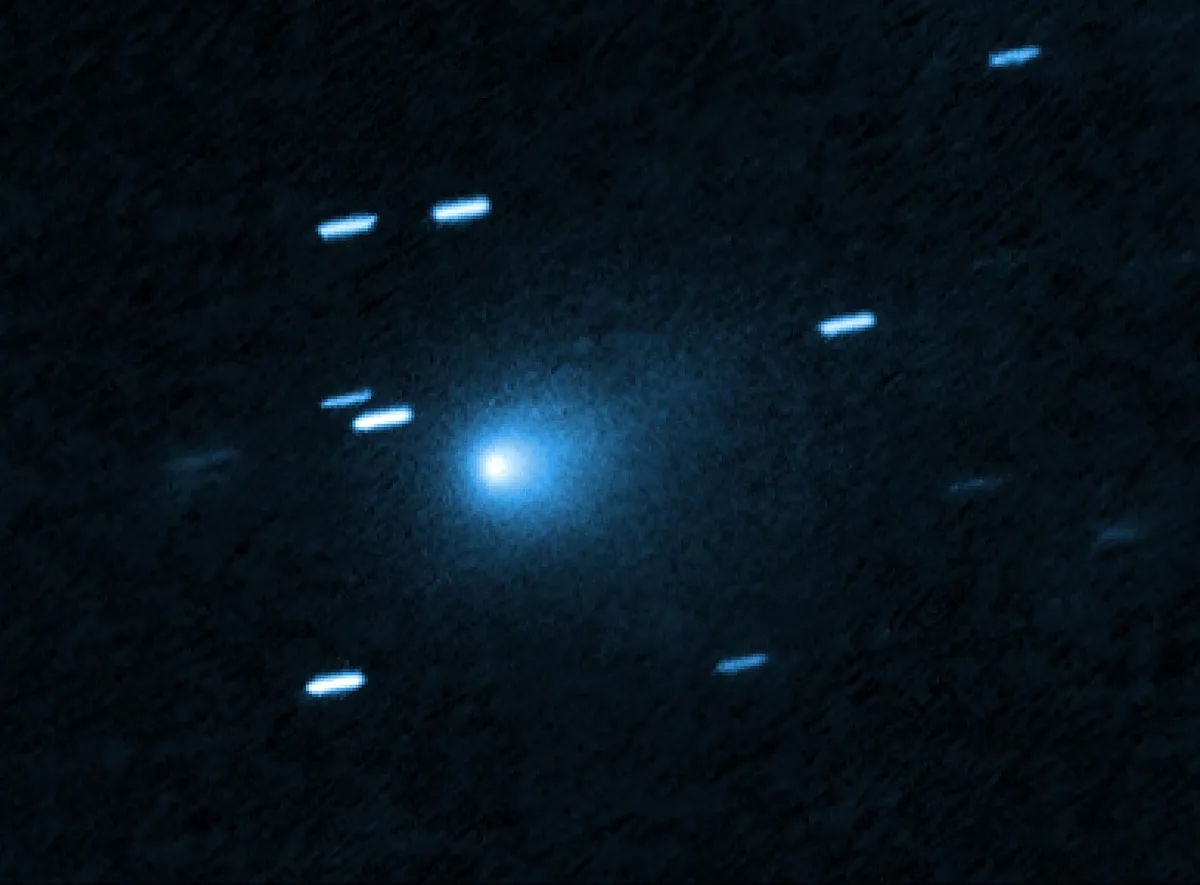
The James Webb Space Telescope, always one for a dramatic reveal, has just dropped a bombshell about a visitor from beyond our solar system. For the first time ever, it snagged a mid-infrared chemical fingerprint of an interstellar object: comet 3I/ATLAS.
This isn't just any space rock. This is a rare, cosmic tourist that’s been zipping through our neighborhood, and what it's carrying is making scientists rethink how planetary systems form.
Webb Catches a Cosmic Stranger
Webb's MIRI (Mid-Infrared Instrument) tracked 3I/ATLAS twice as it made its graceful exit from our Sun's scorching embrace. The first peek happened in mid-December when the comet was a mere 205 million miles from the Sun. A second observation followed just over a week later, with the comet having scooted another 31 million miles further out. Because apparently, even comets need their space.
We're a new kind of news feed.
Regular news is designed to drain you. We're a non-profit built to restore you. Every story we publish is scored for impact, progress, and hope.
Start Your News DetoxWhat Webb saw was… weird. It directly detected methane gas. On an interstellar object. Which, if you're not a comet scientist, might not sound like a big deal. But methane is highly volatile, meaning it turns to gas faster than you can say "cosmic chemistry experiment." Its presence after the comet had its close-up with the Sun suggests this methane was tucked away, deep beneath the surface, protected from the solar heat until its grand unveiling.
And here’s the kicker: the sheer amount of methane compared to water was totally unexpected. Very few comets from our own solar system have a similar chemical profile. It's like finding a penguin in the Sahara – not impossible, but definitely raises some questions about how it got there.
Carbon Dioxide Levels Hint at a Different Origin Story
Adding to the mystery, 3I/ATLAS also boasts unusually high levels of carbon dioxide. Again, relative to water, this interstellar interloper is spewing out way more CO2 than your average homegrown comet.
These methane and carbon dioxide levels aren't just quirks; they're like chemical breadcrumbs. They strongly suggest 3I/ATLAS didn't form in the same cosmic nursery as our solar system's comets. It probably hails from a completely different planetary system, around a different star, with its own unique recipe for cosmic ingredients.
As the comet continued its journey away from the Sun, Webb observed a sharp drop in gas production, especially water. This makes sense – the further you get from a heat source, the less ice turns into gas. But the initial composition? That's the real head-scratcher. It's almost as if this comet is sending us a postcard from another star, and the message is: "Things are different out here."
So, thanks to Webb's fancy MIRI, which basically acts like a cosmic prism, scientists could map these gases around the comet's nucleus. They're peeling back the layers on an object that literally traveled light-years to give us a peek into alien chemistry. Which, if you think about it, is both impressive and slightly terrifying.