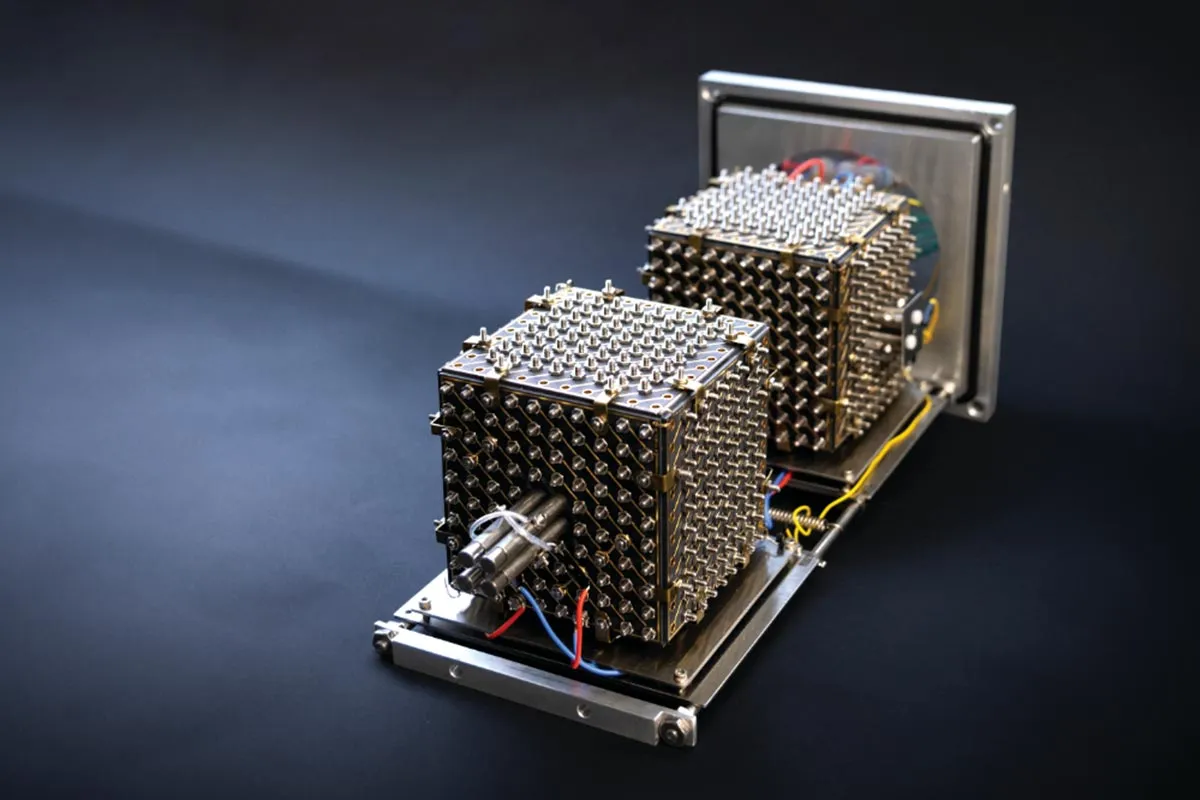
For over a century, mass spectrometry has been the microscopic equivalent of a detective with a magnifying glass, painstakingly identifying molecules one by one. It's powerful, but also, let's be honest, a bit slow. Now, a new prototype called MultiQ-IT is ready to throw out the magnifying glass and bring in the surveillance team, analyzing billions of molecules at once.
Think of it as the ultimate molecular speed-dating event, where instead of awkward small talk, an electric charge helps identify and count every single participant. This isn't just an upgrade; it's a seismic shift, promising to map every molecule in a single cell, monitor thousands of chemical reactions simultaneously, and dramatically accelerate drug discovery. Because apparently that's where we are now.
Brian T. Chait from Rockefeller University, a lead researcher, puts it in perspective: "What changed DNA sequencing wasn't the chemistry, but the ability to run many reactions at the same time." He’s aiming for a similar revolution here, making molecular analysis cheaper and faster.
We're a new kind of news feed.
Regular news is designed to drain you. We're a non-profit built to restore you. Every story we publish is scored for impact, progress, and hope.
Start Your News DetoxSolving a Century-Old Bottleneck
Mass spectrometry has been around since 1913, identifying molecules by zapping them with a charge and then measuring their mass. Simple enough. But the Achilles' heel has always been its one-at-a-time approach, which means rare, but often crucial, molecules can get lost in the noise. Chait called these limitations "frustrating," which is scientific speak for "we knew there had to be a better way."
Especially in fields like single-cell proteomics, where scientists try to measure all proteins or metabolites in a single cell, the stakes are high. Unlike DNA, these molecules can't just be copied. And when common molecules can outnumber rare ones by millions, finding that one significant signal is like trying to hear a whisper at a rock concert. The solution? "Massive parallelization," Chait's team decided. Break the big problem into tiny, simultaneous tasks, much like how GPUs supercharged computing or how DNA sequencing got its groove.
Andrew Krutchinsky, a senior research associate, sums up the challenge: "It was a very clear idea. But how to do it with mass spectrometry wasn't clear."
The Cell-Inspired Design That Changed Everything
The inspiration for MultiQ-IT came from an unlikely source: the humble cell nucleus. Specifically, how molecules traffic in and out through its many-mouthed nuclear pore complexes. If a cell can handle multiple molecular movements at once, why couldn't mass spectrometry?
The team designed a cube-shaped ion-trapping chamber with hundreds of tiny, electrically controlled openings. Ions enter, get slowed down by gas molecules, then are simultaneously held, filtered, and redirected. From six openings to over 1,000, the design evolved, proving that one stream of ions could indeed be split into many for analysis. Because sometimes, more is just… more.
A Thousand-Fold Leap in Sensitivity
The improvements are, frankly, a bit ridiculous. A MultiQ-IT with 486 ports could hold up to ten billion charges at once – roughly a thousand times more than standard ion traps. Let that satisfying number sink in.
But it's not just about quantity. The system also filters out common background molecules while keeping the rarer, more important ones. This makes signals up to 100 times clearer, revealing proteins that were previously invisible. They achieved this with a small voltage barrier at the trap's exits, letting singly charged ions escape while keeping the more biologically relevant, multiply charged ions trapped. It's like having a VIP section for the most interesting molecules.
This newfound sensitivity could be a game-changer for understanding complex protein structures, where the "least abundant things can be more important than the more abundant things," as Krutchinsky notes. Which, if you think about it, is both impressive and slightly terrifying.
While MultiQ-IT is still a prototype, the researchers believe they've cracked the code for a more efficient way to do mass spectrometry. Chait hopes it will follow the path of DNA sequencing and transistors: a breakthrough that industry can then run with. Just imagine what secrets billions of molecules, simultaneously interrogated, might spill.