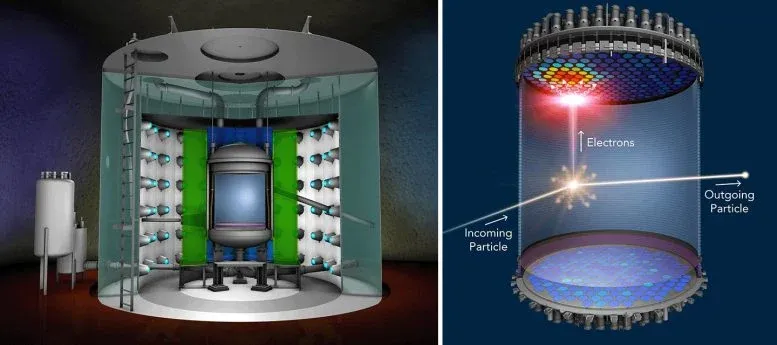
Scientists looking for dark matter have found a fascinating event inside the LUX-ZEPLIN (LZ) detector. This detector is located almost a mile underground in South Dakota.
For nearly 100 years, scientists have tried to find dark matter. This mysterious material is thought to make up about 85% of all matter in the universe. Even though it greatly affects galaxies and cosmic structures, dark matter has never been seen directly. Its true nature remains one of the biggest puzzles in physics.
An Intriguing Signal Deep Underground
A new study from the LZ experiment has shown a very interesting result. Researchers recorded a single particle interaction that is hard to explain using known background signals from regular matter. This finding is not strong enough to be called a discovery, but it is the strongest hint of dark matter LZ has reported so far.
We're a new kind of news feed.
Regular news is designed to drain you. We're a non-profit built to restore you. Every story we publish is scored for impact, progress, and hope.
Start Your News DetoxThe LZ experiment involves 250 scientists and engineers from 39 different groups. It is managed by the U.S. Department of Energy’s Lawrence Berkeley National Laboratory (Berkeley Lab). The detector works almost a mile underground at the Sanford Underground Research Facility (SURF) in South Dakota.
At its heart are 10 tons of very pure liquid xenon. Scientists use this material to look for possible collisions with dark matter particles. They are especially interested in hypothetical particles called WIMPs, or weakly interacting massive particles.
These latest findings were shared at the 2026 TeV Particle Astrophysics conference in Japan. The research paper will soon be available online and submitted to Physical Review Letters.
Rick Gaitskell, a professor at Brown University and spokesperson for LZ, said they are very interested in this event. It appeared in a part of the data where dark matter is expected and where other background signals are very low. He noted that with only one event, they are not claiming to have found dark matter, but it is an interesting observation they want to share with other scientists.

Expanding the Search for WIMPs
The LZ team looks at its observations in batches. For this study, researchers analyzed 220 days of data collected between March 2023 and April 2024.
Scientists had already checked this same data for faint signals from the simplest WIMP interactions. This time, they looked for other possible WIMP interactions that could release more energy inside the detector. LZ is very good at finding these types of events while keeping the chance of false alarms low.
Sam Eriksen, a lead author of the study and a senior research associate at the University of Bristol, explained that this was a detailed study in a new area of their data. They spent months understanding all possible background events. He added that their understanding of the detector and backgrounds is so good that even a single unusual event is important. Dark matter events are expected to be very rare, so a few could signal the first detection of WIMP dark matter.
What the Mysterious Event Could Mean
If dark matter caused this unusual event, the WIMP responsible would likely have a mass of at least 200 GeV/c2. This means it would be more than 200 times heavier than a proton.
Such a result would also suggest a specific type of interaction between WIMPs and regular matter. This interaction would be different from the simpler models scientists have usually looked for.
However, the evidence is not yet strong enough to be called a discovery. Particle physicists usually need a result to reach "5-sigma" significance to make such a claim. The new LZ analysis is at 2.6 sigma. This means there is about a 0.5% chance that known background processes could explain the event.
More observations will help determine if the signal becomes more significant or if it eventually fades into the statistical background. LZ has already gathered the world's largest dataset for dark matter searches. It will continue collecting WIMP data at SURF, giving researchers much more information to study.
How LZ Searches for Invisible Matter
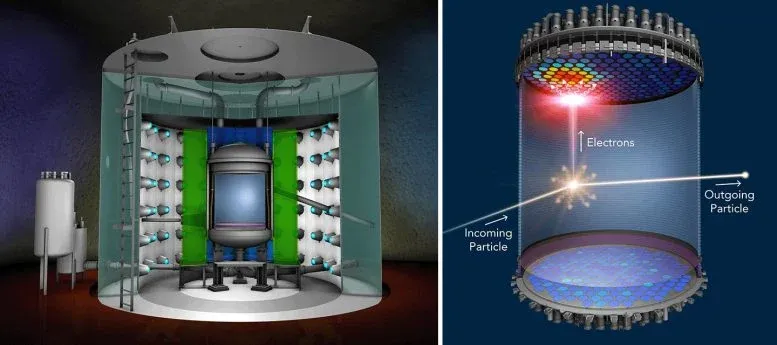
Dark matter cannot be seen directly. So, LZ looks for indirect signs of a particle collision. When energy is deposited inside the detector, the liquid xenon can produce special flashes of light. Sensitive instruments record these flashes.
The challenge is to tell a potential dark matter interaction apart from signals made by ordinary particles. LZ uses several layers of protection and analysis to do this.
Almost a mile of rock above the experiment blocks most cosmic radiation from space. A surrounding water tank and other outer detectors help shield the main instrument from background neutrons. Researchers also use advanced computer methods to identify different types of particle interactions. They eliminate events that look like dark matter but are not.
An Outlier That Survived Scrutiny
Unexpected events are common in such sensitive experiments. Most of the time, a closer look reveals an ordinary explanation. What makes this event unusual is that researchers have not yet found such an explanation.
Aaron Manalaysay, a physicist at Berkeley Lab and chair of LZ’s Institutional Board, said that outlier events are not unexpected, but they usually turn out to be a type of background when examined closely. He noted that this is the first time in his experience that an outlier seems valid in every way. He added that they are still trying to think of any rare background mechanisms they might have missed, but it is exciting to wonder if this could be the first hint of dark matter.
Whether this possibility holds up will depend on what LZ finds as its data continues to grow.
Deep Dive & References
Search for dark matter particle interactions in an extended nuclear recoil energy window with the LUX-ZEPLIN (LZ) experiment - arXiv, 2026