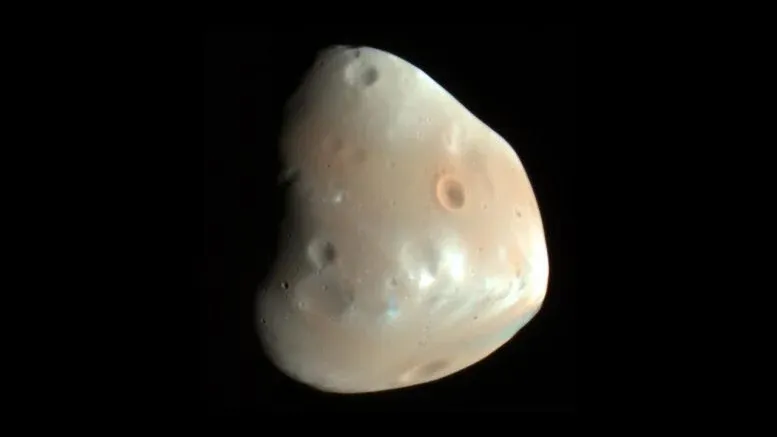
An asteroid strike may have dramatically reshaped Deimos, one of Mars's moons. This single impact could explain the moon's smooth, dusty surface and a large depression near its south pole.
Researchers from the University of Bern led an international team. They used high-resolution computer simulations and new data from ESA’s Hera spacecraft. Their findings offer a new understanding of Deimos's unique features.
Deimos's Distinctive Look
Deimos is smaller and farther from Mars than its other moon, Phobos. Deimos has an oval shape and a noticeable dip near its south pole.
We're a new kind of news feed.
Regular news is designed to drain you. We're a non-profit built to restore you. Every story we publish is scored for impact, progress, and hope.
Start Your News DetoxIts surface is very different from Phobos. Phobos is covered in craters, but Deimos looks much smoother. This is because it's covered in loose dust, broken rock, and other debris, called regolith.
For decades, spacecraft have photographed Deimos. However, scientists didn't know how the southern depression formed or where the regolith came from.
Dr. Sabina Raducan led a new study that offers a possible answer. The team included researchers from the Observatoire de la Côte d’Azur, the University of Arizona, and the University of Tokyo.
The team used "Bern Smoothed Particle Hydrodynamics (SPH)" code. This code simulates collisions. They found that the south polar depression likely came from a single asteroid impact. This impact was powerful enough to reshape Deimos but not destroy it. The same collision also likely created the regolith covering the moon.
This study is the first to use data from Hera's close flyby of Deimos. The findings were published in Nature Astronomy.
Simulating an Ancient Collision
To test different impact ideas, the researchers used the Bern SPH code. This system, developed over 20 years, simulates collisions of asteroids, comets, and planets.
The software treats colliding objects as millions of particles. Researchers can change factors like gravity, density, material strength, impact speed, and angle. This shows how different collisions might happen.
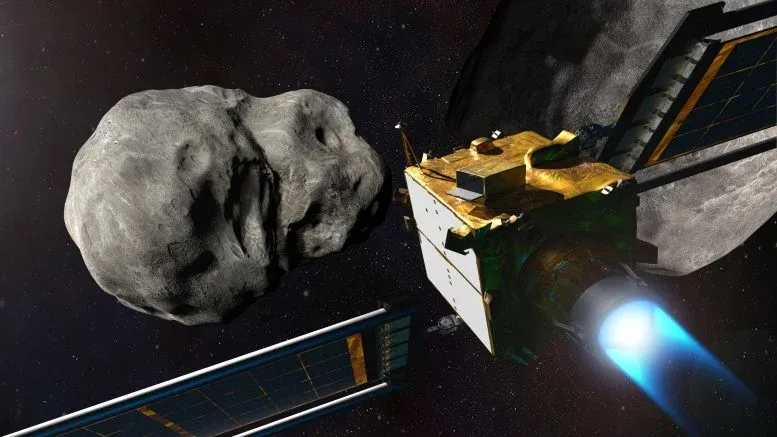
The University of Bern has a lot of experience with these impact models. They used the same method to simulate NASA’s DART spacecraft hitting the asteroid Dimorphos.
Sabina Raducan, the study leader, explained that the code runs on a high-performance computer. It's one of the few systems that can do this type of simulation.
The team ran about 100 simulations. Each one took about a week. They changed the asteroid's size and speed, the impact angle, and ideas about Deimos's inside structure.
Then, they compared their results with observations from ESA’s Hera spacecraft. Hera's main mission is to study the aftermath of the DART impact. In March 2025, Hera flew past Mars for a gravity assist. During this flyby, Hera observed Deimos up close, giving scientists new information.
One Impact, Two Features
The simulations strongly suggested one scenario. An asteroid about 320 meters wide hit Deimos at a 45-degree angle. This collision could create the depression seen near the south pole.
It also explains the widespread regolith. The impact would have thrown huge amounts of material across Deimos. This buried older surface features under layers of debris. In some places, this material might be over 200 meters deep.
Co-author Martin Jutzi said the simulation shows that one impact was enough to shape Deimos's current landscape. The impact was strong enough to spread material globally but not so strong that it shattered the moon.
The match between the simulations and observations suggests Deimos has a weak outer layer and a very porous inside. This porous structure might have absorbed the collision's force. This allowed the moon to survive an event strong enough to cover almost its entire surface with debris.
Raducan noted that Deimos's physical properties are more like "rubble-pile asteroids" than Earth's Moon. Rubble-pile asteroids are made of loosely connected fragments, not a single solid piece.
She added that this doesn't mean Deimos is an asteroid. It could have formed from material ejected during impacts on Mars.
What's Next for Martian Moon Exploration
Other explanations for Deimos's smooth surface and southern basin are still possible. However, this study offers one scenario that explains both features. It also makes specific predictions for future spacecraft to test.
JAXA is preparing the Martian Moons eXploration (MMX) mission, set to launch in 2026. MMX will study both Martian moons in detail. It will also bring samples from Phobos back to Earth.
Raducan explained that their study provides important predictions for the MMX mission. These include the thickness and spread of the regolith layer and the mechanical properties of Deimos's material. This gives MMX a clearer idea of what its instruments and sample collection can expect.
Deep Dive & References
Deimos’s shape and geology explained by a subcatastrophic impact - Nature Astronomy, 2026