Scientists have found a new rule that could make fuel cells cheaper and more powerful. This discovery challenges old ideas about how catalysts work. It could speed up the search for better materials for clean energy.
Fuel cells turn hydrogen into electricity with no pollution. But they often use expensive metals like platinum. This metal is key for a process called the oxygen reduction reaction (ORR). This reaction affects how well fuel cells work and how much they cost.
Scientists have been looking at catalysts made of single atoms or pairs of atoms as a cheaper option. Experiments showed that dual-atom catalysts (DACs) often work better, but no one knew why.
We're a new kind of news feed.
Regular news is designed to drain you. We're a non-profit built to restore you. Every story we publish is scored for impact, progress, and hope.
Start Your News DetoxWhy Dual-Atom Catalysts Outperform
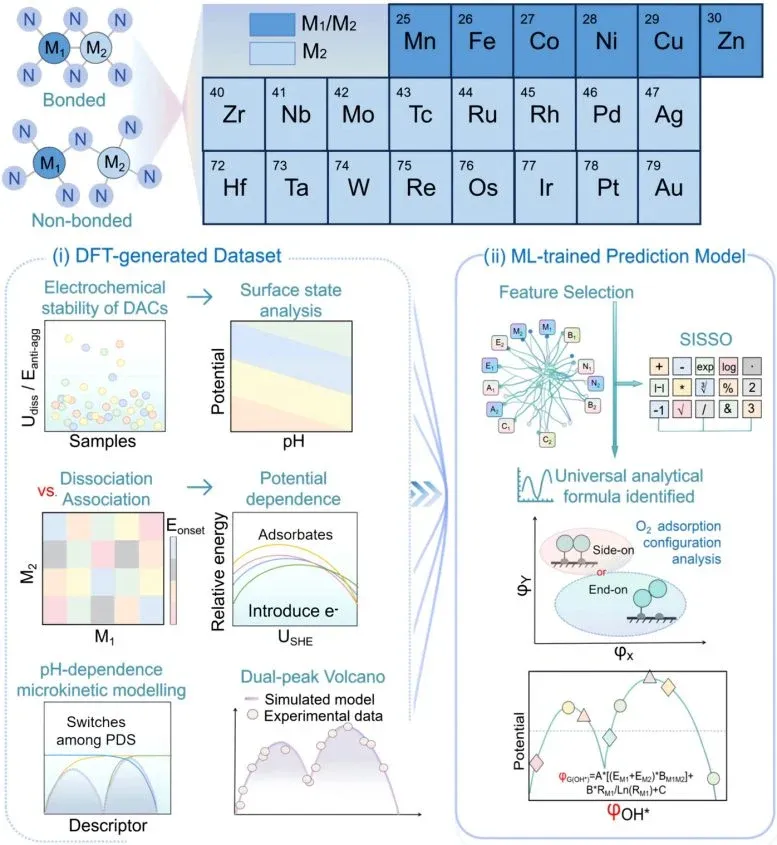
For many years, scientists thought catalyst activity followed a "single-peak volcano" model. This model says there's one perfect spot for a catalyst to perform best. But new research from Tohoku University shows that DACs don't follow this rule.
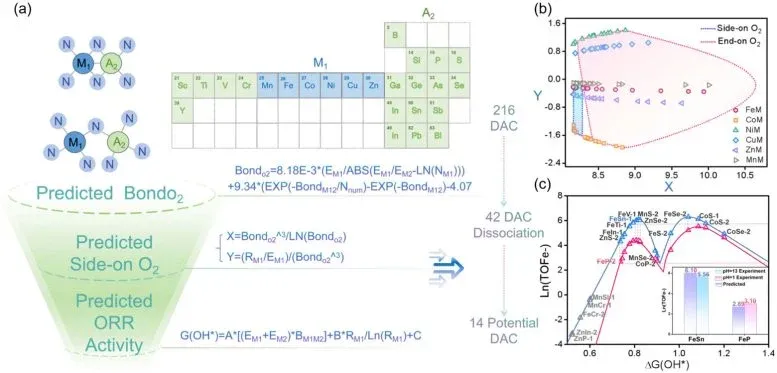
Researchers looked at many experimental results and studied over 200 DACs using computer models and machine learning. They found that DACs mostly use a different reaction path called the dissociative mechanism. Single-atom catalysts usually use the associative mechanism.
This difference changes how DACs perform. Instead of one peak, DACs show two optimal regions. Scientists call these "dual-Sabatier optima." These two peaks appear because the slowest step in the reaction changes during the process.
A New Way to Design Catalysts
This new principle applies to many types of catalysts, including those with transition metals and non-metals. By combining machine learning with theoretical models, the team created a way to quickly find promising catalyst structures.
Hao Li, a professor at Tohoku University, said this discovery changes how we think about catalyst design. He explained that when two atoms work together, completely new mechanisms can appear. This opens up new ways to design efficient materials for clean energy.
These findings could help more than just fuel cells. They might also guide the creation of catalysts for other energy and chemical processes. The work also shows how artificial intelligence can uncover hidden scientific rules, speeding up the search for new materials.
The team plans to use this method on more complex catalysts and other energy reactions. They hope to build an automated system using AI and machine learning to design the next generation of catalysts for sustainable energy.
Deep Dive & References
Dual-Sabatier Optima: How Reaction Mechanism Determines Activity Volcano Map of Dual-Atom Catalysts for Oxygen Reduction Reaction - Angewandte Chemie International Edition, 2026