New fossils suggest that complex animal life began earlier than scientists thought. This discovery pushes back the timeline for when many animal groups first appeared.
For most of Earth's history, life was simple and small. Microbes were common in the oceans. This changed about 538 million years ago during the Cambrian period. Many new animals appeared in what is called the "Cambrian explosion."
Fossils from this time include starfish, sea cucumbers, spiders, and insects. Many of these animals belong to a group called Bilateria. These animals have symmetrical left and right sides. They also have brains and complex muscles.
We're a new kind of news feed.
Regular news is designed to drain you. We're a non-profit built to restore you. Every story we publish is scored for impact, progress, and hope.
Start Your News DetoxScientists have wondered if this rapid increase in animal life happened all at once. Or did the ancestors of these animals exist even earlier? New research helps answer this question.
Strange Creatures of the Ediacaran Period
The Ediacaran period (635-538 million years ago) came before the Cambrian. Organisms from this time were very unusual. Their bodies often looked like sacs or quilted pillows. They don't have clear relatives among animals alive today.
Scientists have struggled to classify these Ediacaran creatures. Some thought they were fungi or even an extinct kingdom of life. These organisms lived with microbial mats on the seafloor. This type of ecosystem disappeared when grazing animals arrived.
Recent studies suggest these creatures were simple animals. However, they don't have direct descendants living today.
Towards the end of the Ediacaran period, the fossil record shows hints of more complex animals. Most of this evidence comes from fossilized burrows and trails. These suggest complex life but don't show the animals themselves. This has led to much debate about the shift from the Ediacaran to the Cambrian period.
A Discovery Fills the Gap
In 2023, Gaorong Li, a PhD student, made an important discovery. This finding helps clarify the period between the Ediacaran and Cambrian.
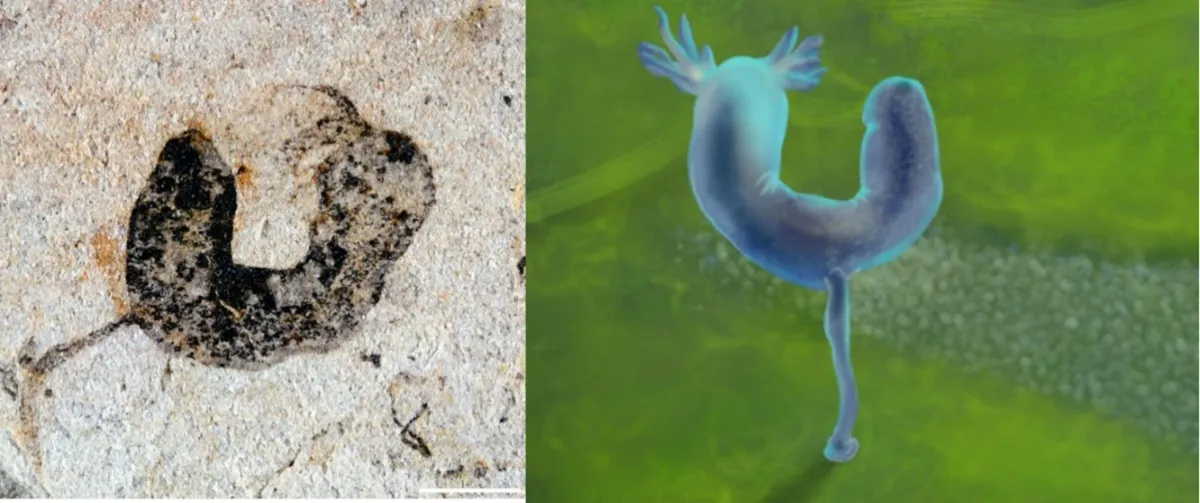
Li and his supervisors explored Ediacaran rocks in Eastern Yunnan, China. They were looking for fossil algae. Instead, they found a strange worm. It was tethered to the seafloor and could turn its proboscis inside out to eat. These were clearly complex animals, but unlike any known today.
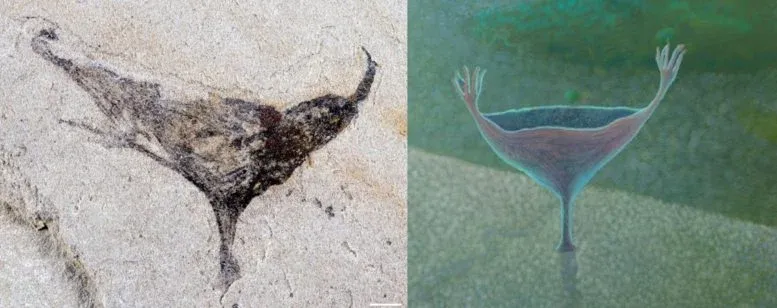 This fossil (plus artist’s reconstruction), found in the Jiangchuan biota (~554-539mya), is an early cnidarian: the phylum that includes jellyfish, sea anemones, and corals. Scale bar: 2mm. Credit: Gaorong Li and Xiaodong Wang
They nicknamed it the "bugle worm." The team is still trying to classify it. Previously, only the anchoring disc of this creature was known. It was called Cycliomedusa. The new fossils revealed the entire organism.
As they continued to find more fossils, it became clear that the Jiangchuan biota held many animals. In 2024, a team from the University of Oxford joined the effort. They found organisms typical of both the Ediacaran and Cambrian periods.
They also found animals previously only known from the Cambrian explosion. These included a primitive animal similar to Mackenzia, various worms, and swimming predators called ctenophores.
Most importantly, they found the oldest evidence for deuterostomes. This is the group that includes humans.
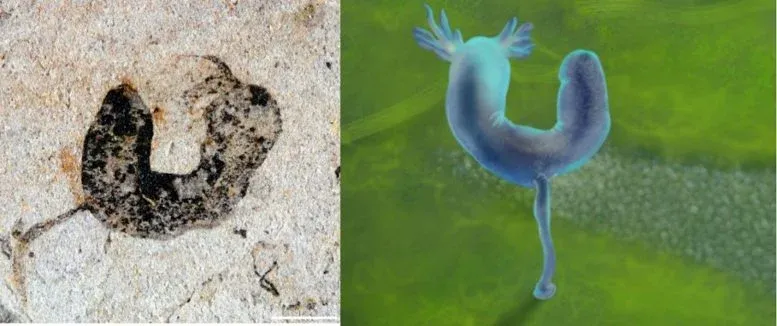 A deuterostome cambroernid fossil from the Jiangchuan Biota (~554-539mya), plus artist’s reconstruction (scale bar: 2mm). Credit: Gaorong Li and Xiaodong Wang
Several of these fossils have a stalk and tentacles. They look like Cambrian fossils called cambroernids. These extinct animals are related to living starfish and acorn worms. These are the closest invertebrate relatives to humans. This shows that our own evolutionary story began in the Ediacaran period.
The discovery of diverse, complex animals in the Jingchuan biota suggests that many animal groups lived alongside the Ediacaran creatures for millions of years. This means complex animal life has a much older history than previously thought.
Deep Dive & References
The dawn of the Phanerozoic: A transitional fauna from the late Ediacaran of Southwest China - Science, 2026