Imagine your phone remembering both the last song you played and the specific way you held it while listening. Now imagine that holding it a certain way for too long makes it forget the song entirely. That’s essentially what physicists just found happening in everyday materials.
Tiny particles in a thick liquid can apparently hold two distinct types of memories at once: one about the direction they were stirred, and another about how strongly they were rocked. The kicker? One memory can actively wipe out the other, like a particularly aggressive software update.
This isn't just a parlor trick for futuristic slimes. This discovery could pave the way for designing new materials that react predictably to changes, or even offer a microscopic lens into how different kinds of memories interact in the brain — a bit like how your short-term memory can nudge, or even overwrite, a long-term one.
We're a new kind of news feed.
Regular news is designed to drain you. We're a non-profit built to restore you. Every story we publish is scored for impact, progress, and hope.
Start Your News DetoxWhen Materials Get Sentimental
We're talking about "material memory," which is exactly what it sounds like. Think of a folded piece of paper; the crease remains even after you flatten it. The material remembers its past. But what if it could remember multiple pasts?
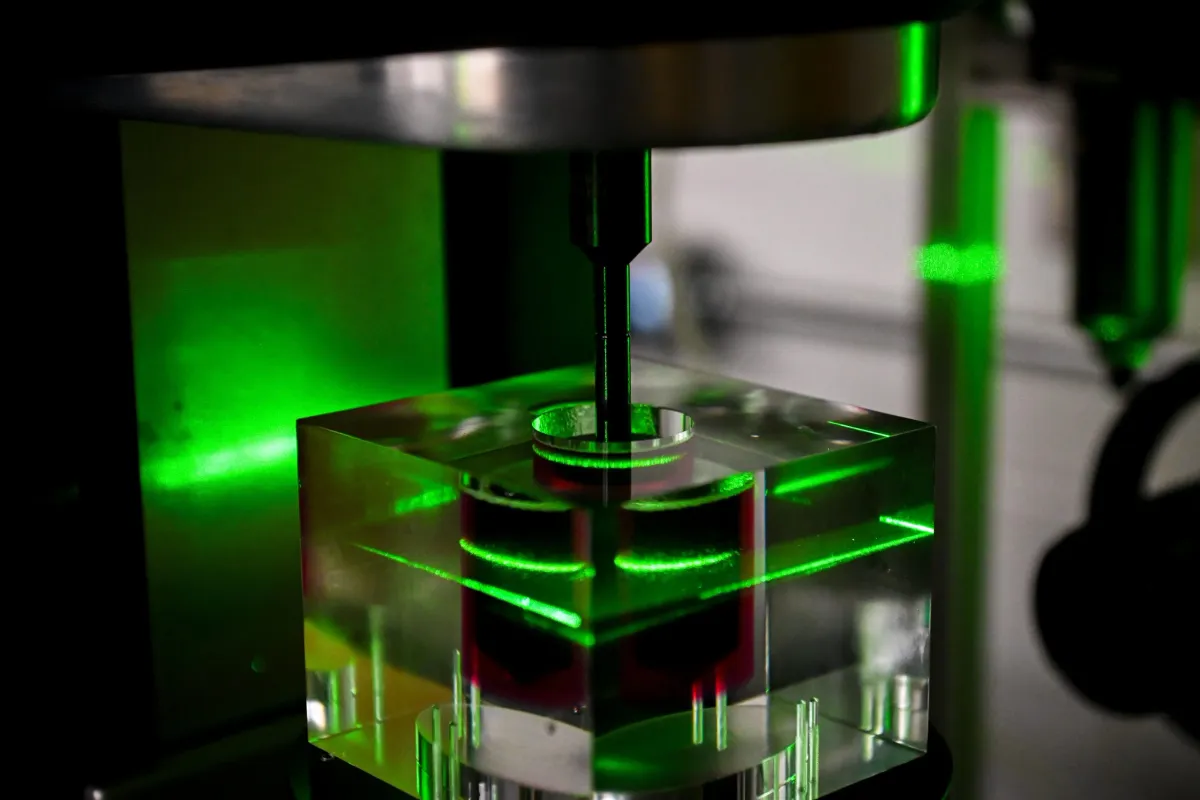
Researchers at Penn State showed that two types of material memory can coexist in a simple mix of small particles suspended in a thick liquid. They were inspired by the human brain, where new experiences can change older memories. Computer files don't affect each other, as physics graduate student Surendra Padamata noted, but our brains are a messy, beautiful free-for-all.
The scientists focused on "non-Brownian suspensions" — basically, things like chocolate syrup or wet concrete. These are mixtures with relatively large particles floating in a viscous liquid. Because the particles are too big for random jiggling caused by heat, their movement is entirely dictated by external forces. What the researchers do to them, they remember.
Previous studies had already shown these suspensions could remember the direction they were stirred, and also the strength of a rocking motion. But never together.
So, the team got to work. First, they stirred the mixture to create a directional memory. Then, they rocked it back and forth at varying strengths to see if these two memories would play nice. (Spoiler: They did not always play nice.)
The Battle of the Bumps
When the researchers rocked the suspension gently, both memories persisted: the initial stirring direction and the rocking strength. It was a harmonious, multi-tasking material.
But as the rocking became more intense, things got dramatic. The directional memory slowly began to fade. At a certain rocking strength, it was completely erased, and the suspension returned to a neutral, balanced state. Just gone. Poof.
And then, if the rocking got even stronger, it started creating a new directional memory. Because apparently that’s where we are now: materials that can not only forget, but actively replace, their pasts.
Padamata suggests that these memory battles happen when particles bump into each other too often. Gentle rocking means fewer collisions, so both memories can coexist. But ramp up the movement, and it’s a microscopic mosh pit where only the strongest memory survives.
This isn't just about making better chocolate syrup, either. This research could help us understand how biological memory works, and even geological processes. Think about it: temperature changes and vibrations could create "memories" in rocks, influencing things like earthquake risk or sinkholes. Understanding how to erase those memories? Suddenly, it’s not just interesting, it’s potentially life-saving.
Professor Nathan Keim, who led the team, points out that similar memory interactions appear in other soft materials, even those with very different physics. This hints at a universal principle for how disordered materials behave under simple actions like stirring or rocking, and why they might have a limited capacity for remembering the past. Which, if you think about it, is both impressive and slightly terrifying.
This research was funded by the Human Frontier Science Program.
Reference: "Memories of Amplitude and Direction Coexist and Compete in Non-Brownian Suspensions" - Physical Review Letters, 2026