Jupiter and Saturn, the two biggest bullies on the cosmic playground, both boast an impressive collection of moons. Jupiter has over 100, Saturn over 280. But when it comes to the big ones, they're like night and day. Jupiter's got a whole squad of giants, including Ganymede, the solar system's largest. Saturn? Mostly just Titan, a solitary behemoth.
For ages, scientists have scratched their heads over this celestial disparity. Why the lopsided lineup of major moons? Turns out, the answer might be as simple as a planetary force field.
Magnetic Fields: The Ultimate Moon Bouncers
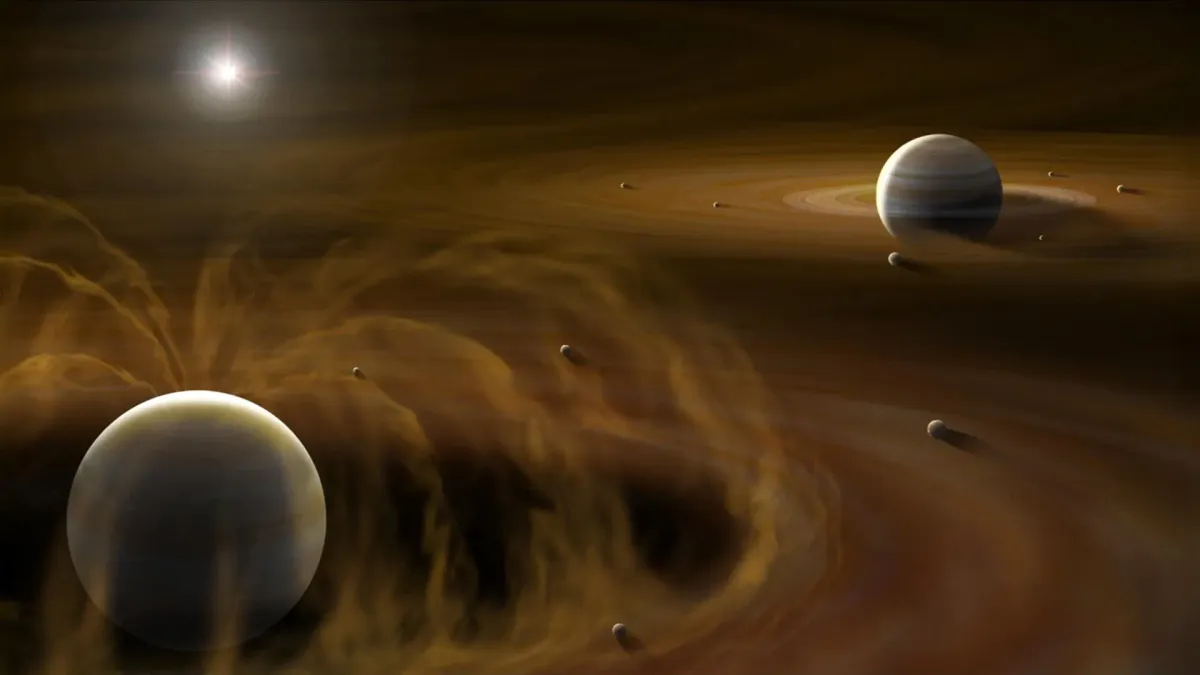
New research points to magnetic fields as the cosmic bouncers dictating which moons get to stay. Imagine a young planet surrounded by a swirling disco of gas and dust — that's a "circumplanetary disk," where moons are born. The big question was whether Jupiter's disk had an empty inner sanctum, a safe zone for baby moons to form and thrive.
We're a new kind of news feed.
Regular news is designed to drain you. We're a non-profit built to restore you. Every story we publish is scored for impact, progress, and hope.
Start Your News DetoxBecause, let's be honest, understanding how our own solar system's planets and moons formed is great, but the real fun is figuring out if we can predict what's happening light-years away. Researchers from Japan and China, including the brainiacs at Kyoto University, built a new model to crack this very nut. As lead author Yuri I. Fujii put it, testing planet formation theories is tough with just one solar system to study, but detailed moon systems? Those are everywhere.
So, they fired up the supercomputers, simulating young Jupiter and Saturn. They peered into their gooey, hot interiors to guess how their magnetic fields might have evolved. Then, they modeled those swirling disks of potential moons, tracking how they formed and moved. You know, just a casual Monday.
Jupiter's Strong Field: A VIP Section for Moons
The simulations delivered the cosmic goods: the divergent moon systems likely boil down to differences in those circumplanetary disks, which were, in turn, controlled by each planet's magnetic field strength. It's all about the magnetic mojo.
Young Jupiter, apparently, was flexing some serious magnetic muscle. Its super-strong field created a "magnetospheric cavity" — essentially an empty, protected bubble inside its disk. This inner VIP section likely acted as a safe harbor, allowing Io, Europa, and Ganymede to survive their turbulent early years as they migrated through the disk. No bumping, no grinding, just smooth sailing to becoming giant moons.
Young Saturn, on the other hand, was a bit of a magnetic lightweight. Its field wasn't strong enough to carve out a similar safe zone. Without that protected area, any budding moons trying to navigate Saturn's rough-and-tumble disk were likely obliterated. Poor little guys never stood a chance.
This isn't just a fun fact about our neighbors. This model suggests that exoplanets the size of Jupiter or larger should generally come with a compact system of multiple moons. Saturn-sized gas giants, however, are more likely to be the proud parents of just one or two. Which, if you think about it, is both impressive and slightly terrifying for future exomoon hunters. Now they know what to look for.
This research was published in Nature Astronomy in 2026. Yes, 2026. Because science is just that ahead of the curve.