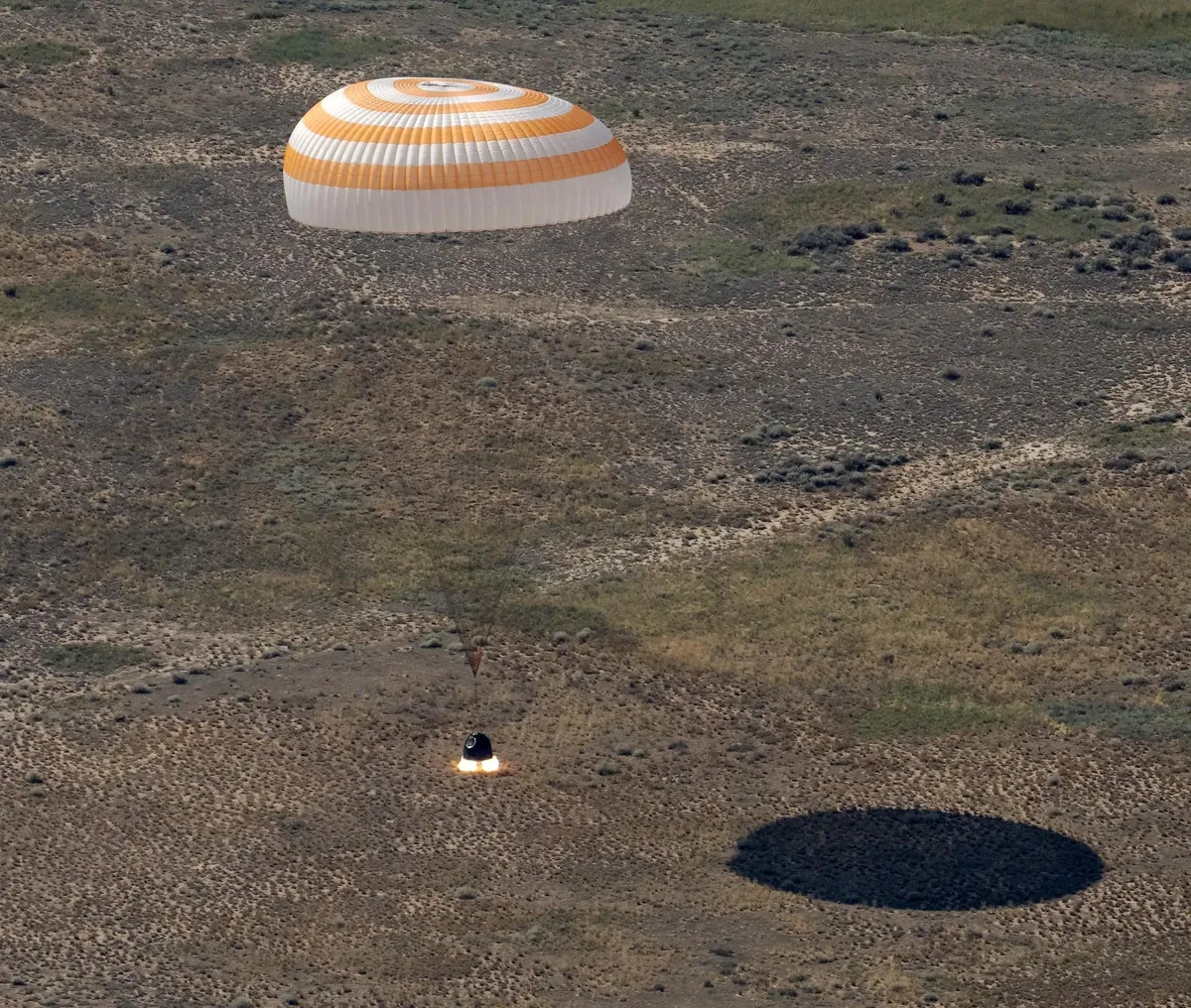
NASA astronaut Chris Williams returned to Earth on Sunday after an eight-month science mission. He completed 3,856 orbits of Earth and traveled over 102 million miles.
Williams landed safely in Kazakhstan with Roscosmos cosmonauts Sergey Kud-Sverchkov and Sergei Mikaev. Their Soyuz MS-28 spacecraft touched down southeast of Dzhezkazgan.
A Long Journey in Space
The crew spent 241 days in space. They launched to the International Space Station (ISS) on November 27, 2025. This was the first space mission for Williams and Mikaev, and the second for Kud-Sverchkov.
We're a new kind of news feed.
Regular news is designed to drain you. We're a non-profit built to restore you. Every story we publish is scored for impact, progress, and hope.
Start Your News DetoxScience and Maintenance on the ISS
During his time on the ISS, Williams worked on many scientific studies. He helped with research that could lead to new cancer treatments. He also conducted experiments to improve how materials for high-performance computers and electronics are made in space.
Williams also performed two spacewalks. One prepared the station for power system upgrades. The other replaced a broken part on the Canadarm2 robotic arm. This work helps improve life on Earth and prepares NASA for future missions to the Moon and Mars.
Returning Home
After medical checks in Kazakhstan, Williams will fly to NASA's Johnson Space Center in Houston.
 The Soyuz MS-28 spacecraft carrying three Expedition 74 crew members parachutes to a landing just feet above the steppe of Kazakhstan, ending an eight-month research mission at the International Space Station. Credit: NASA+
The Future of Space Exploration
Humans have continuously lived and worked on the ISS for over 25 years. This unique environment allows for scientific discoveries and experiments not possible on Earth.
The station also helps NASA study long-duration spaceflight and develop commercial activities in low Earth orbit. These efforts are crucial for future missions, including journeys to the Moon through the Artemis program and eventual crewed exploration of Mars.