Ever wonder how artificial light messes with fish? Scientists did, too. So they built a virtual reality platform for clownfish. Yes, really. It turns out, coastal glow-ups are making fish react to predators in decidedly unhelpful ways.
This isn't just about fish being startled by a sudden spotlight. We're talking about fundamental changes to their metabolism, which, for a tiny fish staring down a virtual barracuda, is basically the difference between life and becoming lunch.
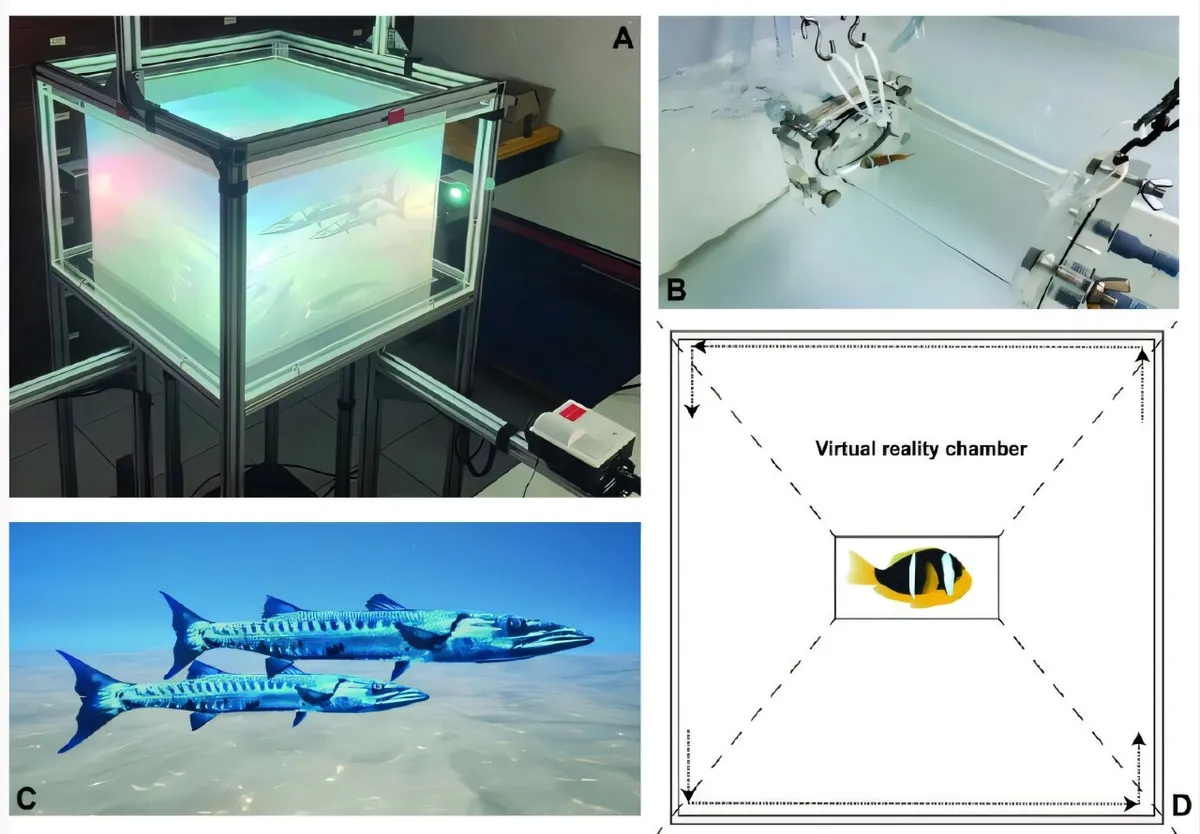
Researchers from the University of Glasgow, Institut de Neurosciences de la Timone, and CRIOBE teamed up to project interactive 3D underwater scenes onto the walls and floor of a special fish tank. Inside, clownfish got to experience what it's like to be attacked by a virtual Heller's barracuda – a very real threat in the wild. Meanwhile, the scientists were busy measuring the fish's oxygen use, essentially spying on their metabolic rate.
We're a new kind of news feed.
Regular news is designed to drain you. We're a non-profit built to restore you. Every story we publish is scored for impact, progress, and hope.
Start Your News DetoxBefore their VR encounter, the clownfish were split into two groups: one lived under natural light cycles, the other under the kind of artificial light you'd find spilling from coastal hotels and resorts. Because apparently that's where we are now.
The results were, shall we say, illuminating.
When the Lights Change, So Does the Game
Fish accustomed to natural light? They knew what to do. When the virtual barracuda swooped in, their metabolic rate dropped. This is a classic anti-predator move, allowing small fish to breathe slower, stay hidden, and generally avoid being seen. It's the underwater equivalent of holding your breath and trying to disappear.
But the fish exposed to artificial light at night? Their metabolic rate increased when faced with the same threat. Instead of chilling out to avoid detection, they seemed to be revving up, making them potentially easier targets. Which, if you think about it, is both impressive and slightly terrifying.
Shaun Killen, a professor at the University of Glasgow, put it simply: artificial light at night changes how fish physically respond during crucial predator interactions. As light pollution creeps further along our coastlines, it's not just an aesthetic problem; it's a potential disruption to entire ecosystems.
Suzanne Mills from CRIOBE noted that this research helps explain why they'd already observed more young reef fish getting eaten in the wild. It's not just bad luck; it's bad lighting.
The Future of Fish Forensics
Isabelle Tiddy, the study's lead author, called VR an "exciting new tool" for ecological research. It allows scientists to simulate realistic situations that were previously impossible to recreate in a lab. You can measure physical responses while a fish is getting virtually chased by a barracuda. Because science.
Manuel Vidal, who designed the platform, sees even more potential. This immersive VR isn't just for predator-prey dynamics; it could be used to study group behavior, decision-making, and how aquatic animals use their senses. It's a way to simulate future ecosystems and predict how wildlife will cope with rapid environmental changes. Which, given the state of things, feels like a pretty good use of VR. And maybe, just maybe, it'll make us think twice about leaving the lights on.