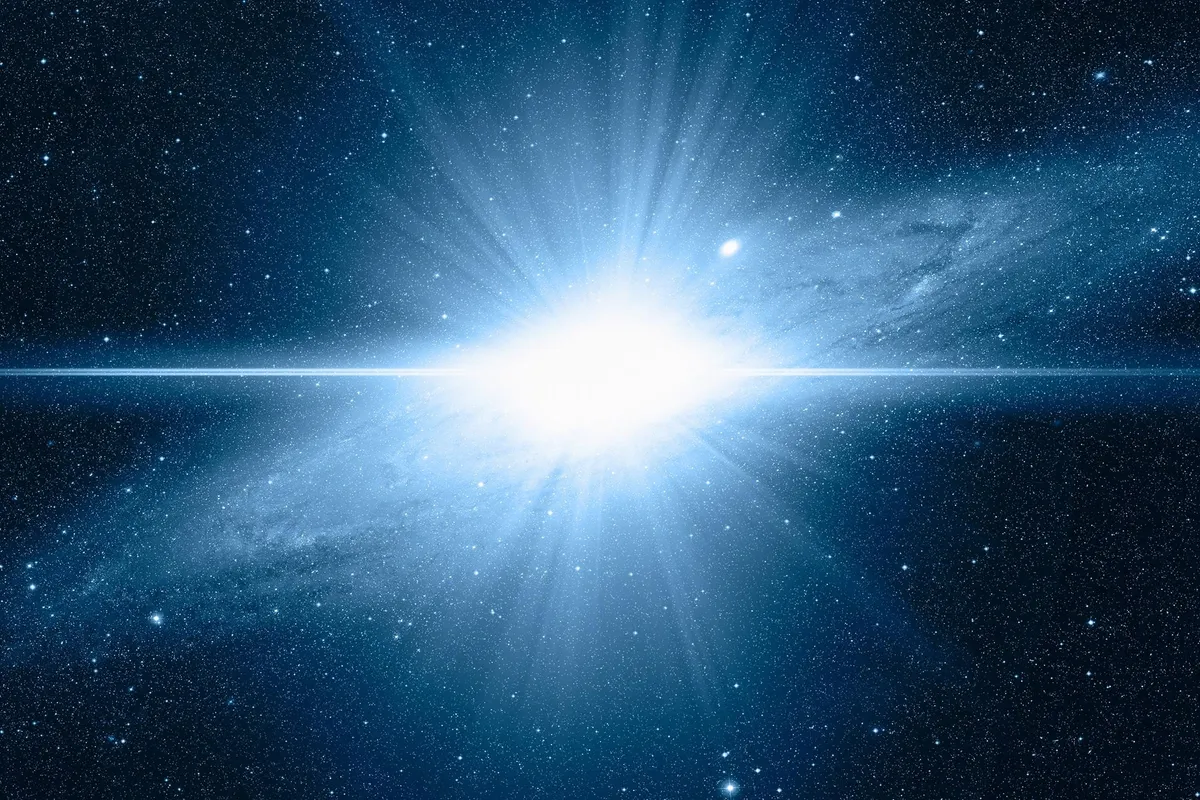
Measuring the universe is tricky business, especially when you're trying to figure out what exactly is making it expand faster and faster. For decades, scientists have relied on exploding stars, specifically Type Ia supernovae, as cosmic 'standard candles' to gauge vast distances.
Problem is, these candles aren't perfectly identical. Their brightness gets subtly messed with by the galaxies they call home. Until now, astronomers used some pretty basic corrections for these galactic influences, which, let's be honest, probably left a lot on the table.
Enter a new AI-powered system called CIGaRS. Developed by an international team led by the Institute of Cosmos Sciences of the University of Barcelona (ICCUB), this framework promises to squeeze four times more information out of these stellar explosions. Because apparently, we can always get smarter about blowing things up.
We're a new kind of news feed.
Regular news is designed to drain you. We're a non-profit built to restore you. Every story we publish is scored for impact, progress, and hope.
Start Your News DetoxThe Universe's Shifty Candles
Type Ia supernovae are the dramatic finales of white dwarf stars. They're valuable because they all explode with roughly the same true brightness. By comparing that known brightness to how dim they appear from Earth, scientists can calculate how far away they are. This method was key to discovering that the universe's expansion isn't just happening, it's accelerating — a phenomenon attributed to the mysterious 'dark energy.'
But here's the rub: a supernova in an ancient, massive galaxy might look slightly different from one in a younger, smaller galaxy. These variations, while small, can throw off cosmic distance measurements. And when you're talking about the entire universe, 'slightly off' can become a big headache.
The CIGaRS framework tackles this by building one massive model that connects everything: the supernova itself, its host galaxy, any light-dimming dust, how often these explosions happen, and even the universe's expansion rate. Instead of treating each factor separately, they created a unified solution.
AI, Meet Exploding Stars
To make this comprehensive modeling actually work, the team turned to simulation-based inference. They essentially created thousands of simulated universes, each with slightly different physical parameters. Then, a neural network (a fancy type of AI) learned to connect these simulations to the underlying physics.
Once trained, this AI can look at real astronomical data — tens of thousands of supernovae at once — and deduce those physical parameters directly. This is a scale that traditional techniques simply couldn't handle. It's like upgrading from a manual calculator to a supercomputer overnight.
One of the coolest parts? CIGaRS can accurately estimate galaxy distances (what astronomers call redshifts) using only images, without needing expensive spectroscopic observations. This is a huge deal, especially with the Vera C. Rubin Observatory in Chile about to kick off a 10-year sky survey.
That observatory is expected to detect millions of supernovae. The vast majority will only be observed through images, not detailed spectra. CIGaRS is basically custom-built for this data deluge, ready to extract maximum cosmic wisdom from all those pixels.
This isn't just about better measurements of the universe, either. The model can also help scientists understand how Type Ia supernovae form and their occurrence rates, shedding light on long-standing questions about these stellar fireworks. Turns out, when you give an AI enough exploding stars, it might just tell you the secrets of the cosmos. Which, if you think about it, is both impressive and slightly terrifying.