Imagine mapping every single road, alley, and footpath in a sprawling metropolis, then discovering the city largely runs itself through a series of highly efficient neighborhood councils. That's essentially what an international team of researchers just did for the humble fruit fly, and the implications are… a lot.
After meticulously charting every neural connection in an adult fruit fly's central nervous system — a complete "connectome" — they stumbled upon a rather elegant surprise: complex behaviors might not be dictated by a single, all-powerful brain command center. Instead, it seems local neural teams are doing a significant amount of the heavy lifting.
The Brain and the Cord, Connected
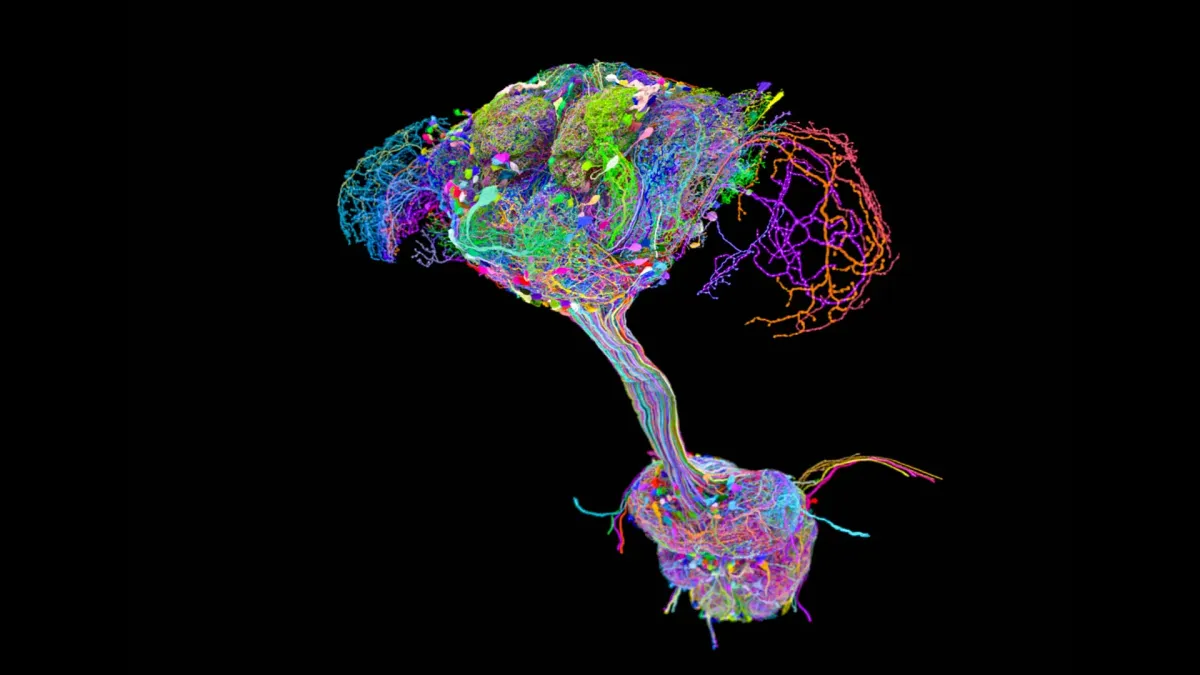
This isn't just the fruit fly's brain; it's the whole central nervous system, including its nerve cord (think of it as a tiny spinal cord). For the first time, scientists can trace information flow from a sensory input all the way to a physical action across an entire, living nervous system. It’s like having Google Maps for a fly's every thought and wiggle, but with all the individual neurons labeled.
We're a new kind of news feed.
Regular news is designed to drain you. We're a non-profit built to restore you. Every story we publish is scored for impact, progress, and hope.
Start Your News DetoxTo build this biological blueprint, the team took a single fruit fly, sliced it into thousands of impossibly thin sections, and then used electron microscopy to capture millions of images. AI swooped in to stitch these images into a glorious, navigable 3D map. The result? A connectome showing how approximately 160,000 neurons, all 160,000 of them, connect at the synapse level. Let that satisfying number sink in.
Local Control, Global Impact
What this unprecedented map revealed is a departure from the long-held belief that the brain is the sole puppet master. Instead, many fruit fly actions appear to be governed by local neural circuits. Want to move a leg? That leg largely handles its own business, with its local circuits coordinating with others for more complex maneuvers like walking or flying.
It’s a bit like a well-organized company where individual departments handle their core functions, only communicating with HQ for high-level strategy. This distributed control extends to wings and even the mouth. These motor circuits also tap into other systems, like visual or endocrine, to add extra flavor to behavior. The brain isn't out of a job, of course, but it's more of a coordinator than a dictator.
Why This Matters (Beyond Tiny Flies)
Fruit flies, Drosophila melanogaster, are the unsung heroes of neuroscience. They're cheap to keep, have a relatively compact nervous system, yet can perform surprisingly complex feats: navigating, socializing, learning, and even having opinions on sensory signals. Plus, their genetics are a dream for scientists.
This new map isn't just a win for entomologists; it's a potential Rosetta Stone for all nervous systems, including ours. Many discoveries from fruit fly research have already translated to mammals, from how we navigate to how we smell and remember. The big question now is whether this distributed control system is unique to the fruit fly, or if it's a fundamental principle of biology.
And for those playing the long game, there are implications for artificial intelligence. A tiny fly can do things advanced AI agents and robots still struggle with. Understanding how its nervous system is organized, with its elegant local control, could offer critical lessons for building more efficient and capable AI. Because apparently, that's where we are now: looking to insects to teach our robots how to live.