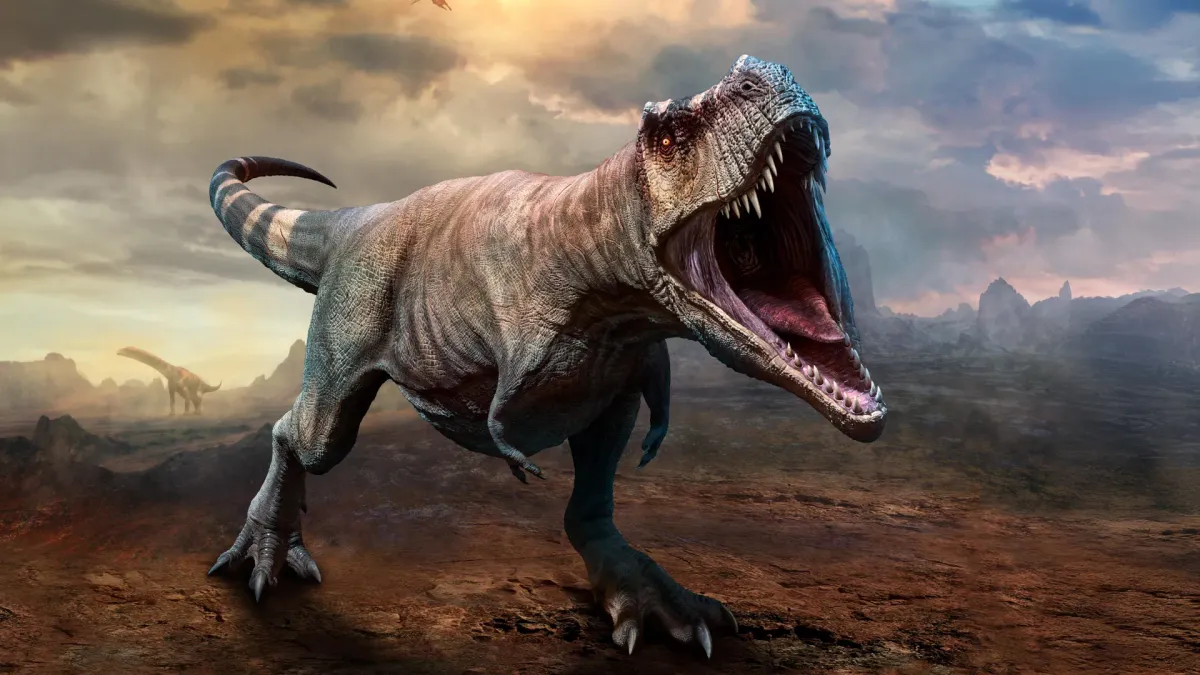
Turns out the King of the Dinosaurs wasn't exactly in a hurry. New research suggests Tyrannosaurus rex spent a full four decades growing into its fearsome adult self — a leisurely 15 years longer than anyone previously thought. That's like realizing your angsty teenage phase actually lasted until your mid-30s. Poor T. rex.
This isn't just a minor tweak to the dinosaur's life story. It's a fundamental rewrite, based on the largest dataset ever assembled for T. rex fossils. And it hints that some famous T. rex specimens might not even be T. rex at all. Because apparently, even paleontologists have identity crises.
The Secret Life of Bone Rings
For years, scientists have been reading growth rings in fossil bones — much like tree rings — to estimate a dinosaur's age and growth rate. But this new study, published in PeerJ, took things up a notch. Researchers used advanced imaging techniques, peering at thin slices of bone under special lighting. This revealed previously hidden growth rings, making the old estimates look, well, a little underdeveloped.
We're a new kind of news feed.
Regular news is designed to drain you. We're a non-profit built to restore you. Every story we publish is scored for impact, progress, and hope.
Start Your News DetoxThey then combined this newfound data with complex statistical models, stitching together growth records from 17 different tyrannosaur fossils. It’s like creating a dinosaur yearbook, but instead of awkward photos, it's all about bone density and growth spurts.
"This is the largest data set ever assembled for Tyrannosaurus rex," explained Holly Woodward, a professor at Oklahoma State University who led the research. She noted that piecing together these year-by-year growth patterns from multiple individuals — since a single leg bone only tells part of the story — allowed for an unprecedented look at how these giants matured.
A Slower Climb to the Top Predator Spot
Instead of a rapid ascent to apex predator status, T. rex apparently preferred a slow, steady burn. This extended growth period might have been a clever evolutionary strategy. Younger tyrannosaurs could have filled different ecological roles, feasting on different prey, before bulking up into the massive, bone-crushing adults that dominated the late Cretaceous Period.
Think of it as a dinosaur version of an apprenticeship program, but with more biting. This gradual development could explain how T. rex became such a dominant force, allowing them to adapt and thrive across various stages of their lives, co-author Jack Horner of Chapman University suggested.
Is That Even a T. rex?
Perhaps the most deliciously controversial finding? The study reignites the debate over whether all fossils currently labeled T. rex actually belong to the same species. Some smaller specimens, like the famous "Jane" and "Petey," showed significantly different growth patterns from the others.
While growth data alone isn't a definitive species-splitter, their unusual trajectories strongly suggest they might be something else entirely – perhaps the long-debated Nanotyrannus. It seems even a hundred million years later, some dinosaurs are still keeping us guessing. And honestly, isn't that just classic T. rex?