Imagine a world where your Wi-Fi is faster, medical scans see more, and astronomers peer deeper into the cosmos. That world just got a significant upgrade, thanks to a new quantum detector that boosts terahertz (THz) sensitivity by a whopping 20 times. Because apparently, we're not quite done making everything better, faster, and slightly more mind-bending.
Terahertz radiation sits in that awkward, hard-to-work-with part of the electromagnetic spectrum — between microwaves and infrared light. Current THz detectors are often slow, not sensitive enough, or demand refrigerators the size of small cars to function. Not exactly ideal for your next smartphone, or, you know, anything outside a lab.
But now, researchers have cooked up a compact detector that combines quantum physics with a special metasurface. Think of it as a tiny, patterned structure that can grab THz waves with vastly improved efficiency. This work, recently published in Advanced Photonics, could unlock the next generation of wireless communication, medical imaging, and even astronomy.
We're a new kind of news feed.
Regular news is designed to drain you. We're a non-profit built to restore you. Every story we publish is scored for impact, progress, and hope.
Start Your News DetoxThe Quantum Trick Behind the Tech
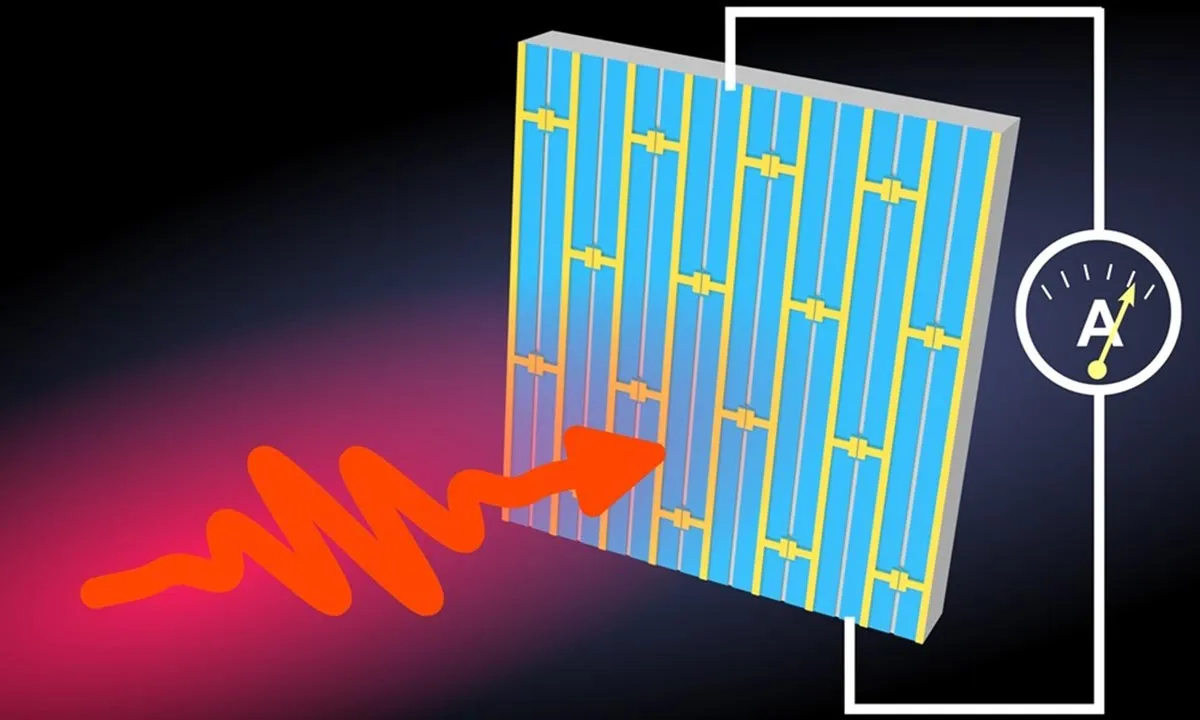
At its heart, this device uses something called the in-plane photoelectric effect. In plain English: when incoming THz photons hit a two-dimensional electron gas, they energize electrons. These electrons then hop over a tiny, specially designed step, creating an electrical current that can be measured. It’s like a microscopic obstacle course for light particles, and the finish line is a measurable signal.
What makes this clever? Unlike older detectors, these photons don't need a minimum energy level to get things moving. Plus, the whole process happens within the material, sidestepping the usual efficiency problems. Previous attempts at this idea were like trying to catch rain with a thimble — they only captured a tiny fraction of the incoming radiation.
To fix that, the team built the new detector around a metasurface. This isn't just a fancy word; it's a precisely patterned structure that focuses electromagnetic energy into areas much smaller than the radiation's wavelength. Imagine a tiny brickwork pattern designed to funnel every last THz wave into narrow gaps where the actual detection happens. Each gap is a mini-detector, and by linking them all up, they create one super-sensitive signal.
This integrated approach means no more clunky external lenses or complex detector arrays. The metasurface ensures the incoming radiation is laser-focused exactly where it needs to be. Wladislaw Michailow, who led the research, noted that this design “ensures the metasurface connects optimally to the detection elements,” leading to that impressive 20-fold jump in sensitivity.
Simpler, Stronger, Smarter
The researchers didn't just stumble upon this. They used computer simulations to fine-tune every detail, from the spacing of the tiny "bricks" to the size of the detection gaps. It’s a delicate dance between containing the electric field and allowing electrons to flow, all to produce the strongest possible signal.
The detector itself was fabricated using standard semiconductor techniques, making it easier to integrate with existing electronic circuits down the line. And because the metasurface does all the focusing, there's no need for external optical parts, simplifying assembly and potentially making mass production a reality. Fewer moving parts, more efficiency — the tech world's favorite mantra.
Put to the test, even at a chilly 10 Kelvin (which, admittedly, is still quite cold, but reachable with compact cryocoolers), the detector picked up THz radiation near 1.9 THz with stunning clarity. It achieved a responsivity of 2.7 amperes per watt and an external quantum efficiency of 2.1 percent. That 20x improvement over previous devices largely comes from the metasurface’s ability to capture and direct more radiation into the active detection areas. Oh, and it works without a source drain bias, which means less unwanted noise. Because nobody likes static.
This flat, planar design fits right into existing manufacturing methods and could eventually work at warmer temperatures than many competing designs. It bridges the gap between ultra-sensitive, super-cold detectors and less sensitive, room-temperature tech. David Ritchie, head of the Semiconductor Physics Group, points out the real-world implications: faster wireless networks, better healthcare diagnostics, and even manufacturing quality control. Which, if you think about it, is both impressive and slightly terrifying. Imagine an X-ray that sees not just bones, but the very fabric of your sweater, or the precise composition of that mystery meat. The future, apparently, is going to be incredibly well-defined.