Just when you thought Antarctica couldn't get any more mysterious, scientists went and found something truly wild: a colossal geological formation, buried under miles of ice, that effectively rewrites the continent's entire backstory. Think of it as finding a secret basement under your house, but the basement is the size of a small country and influences global climate.
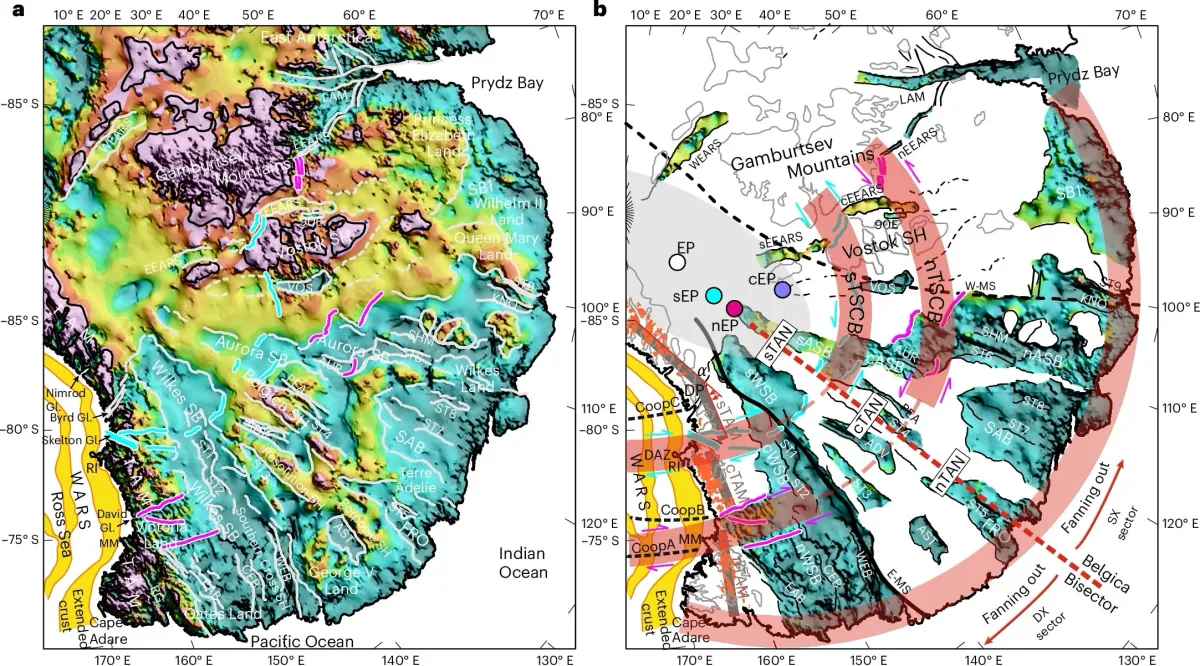
An international team, with brainpower from the University of Cambridge, was poking around East Antarctica — specifically under some of the thickest ice on Earth, where it's a casual two miles deep. What they uncovered wasn't just a basin, but a whole interconnected system of them, spanning an enormous fan-shaped area. They've dubbed it the East Antarctic Fan-shaped Basin Province, which, while not the snappiest name, accurately describes something truly immense.
The Continent's Hidden Plumbing System
For years, researchers have studied individual basins in this region, like the famous Wilkes Basin or the one holding Lake Vostok (Earth's largest known subglacial lake, because of course Antarctica has one of those). But this new research connects the dots, revealing them all as part of one giant, unified geological structure.
We're a new kind of news feed.
Regular news is designed to drain you. We're a non-profit built to restore you. Every story we publish is scored for impact, progress, and hope.
Start Your News DetoxNow, how does a continent even get a secret, mile-deep fan-shaped plumbing system? The scientists suggest it formed through something called "distributed rotational extension." Imagine holding your hand flat, keeping your thumb still, and spreading your fingers apart. The gaps that open up between your fingers? That's roughly what happened to the continental crust, creating these triangular basins as it stretched and rotated outwards from a central point.
It’s believed this might be one of the largest examples of rotational extension ever found in continental crust. Let that satisfyingly complex number sink in.
A Time Machine Under the Ice
This isn't just a cool geological parlor trick. This hidden structure is a direct link to Earth's deep past, likely forming during the tumultuous era when the ancient supercontinent Gondwana was doing its thing — connecting Antarctica with other landmasses before they all decided to go their separate ways.
In fact, this massive fan might have even influenced the eventual breakup between Antarctica and Australia. Which, if you think about it, is both impressive and slightly terrifying. It's like finding out your house's foundation dictated whether your neighbors ever spoke to each other.
Beyond ancient history, this discovery has very modern implications. The shape of the bedrock under the ice directly affects how ice moves and where subglacial lakes form today. So, this newly mapped, hidden landscape could be a major player in the stability of parts of the Antarctic Ice Sheet that are particularly sensitive to climate change. Because apparently that's where we are now: finding out ancient geological secrets could impact our very near future.
To pull off this feat, the team essentially stripped Antarctica naked (geologically speaking). They combined everything from subglacial topography and gravity measurements to seismic data and models of what the continent's land would look like if the ice sheet vanished entirely. (Spoiler: it would rebound upward by as much as a kilometer, because continents are surprisingly springy.)
It's a stark reminder that even on a planet we think we know, there are still vast, continent-sized secrets waiting to be uncovered, lurking just out of sight.