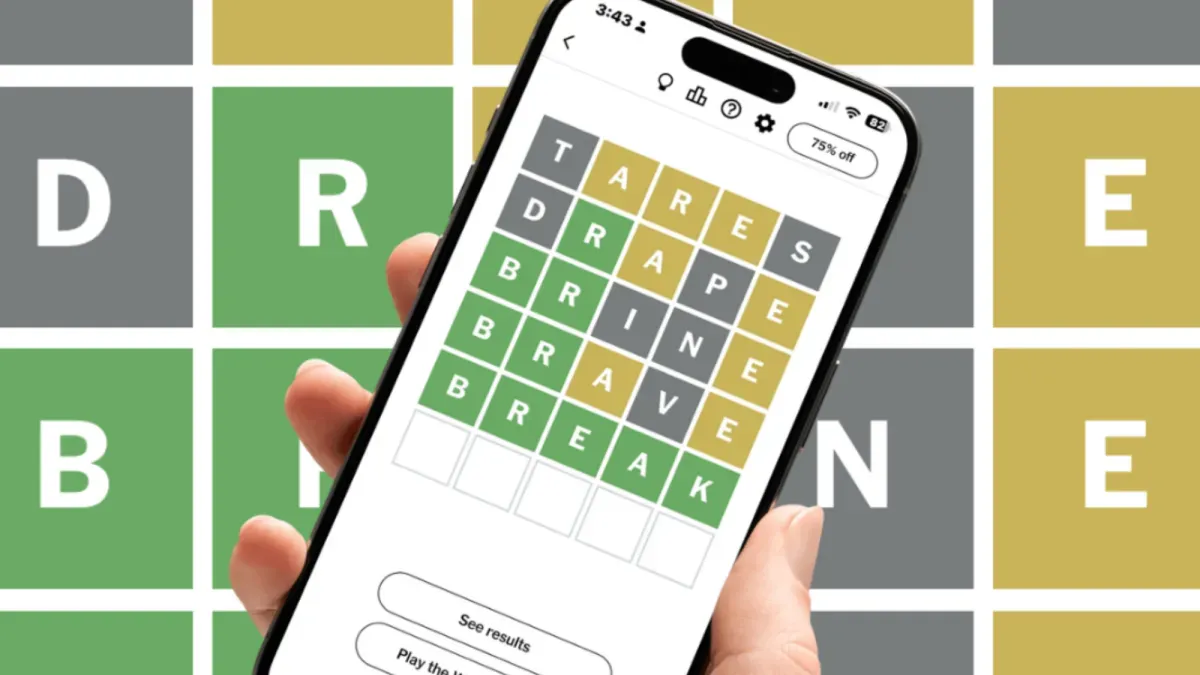
You know that satisfying little green grid? The one that either makes you feel like a linguistic genius or a five-letter fraud? Turns out, one of the best ways to conquer Wordle has less to do with your vocabulary and more to do with a mathematical theory from the 1940s.
Researchers at Binghamton University decided to take the guessing out of the game, applying a concept called Shannon Entropy to the popular word puzzle. Because apparently, that's where we are now: using Cold War-era information theory to solve a daily brain teaser.
The Secret Weapon: Information Theory
Instead of just flinging words at the screen and hoping for the best, the team used principles from information theory to pick guesses that yielded the most information. Think of it less as trying to be right, and more as trying to learn as much as possible with each move. This method steadily narrowed down the possible words, turning a game of intuition into a logical deduction.
We're a new kind of news feed.
Regular news is designed to drain you. We're a non-profit built to restore you. Every story we publish is scored for impact, progress, and hope.
Start Your News DetoxTheir system, which involved a computer script (more on that in a moment), found the correct word a jaw-dropping 99% of the time. This strategy focused on reducing uncertainty, blowing traditional vowel-heavy approaches out of the water.
Now, for those who religiously start with 'ADIEU' because it's packed with common vowels, prepare for a mild shock: a New York Times analysis found it's actually one of the least efficient popular starting words. Ouch. All those proud 'ADIEU' starts, potentially leading you down a longer, more frustrating path.

The Binghamton team viewed Wordle as a feedback system. Each guess provides information, reducing the 'entropy' — or uncertainty — about the secret word. The goal, then, is to reduce this entropy with every guess, a concept straight out of Claude Shannon's seminal 1948 paper, A Mathematical Theory of Communication.
Their entropy-based method solved the puzzle 99% of the time. The traditional, human-intuition approach? A respectable, but comparatively humble, 90%. Let that satisfying 9% difference sink in.
The Human Element (or Lack Thereof)
Of course, there's a catch. To achieve this near-perfect success rate, you need a computer script to crunch the numbers and enter feedback. Which, if you think about it, might take a little bit of the human-powered glory out of your winning streak.

Even Professor Jason Riggle, a linguist who also wrote a program to 'beat' Wordle, noted that too much understanding can sometimes remove the joy. For many, the delightful struggle, the near misses, and the eventual triumph are what make Wordle fun. If a machine is doing all the heavy lifting, are you really winning?
So, while information theory offers a powerful, almost foolproof tool for keeping that winning streak alive, you might have to decide if absolute victory is worth sacrificing the sweet, sweet agony of a truly human guess.