Flocks of birds, groups of bacteria, and even tissue cells sometimes move in ways that seem to break one of physics' most basic rules: Newton's third law. This law states that for every action, there is an equal and opposite reaction.
However, in these collective systems, individual elements only react to a part of their surroundings. This means they don't follow the action-reaction principle. Now, physicists in Dresden have created a new theory to describe and simulate these exceptions much more accurately.
When Action Doesn't Equal Reaction
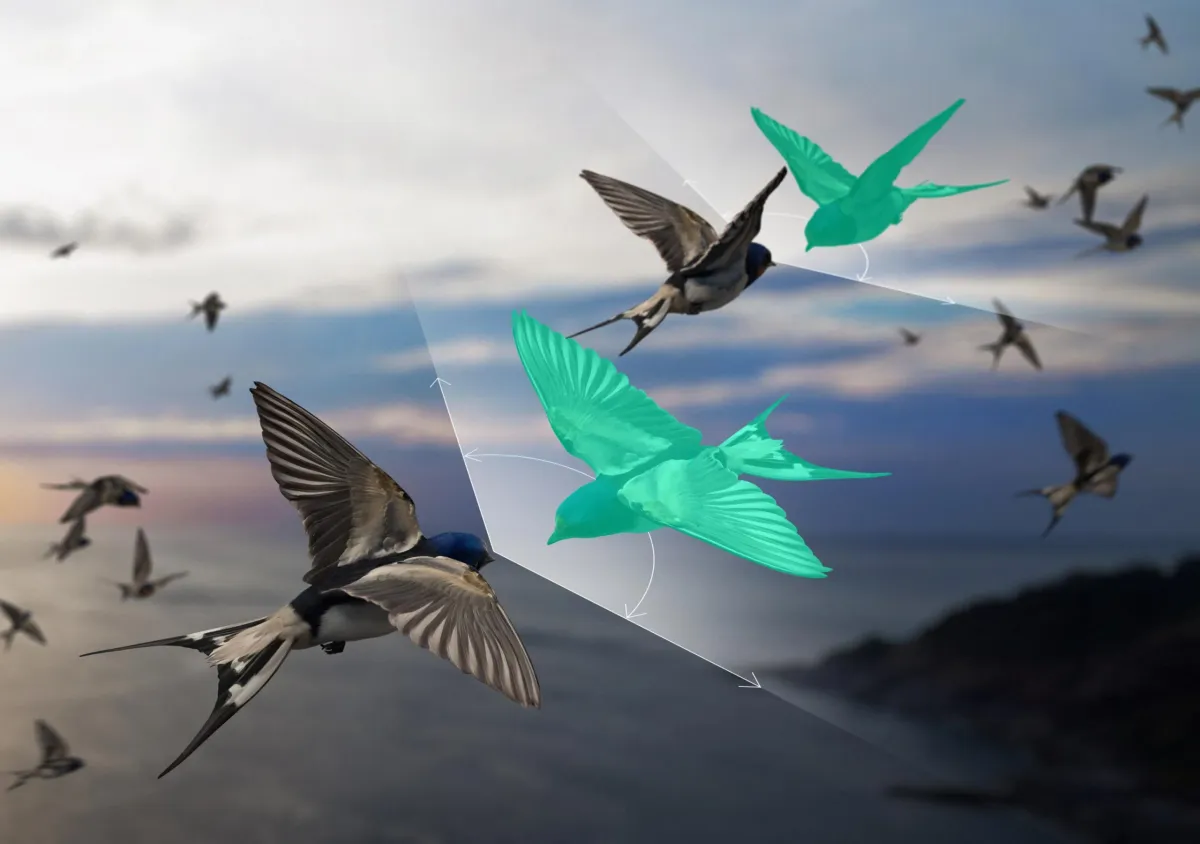
Imagine a flock of birds. Each bird sees what's around it, but it mainly reacts to birds next to or in front of it. It doesn't adjust its flight based on birds behind it. This one-sided influence means the usual rule of equal action and reaction doesn't apply. Scientists call these "non-reciprocal interactions."
We're a new kind of news feed.
Regular news is designed to drain you. We're a non-profit built to restore you. Every story we publish is scored for impact, progress, and hope.
Start Your News DetoxNewton's third law is a cornerstone of classical mechanics. It explains why a car moves forward when its wheels push backward, or why a balloon shoots off when air escapes. But for systems like bird flocks, this law doesn't fully capture what's happening.
Until now, it was hard to accurately simulate these systems. Existing theories were built for "reciprocal" interactions, where action and reaction are always equal. This made it difficult to study complex behaviors in biology and other fields.
A New Way to Understand Collective Motion
Researchers in Dresden, including physicist Roderich Moessner and research group leader Marín Bukov, have found an elegant solution. They developed a theory that allows these non-reciprocal systems to be described and simulated precisely, even using older, established methods.
The key is to add "auxiliary degrees of freedom," which are like artificial variables. Physicists often use mathematical equations to represent real-world systems, with variables for things like a bird's position or speed.
Biophysicist Ricard Alert explains the trick: "The new theory creates a fictitious partner for each real component of the system." For a bird flock, this means adding an imaginary bird in front of each real bird, facing the opposite direction.
This allows researchers to treat the non-reciprocal system as if it were a reciprocal one. They can then use well-known tools from many-body physics, which improves the accuracy of simulations and helps us understand these systems better.
Looking Ahead
Using auxiliary variables isn't new in physics, but applying them this way to non-reciprocal interactions is. This breakthrough helps researchers explore how these exceptions to Newton's law might lead to entirely new forms of collective quantum behavior.
Moessner notes that scientists are still learning about this. He finds it fascinating to consider what new phenomena could arise when particles in quantum matter interact in these non-reciprocal ways.
Deep Dive & References
Hamiltonian description of non-reciprocal interactions - Nature Physics, 2026