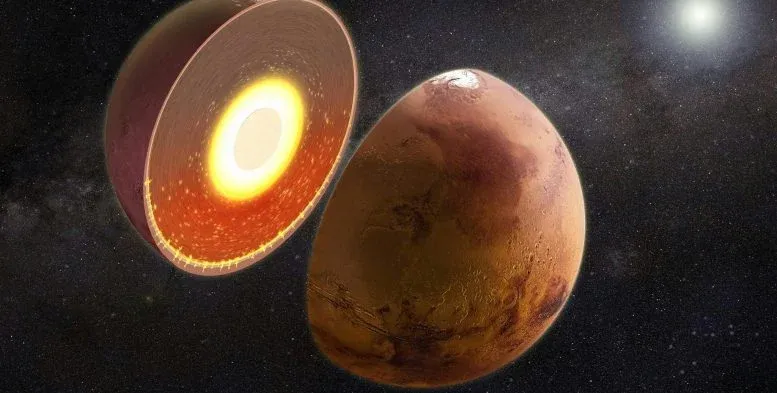
Turns out Mars has a hot side and a… less hot side. Scientists recently peered deep into the Red Planet's guts and found a scorching secret: the southern interior is a whopping 200 to 400 degrees Celsius hotter than its northern counterpart. We're talking potentially partly melted rock, all hiding beneath the surface.
This isn't just a fun fact for your next dinner party. This fiery revelation, led by Caltech alumnus Alexander Berne and published in Nature, could unlock some serious mysteries about Mars's past geology and even those tantalizing periods when it might have been a cozy place for life.
Peeking Beneath the Red Dust
So, how do you take Mars's temperature from millions of miles away? You use gravity, naturally. Berne, while at Caltech, developed a clever model that translates tiny shifts in a planet's gravitational pull into a 3D map of its internal structure. Think of it as feeling for lumps in a mattress, but on a planetary scale.
We're a new kind of news feed.
Regular news is designed to drain you. We're a non-profit built to restore you. Every story we publish is scored for impact, progress, and hope.
Start Your News DetoxHis team then fed years of data from three different Martian missions—Mars Global Surveyor, Mars Odyssey, and Mars Reconnaissance Orbiter—into this model. They meticulously tracked the ever-so-slight changes in how fast these spacecraft moved, which allowed them to map Mars's gravity field with impressive detail.
Here's where it gets really clever: The Sun's gravity tugs on Mars differently depending on the season, thanks to Mars's slightly wonky orbit and tilted axis. By studying how these gravitational effects (called tidal tomography) change over time, scientists can build a dynamic picture of what's happening deep inside. Because, as Berne points out, planets aren't always perfectly uniform spheres on the inside, no matter how much we might want them to be.
A Planet of Extremes
We've known for ages that Mars is a tale of two hemispheres on the surface. The south is a rugged, crater-pocked highland, while the north is mostly flat, low-lying plains. It's like one half got hit with a cosmic hammer and the other half got smoothed out by a giant spatula.
This new research confirms that this dramatic north-south divide isn't just skin deep; it goes straight to the core. A southern interior that's hundreds of degrees hotter than the north could explain a whole host of other Martian oddities.
For instance, the southern hemisphere's iron-rich minerals show some bizarre magnetic patterns. A massive hot spot in the mantle could explain why Mars's ancient magnetic field might have created such different magnetism between its two halves. It also aligns with findings from NASA's InSight mission, which observed seismic waves losing energy faster in the south. Heat, it turns out, really messes with how seismic energy travels through rock. Co-author Amirhossein Bagheri notes that understanding this deep thermal asymmetry is crucial for piecing together Mars's water story, including how those ancient, water-filled basins formed. Because where there's heat, there's often movement, and where there's movement, water tends to follow.
So, what caused this colossal hot spot? Scientists are still kicking around a few ideas. Maybe a colossal impact in the north released heat, or perhaps hot material simply moved around in the southern mantle eons ago. Or, and this is a fun one, maybe thick rock structures acted like a thermal blanket, trapping all that warmth beneath the surface. Whatever the cause, figuring it out could rewrite some major chapters in Mars's dramatic history.