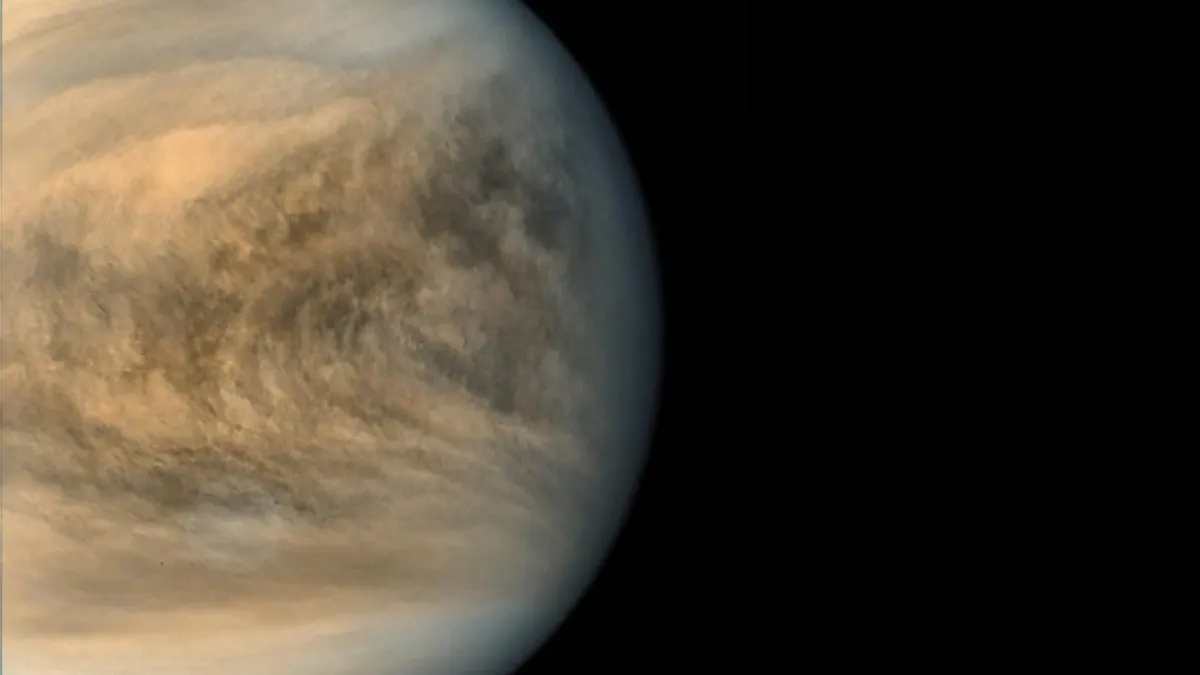
Venus, that shimmering pale yellow orb in our sky, looks rather serene. But peer at it through ultraviolet light, and things get a little weird. Dark, mottled patterns emerge in its sulfuric acid clouds, like bruises on a banana. Scientists have been scratching their heads over these patterns for a century, because no one knows what's causing them. It's the ultimate cosmic whodunit, dubbed the "unknown absorber."
Now, an international team of researchers has narrowed down the suspect list, or at least, the suspect's characteristics. Using observations and computer models, they've figured out just how intensely the liquid inside Venus's cloud droplets must be absorbing UV and blue light to create those mysterious splotches.
What if We Could Put Venus's Clouds in a Beaker?
Here’s the clever bit: lead author Dr. Jan Spacek flipped the script. Instead of just looking at the clouds from afar, he asked, what if we could scoop up Venus's cloud material and study it as a liquid in a lab? Because, as it turns out, a cloud can look very different from the tiny particles it's made of.
We're a new kind of news feed.
Regular news is designed to drain you. We're a non-profit built to restore you. Every story we publish is scored for impact, progress, and hope.
Start Your News DetoxThink about cigarette smoke. It looks white, right? Because the tiny particles are fantastic at scattering light. But if you collected all that smoke, you'd end up with a dark, tar-like sludge. Venus's clouds, with particles roughly the same size as smoke, might be doing something similar. Those pale yellow clouds could be hiding a surprisingly dark, concentrated liquid within.
Their model essentially asks: if we put this cloud liquid in a lab spectrometer, what would it tell us? The answer: it needs to be seriously good at absorbing light. We’re talking an absorption coefficient of about 1,278 cm⁻¹ at 375 nm. Which, if you're not a spectroscopist, just means it's a very, very strong absorber. Either it's incredibly efficient at soaking up light, or it's present in very high concentrations, or both.
The Prime Suspects: Carbon-Based Molecules?
So, what kind of substance absorbs light with such gusto? Highly absorbing conjugated organic molecules are a strong candidate. "Organic" here simply means they're carbon-based, not necessarily from life. For molecules with absorption strengths similar to efficient pigments like porphyrinoids, you'd need about 10 grams per liter.
Before you start picturing Venusian chlorophyll, the researchers are quick to clarify: they're not saying aliens are making pigments. They're just pointing out that these compounds are excellent examples of highly efficient light absorbers.
The shape of Venus's absorption spectrum also drops a clue. Simple organic compounds in concentrated sulfuric acid often form dark, tar-like mixtures that absorb light across the entire visible spectrum, making them appear brown or black. But Venus's absorption drops off sharply between 365 and 455 nm. This suggests a specific, resistant absorber that doesn't just turn into generic tar.
The Mystery Just Got Harder (and More Interesting)
Instead of solving the mystery, these findings have made it deliciously more complex. Janusz J. Petkowski of Wroclaw University of Science and Technology notes that by adding more constraints, they might have made the mystery even more interesting. Inorganic explanations face similar hurdles, needing extremely high concentrations to match the observed absorption.
So, no, this doesn't prove life exists in Venus's clouds. But it does set some very specific, very tough requirements for any proposed material, be it organic or inorganic. It needs to absorb light this well, be this concentrated, and exist within specific atmospheric distributions and particle sizes.
Good news for future missions: these new limits can now be tested in lab experiments and, eventually, by spacecraft designed to sniff out the chemistry of Venus's clouds directly. The Morning Star Missions initiative is already developing instruments, like the Autofluorescence Nephelometer, which will look for fluorescence linked to organic molecules. Because apparently, we're finally going to get to the bottom of Venus's dark little secret.