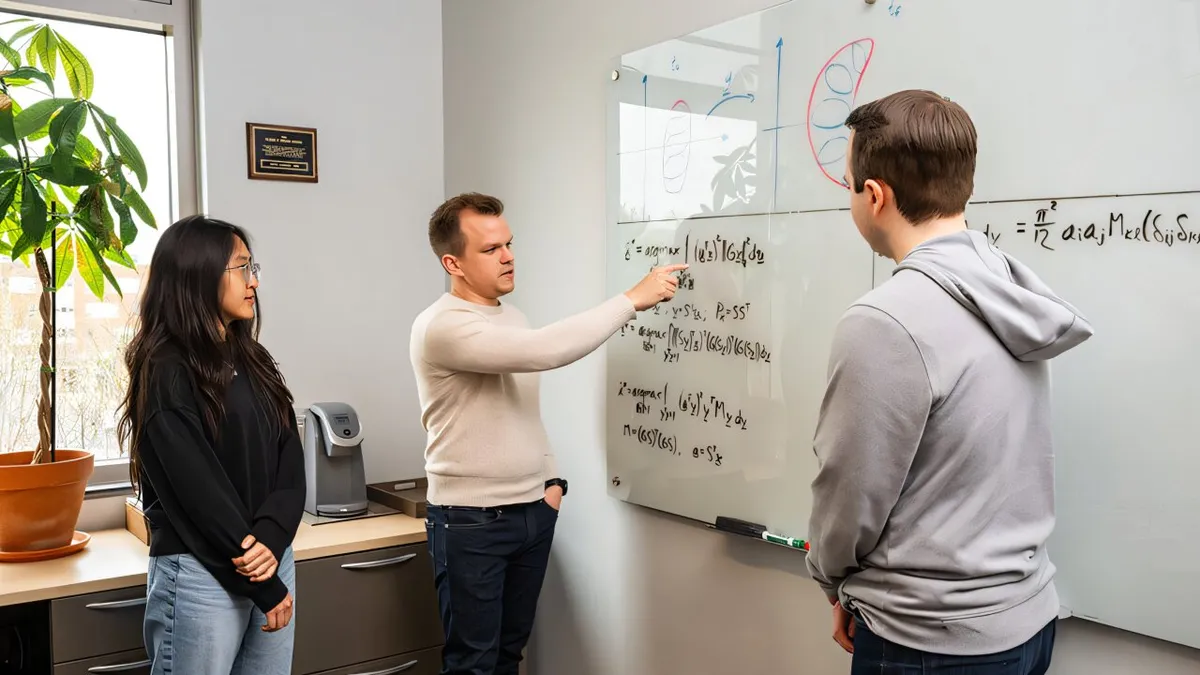
Imagine trying to track a dandelion seed you blew into a hurricane. Now, make that seed a multi-million-dollar satellite, and the hurricane is the vast, chaotic expanse beyond the moon. That's the challenge Purdue University engineer Keith LeGrand and his team are tackling: keeping tabs on objects in cislunar space.
Most of our space junk and useful satellites hang out relatively close to Earth. But as more and more ventures push past the moon's orbit — a whopping 300,000 miles out — tracking them becomes less of a luxury and more of a cosmic necessity. Because apparently that's where we are now.
Why is cislunar space such a nightmare for trackers? Think poor visibility, unimaginable distances, and the gravitational tug-of-war between the sun, Earth, and moon. Scientists call it a "restricted four-body problem," which sounds exactly as complicated as it is. Small satellites, in particular, tend to get lost in this gravitational blender.
We're a new kind of news feed.
Regular news is designed to drain you. We're a non-profit built to restore you. Every story we publish is scored for impact, progress, and hope.
Start Your News DetoxThe Art of Not Losing a Satellite
LeGrand's team is all about "space situational awareness." Basically, knowing where everything is and where it's going. They're building algorithms that predict how fuzzy our certainty about a satellite's location gets over time. Because, just like that dandelion seed, the longer it's out there, the less sure you are of its exact address.
Traditional methods for predicting satellite paths either sacrifice accuracy for speed or vice-versa. Neither works for the tiny satellites in cislunar space, which, LeGrand notes, have about as much processing power as an old video game system. You can't just throw endless calculations at them.
Enter LeGrand's ingenious solution: Gaussian mixture approximation. Instead of one big, wobbly guess, his algorithms break down the uncertainty into smaller, more manageable "bell curves." When one of these curves starts to stretch and distort too much — a sign that chaos is setting in — it splits into even smaller, more precise curves.
This is where the magic happens. It's like having a bunch of tiny, efficient search parties instead of one massive, overwhelmed one. Each smaller piece can be tracked with simpler equations, using less computational power. Which, if you think about it, is both impressive and slightly terrifying in its elegance.
HOTDOGS: The Algorithm That Knows When to Split
LeGrand even developed an algorithm with the delightfully absurd name of "Higher-Order Tensor-Based Deferral of Gaussian Splitting" — or HOTDOGS, for short. HOTDOGS starts with minimal splits and only intervenes when a distribution gets too wonky. It waits until it's absolutely necessary to add more detail, saving precious processing power.
This means the algorithm avoids doing more work than needed, achieving the same accuracy without breaking a sweat (or a microchip). It's a smart, efficient way to keep a clearer picture of everything floating around out there.
As cislunar space gets more crowded — because, let's be honest, it will — LeGrand's work promises safer navigation, better awareness, and fewer lost satellites. Which is good news for everyone who prefers their space endeavors to be less of a cosmic game of hide-and-seek.